 TIGERFASTENERS
A Resin Anchor in Masonry Is Rated by Five Pull-Outs in Your Brick, Minus 3,4 Standard Deviations
Somebody asked an engineering forum this week where the strength of a resin anchor in hollow brick actually comes from. You push in a mesh sleeve, inject resin, insert a threaded rod, and the only place the resin touches the brick looks tiny. Six replies gave the right mechanism in words. The document that governs these products in Europe is seventy nine pages, free to download, and gives the same answer in its first sentence. It then does something the replies did not, which is say where the number on the approval came from.
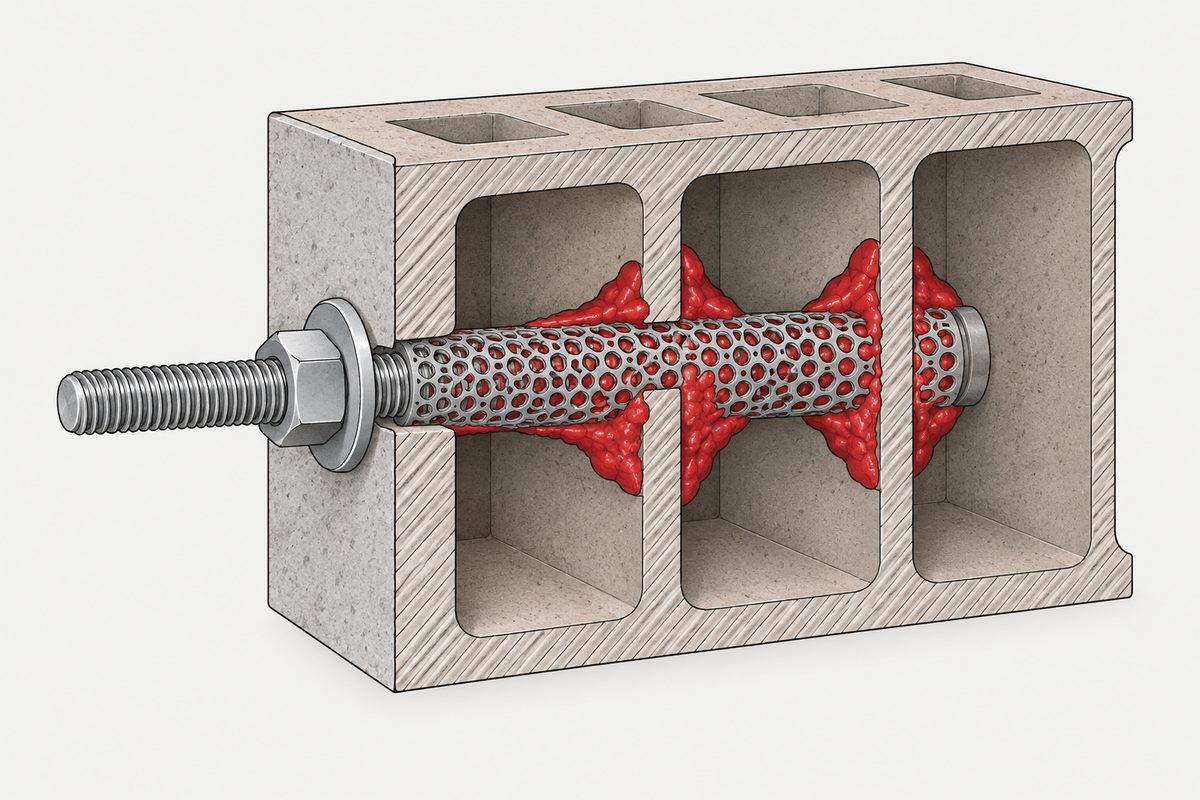
The first sentence of the scope answers the question: “anchored by bonding and mechanical interlock”. Both, not one. And the sleeve is not packaging: “Mesh sleeves made of metal or plastic are also covered in this EAD as part of the anchoring system.” The more useful answer is further in. The resistance figure on an approval is not calculated. It is measured, in the actual brick, with the anchor put where it will be weakest, five times per size, and then the mean is reduced by 3,40 standard deviations of the logarithms.
The document is EAD 330076-01-0604, May 2021, Metal injection anchors for use in masonry, published by the European Organisation for Technical Assessment and downloadable in full for nothing. This site has never covered anchors before, and there is a reason to start here rather than with a design code: an assessment document tells you how a number was produced, which is a different and more durable thing than how to use it.
One line early on sets the whole frame: “The product is not covered by a harmonised European standard.” There is no EN that covers injection anchors in masonry. Each product is assessed on its own and gets its own technical assessment. So there is no generic table of resin anchor strengths to look up, and that is by construction.
What the anchor is, in the document’s words
Post-installed metal injection anchors are placed into pre-drilled holes in masonry and anchored by bonding and mechanical interlock. The insert may be a threaded rod, a deformed reinforcing bar, an internal threaded socket or another shape, and the bonding material may be cementitious mortar, synthetic mortar or a mixture, with fillers or additives.
The boundaries are numbers rather than adjectives.
| Smallest thread | M6 |
|---|---|
| Minimum embedment | hef = 50 mm |
| Minimum wall thickness | hef + 30 mm, and at least 80 mm |
| Maximum embedment | wall thickness − 30 mm |
| Internal thread length | at least d + 5 mm |
Read the third and fourth rows together and a rule falls out that is easy to miss: the resin must never reach the far face. Thirty millimetres of brick has to stay behind the end of the anchor, whichever direction you approach the constraint from.
Where solid stops and hollow starts
The forum question began with a guess, that the brick was probably hollow. The document draws that line with two figures rather than by eye.
“Usually, solid masonry units do not have any holes or cavities other than those inherent in the material. However, solid units may have a vertical perforation or grip holes of up to 15 % of the cross section or frogs up to 20 % based on the volume of the brick. Therefore, testing in solid material covers units with vertical perforation or grip holes of up to 15 % of the cross section or frogs up to 20 %.”
So a brick can be a sixth void through its section and still be tested as solid. Above that it belongs to a different base material group, and the anchor has to have been tested there separately. The three groups are b for solid masonry, c for hollow or perforated, and d for autoclaved aerated concrete. An anchor assessed for one is not assessed for another.
The tests are done in your brick, at the worst spot
This is the part that answers the question behind the question. Annex A opens the test programme with a sentence that leaves no room:
“If nothing else is stated, all tests shall be performed in all bricks according to the specific intended use of the anchor. If the intended use includes setting positions in joints of masonry, all basic tests shall be also performed in the joints of masonry.”
And then, in the test member clause, the instruction that decides everything: “The tests shall be carried out at the most unfavourable setting position in the brick, which gives the lowest resistance of the injection anchor.”
For hollow units, that instruction is the entire clause. Section A.2.3, test member for hollow or perforated bricks and hollow blocks, is one sentence long: the location of the anchor with respect to the perforation shall be chosen such that the smallest anchor resistance is expected. No geometry, no rule about webs and shells, just: put it where it will do worst, and pull.
That is why the approval has to name the brick. The list of what the technical assessment must state includes the specific masonry units including size of units, geometry of holes, webs and shells, along with the mean gross dry density, the compressive strength, joint width, mortar class, whether there is plaster, and the setting position, wall side or reveal, and distance to joints. A resistance in kilonewtons that is not attached to that list is not a resistance.
Five tests, and what five tests cost
The basic test series A1 to A7 each call for five tests, at the smallest, a medium and the largest anchor size. Then the characteristic value is derived, and the document is explicit about the statistics.
“The 5%-fractile of the ultimate loads shall be calculated according to statistical procedures for a confidence level of 90 %. A logarithmical normal distribution and an unknown standard deviation of the population shall be assumed…” with the statistical factor ks = 3,40 for n = 5 and ks = 2,57 for n = 10.
Those two numbers are the price of a small sample, and they are worth turning into a ratio. The arithmetic below is ours. The characteristic value divided by the geometric mean of the tests is e to the power of minus ks times s, where s is the standard deviation of the logarithms. For scatter of this size s is close to the coefficient of variation, though not equal to it.
| Scatter, s | Five tests, ks = 3,40 | Ten tests, ks = 2,57 |
|---|---|---|
| 0,10 | 0,71 of the mean | 0,77 |
| 0,15 | 0,60 | 0,68 |
| 0,20 | 0,51 | 0,60 |
| 0,30 | 0,36 | 0,46 |
Doubling the number of tests buys back six to ten points of the mean, and the messier the material the more it buys. Which is a reasonable description of why anybody bothers testing more than five times.
Scatter is then penalised a second time. If the coefficient of variation in a basic test exceeds 20 %, a further factor of 1/(1 + 0,03(v% − 20)) applies, and for a functioning test the threshold is 30 %. Our own arithmetic again: a basic test series with 30 % scatter picks up a factor of 1/1,3, which is 0,769. Multiply that by the 0,36 from the table and the characteristic value has fallen to about 28 % of the mean pull-out load. A wobbly material does not just get a lower number, it gets a lower number twice.
The conditions that come attached
An approval is not one number, it is a number plus the envelope it was demonstrated in. A few of those are worth knowing because they are easy to violate without noticing.
- Wet or dry, twice. Conditions are split into d/d, installed dry and used dry; w/d, installed dry or wet and used dry; and w/w, installed dry or wet and used dry or wet. The hole and the service life are separate questions
- Two service temperature ranges. Range Ta is minus 40 to plus 40 degrees with a long-term maximum of plus 24; range Tb is minus 40 to plus 80 with a long-term maximum of plus 50. Long-term means approximately constant over significant periods
- Freezing has its own definitions. A standard variation is a swing from below zero to plus 24 or more taking longer than twelve hours; a rapid variation is the same swing inside twelve hours, and they are assessed separately
- Curing time is a tested quantity. The minimum curing time at normal ambient temperature has to deliver at least 0,9 of the reference tests done at a long curing time, and the document defines long as 24 hours for resins and 14 days for cementitious mortars
There is also a conversion rule that is useful on its own. To move a test result from the unit strength that was tested to a different unit strength, the load scales as the strength ratio to the power of 0,5 for clay, concrete and solid calcium silicate units, and 0,75 for perforated calcium silicate. So for most masonry, doubling the brick strength buys about forty per cent more anchor, not twice as much.
One detail about aerated concrete
Autoclaved aerated concrete gets its own test member clause, and inside it is a requirement that says something real about the material. The sample cube used to determine the compressive strength shall be taken from the same height as the position of the anchor relative to the direction of rise of the specimen, because the strength differs depending on the height of the direction of rise.
The block is not uniform. It rose, and it is weaker or stronger depending on how far up it was when it set. So the check specimen has to come from the same altitude as the hole. That is the kind of requirement that only gets written after somebody has been caught out by it.
What this page will not tell you
Whether a particular wall will hold a particular thing. That is a structural question about a wall nobody here has seen, and the document is an assessment method rather than a design code. We also downloaded the technical report that covers the design method and did not read it, so there is nothing here about partial factors or design resistances. No anchor or resin product is named. Nothing is quoted from the masonry, seismic or aerated concrete standards the EAD refers to, because we have not read them either.
What the document does support is a way of reading an approval. It also puts a floor under the forum’s instinct. The last reply there ended with a list, that the strength depends on the type of masonry, hole preparation, resin system, curing time and load. That list is correct, and the EAD is the same list with numbers, thresholds and a test for each item.
How to use it
- Ask which base material group. Solid, hollow or perforated, and aerated concrete are assessed separately, and an anchor approved in one is not approved in the others
- Ask which units. The assessment has to state the specific masonry units including the geometry of holes, webs and shells, the density and the compressive strength. Those are the conditions the number belongs to
- Ask about the setting position. It is a declared parameter, wall side or reveal and distance to joints, and the tests were done at the worst one
- Expect a number well below the mean. Five tests carry a statistical factor of 3,40, and scatter above 20 % in a basic test is penalised again
- Check the envelope, not just the kilonewtons. Installation and service wet or dry, service temperature range, minimum curing time and installation temperature all have separate test series behind them
The mesh sleeve question has a satisfying answer, which is that the sleeve is a structural component and the standard says so. But the answer worth carrying is the one about where the number came from. It is not a property of resin. It is the result of somebody drilling into the same brick you have, in the worst place they could find, and pulling until it let go, five times.
A hole that has already stripped is a different object again, and the published relationships have no variable for it.
This page covers step 1, the substrate. The whole order is substrate, thread, head, drive, finish, documentation, and why doing it out of order is rework rather than a tweak is in specifying a screw.
Common questions
How does a resin anchor hold in hollow brick?
By two mechanisms at once. EAD 330076-01-0604 describes post-installed metal injection anchors as placed into pre-drilled holes and anchored by bonding and mechanical interlock, with the mortar bonding the metal element to the sides of the hole. Mesh sleeves of metal or plastic are covered by the same document as part of the anchoring system, not as packaging.
Is there a general table of resin anchor strengths?
No, and the assessment document says why. It states that the product is not covered by a harmonised European standard, so each product is assessed individually and receives its own technical assessment. The resistance belongs to a named product in a named masonry unit rather than to resin anchors as a class.
When does a brick count as solid rather than hollow?
The document allows a solid unit to have vertical perforation or grip holes of up to 15 per cent of the cross section, or frogs of up to 20 per cent based on the volume of the brick, and states that testing in solid material covers units within those limits. Beyond them the unit belongs to the hollow or perforated group and needs its own tests.
Where is the anchor tested in the brick?
At the worst place. The document requires that tests be carried out at the most unfavourable setting position in the brick, which gives the lowest resistance of the injection anchor. For hollow or perforated units that instruction is the whole of the test member clause: the location with respect to the perforation shall be chosen such that the smallest anchor resistance is expected.
How many tests are behind the characteristic resistance?
Five per anchor size for each basic test series, at the smallest, a medium and the largest size. The characteristic value is the 5 per cent fractile calculated at a 90 per cent confidence level assuming a log-normal distribution and an unknown population standard deviation, with a statistical factor of 3,40 for five tests and 2,57 for ten.
How much does a small sample cost in strength?
By our own arithmetic on the standard formula, the characteristic value divided by the geometric mean is e to the power of minus the statistical factor times the standard deviation of the logarithms. With five tests and scatter of 0,15 that is about 0,60 of the mean, and with ten tests about 0,68. With scatter of 0,30 it is about 0,36 and 0,46 respectively.
Does wide scatter get penalised twice?
Yes. Beyond the fractile calculation, if the coefficient of variation of the ultimate load exceeds 20 per cent in a basic test, a further factor of one over one plus 0,03 times the excess applies, and for a functioning test the threshold is 30 per cent. Our own arithmetic: a basic test with 30 per cent scatter picks up a factor of 0,769 on top of a fractile ratio around 0,36, leaving roughly 28 per cent of the mean.
How does anchor resistance scale with brick strength?
Not proportionally. The conversion in the assessment document raises the ratio of unit compressive strengths to the power of 0,5 for clay, concrete and solid calcium silicate units, and to the power of 0,75 for perforated calcium silicate. Doubling the unit strength therefore buys about forty per cent more load on most masonry.
Why does the aerated concrete test cube have to come from a particular height?
Because the material is not uniform in the direction it rose. The document requires the sample for determining the material characteristics to be taken from the same height as the position of the anchor relative to the direction of rise, stating that the strength differs depending on the height of the direction of rise.
References
- EAD 330076-01-0604, May 2021, Metal injection anchors for use in masonry, published by EOTA. Clauses 1.1, 1.2.1, 2.2.2, Annex A.1, A.2, Annex B.1 to B.5
- r/AskEngineers, the question this started from, six replies on where the strength is
- How much can a concrete wedge anchor hold — the ETA figures for a mechanical anchor in concrete
The assessment document was read as a complete free PDF of 79 pages published by the European Organisation for Technical Assessment, not a preview. It is EAD 330076-01-0604 of May 2021 and it supersedes EAD 330076-00-0604 of 2014. The following is our own arithmetic, not a statement by the document: the ratio table of characteristic value to geometric mean, the observation that doubling the sample buys back six to ten points, and the figure of roughly 28 per cent of the mean for a basic test series with 30 per cent scatter. The standard deviation of the logarithms is close to but not equal to the coefficient of variation at this level of scatter, and the table above is an illustration of the formula rather than a set of values from any product. We downloaded the EOTA technical report on the design method for anchorages with metal injection anchors and did not read it, so nothing here concerns design resistances, partial factors or how to size an anchorage. Nothing is quoted from EN 1996, EN 1998, EN 12602 or the EN 771, 772 and 998 series beyond the EAD naming them. No anchor, resin or masonry product is named, and this page does not assess whether any particular wall will carry any particular load. One reply in the forum thread quoted pull-out figures for a proprietary product without a source; those are not used here. The thread is cited as the source of the question only.
Enquiries
If an anchor into masonry matters, ask for the technical assessment rather than a catalogue figure, and check that the masonry unit it names is the one on your building, including the geometry of its holes. Ask which base material group was assessed and what setting position the tests used.
Request a quotation
Tell us the part and the quantity. We will come back on feasibility, lead time and price.
Or email us directly sales@tigerfasteners.com