 TIGERFASTENERS
How much can a concrete wedge anchor hold? One M10, 4.1 to 9.5 kN in its own ETA
Ask a Chinese Q&A site how much an expansion anchor in a ceiling can hold and one page gives 20 kg, 60 kg, 200 to 500 kg, 320 kg, and 1,500 to 1,800 kg for an M12, none with conditions attached. In Europe an anchor needs a European Technical Assessment (ETA) to be placed on the market, and it states what the anchor holds and under what conditions. In one public ETA, the same M10 in the same concrete has a permissible tension of 4.1 to 9.5 kN, depending on how deep it is set and whether the concrete is cracked. About 8 minutes to read.
Answers from 20 kg to 1,800 kg
A Chinese site that aggregates Q&A threads collected these replies to one question about anchors in a ceiling:
| Reply | Conditions given |
|---|---|
| One can take 60 kg | None |
| About 200 N in C20 concrete, so 20 kg | Concrete grade, no size |
| M10–M12 take an ultimate vertical pull of 200–500 kg | None |
| M6/8/10/12: worst-case maximum static load 120/170/320/510 kg; a fifth of that in brick | “Correctly installed in concrete” |
| M12 about 1,500–1,800 kg | None |
The largest is 90 times the smallest. None of them is necessarily wrong; each leaves out what decides the answer: which anchor, how deep, what concrete, cracked or not, how far from an edge, and whether other anchors are nearby. Without those, the numbers cannot be compared.
A document you can read
An anchor sold in the EU needs a European Technical Assessment, issued by a designated body after testing to a European Assessment Document (EAD). Many are public. This page uses ETA-05/0069, issued by DIBt for the fischer FAZ II bolt anchor, April 2020 edition, on the basis of EAD 330232-00-0601 (mechanical fasteners for use in concrete). It was chosen because it is public and can be read cell by cell. This site does not represent the brand, and the figures belong to that product only.
Table C1.1 gives characteristic resistances: lower-bound values from the test statistics, before any safety factor. For M10:
| Item | Value |
|---|---|
| Steel failure, characteristic resistance (zinc-plated) | 28.3 kN |
| Effective embedment hef | 40–60 mm |
| Pull-out, cracked concrete C20/25 | 13 kN |
| Pull-out, uncracked concrete C20/25 | 20 kN |
| Characteristic spacing scr,N / edge distance ccr,N | 3·hef / 1.5·hef |
The steel holds 28.3 kN; pull-out is 13 to 20 kN. What fails first is usually not the bolt but the concrete it grips. Multiplying thread area by steel strength gives the first row, and the rows below it govern.
From characteristic values to what you can hang
fischer publishes a permissible-load table that turns the same ETA into what one anchor may carry. Its note says it is designed to EN 1992-4:2018 with the material partial factors of the ETA and a load partial factor γL = 1.4. For zinc-plated M10 in C20/25:
| Embedment hef | Minimum member thickness | Cracked | Uncracked |
|---|---|---|---|
| 40 mm | 90 mm | 4.1 kN | 5.9 kN |
| 60 mm | 110 mm | 6.2 kN | 9.5 kN |
All four can be recovered from the ETA. At 60 mm, cracked: 13 ÷ 1.5 ÷ 1.4 = 6.19, the table’s 6.2; uncracked: 20 ÷ 2.1 = 9.52, the 9.5. At 40 mm the concrete cone governs: k·√fck·hef1.5 with the ETA’s factors 7.7 and 11.0 gives 8.71 and 12.44 kN, and dividing by 2.1 gives 4.15 and 5.92. The ETA table states the 1.5 only for steel; the 1.5 on the concrete side is inferred from these four cells, all of which match. The cone formula comes from EN 1992-4, which this site has not read; it is checked against the table.
Put another way, permissible load is about the characteristic value times 1 ÷ (1.5 × 1.4) = 0.48. Which value it multiplies matters: applied to the 28.3 kN steel strength it gives 13.5 kN, more than any cell in the table.
What those four cells assume
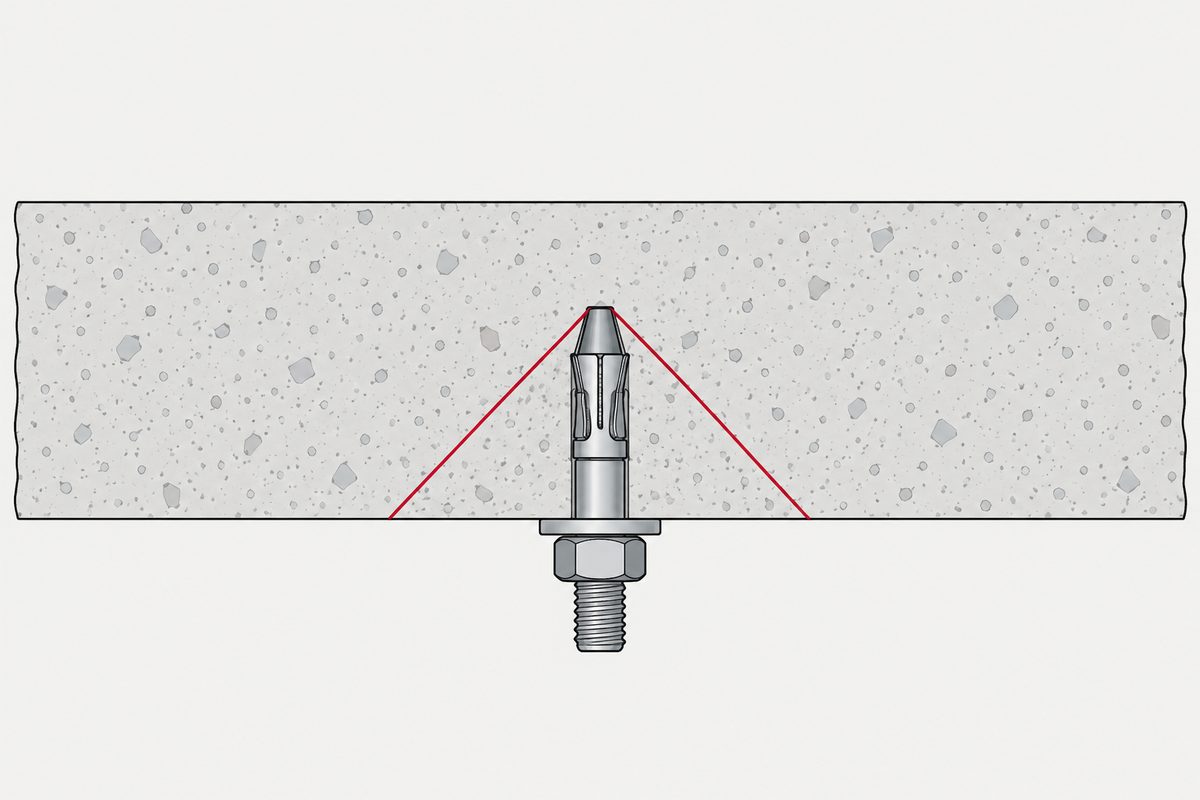
A single anchor. The table note defines it as spacing at least 3·hef and edge distance at least 1.5·hef: at 60 mm embedment, 180 mm apart and 90 mm from an edge. Closer than that, the concrete cones overlap or are cut off by the edge. The table lists reduced minimum spacing and edge distance (40 and 45 mm for M10), and those cases have to be recalculated to EN 1992-4.
Concrete, at least C20/25. The ETA covers concrete. Higher grades raise pull-out; the factor for C30/37 is 1.22. Brick is not in the document, and this site found no source for “a fifth in brick”.
Cracked or uncracked is the designer’s call. At the same embedment, uncracked is 44 to 53 % higher. The ETA gives both columns and does not choose for you.
Installed as documented. The ETA requires the hole perpendicular to the surface within ±5° and cleaned; fischer’s table gives 45 N·m installation torque for M10. Embedment is the effective depth, not the bolt length.
This product. For an anchor without an ETA, none of these numbers applies. Its own assessment or test report is the only source.
Back to the online answers
“320 kg worst case for M10” is about 3.1 kN, below the 4.1 kN permissible value at 40 mm in cracked concrete, so not unreasonable as a conservative figure, but it names no product or conditions. “1,500 to 1,800 kg for M12” is 15 to 18 kN, above the 10.5 kN the same ETA gives an M12 in uncracked concrete after dividing 22 kN by 2.1. Treated as a working load, it would use up most of the safety margin.
What the document teaches is how to ask: “how much will it hold” needs the anchor type, embedment, concrete grade, cracked or not, edge distance and spacing to have an answer.
What this page cannot conclude
This page covers tension only, not shear, combined loads or seismic action. Every figure belongs to the fischer FAZ II, C20/25 concrete, single anchor. EN 1992-4 was not read; the cone formula and the 1.5 on the concrete side are confirmed only by matching the fischer table. Nylon plugs are a different product. Where safety of people depends on the fixing, have it designed by a structural engineer for the actual conditions.
This page covers step 1, the substrate. The whole order is substrate, thread, head, drive, finish, documentation, and why doing it out of order is rework rather than a tweak is in specifying a screw.
Common questions
How much can an M10 concrete anchor hold?
It depends on the product, embedment and whether the concrete is cracked. In the public ETA-05/0069 (fischer FAZ II), a single M10 in C20/25 concrete has a permissible tension of 4.1 kN at 40 mm embedment in cracked concrete, 5.9 kN uncracked, and 6.2 and 9.5 kN at 60 mm. Those figures belong to that product only.
Does the bolt break first, or the concrete?
In that ETA the M10 steel resistance is 28.3 kN, while pull-out is 13 to 20 kN and the concrete cone at shallow embedment is lower still. The concrete side usually governs, so estimating from thread area and steel strength overestimates capacity.
How far from an edge should an anchor be?
That ETA gives a characteristic edge distance of 1.5 times effective embedment and spacing of 3 times. At 60 mm embedment that is 90 mm from the edge and 180 mm apart for single-anchor values. Closer is possible, but capacity must be recalculated to EN 1992-4.
References
- ETA-05/0069 (DIBt, 2020-04-24) — fischer Bolt Anchor FAZ II, FAZ II R, FAZ II HCR. Table C1.1 and Annex B installation instructions
- fischer — Loads Bolt anchor FAZ II (permissible loads, single anchor, C20/25)
- betermondo — aggregated Q&A on expansion anchor pull-out, in Chinese
- Masonry injection anchor values come from five pull-outs in that brick
- Solar racking screws — when the base material is a thin aluminium wall
- Threaded rod — the rod that hangs from the anchor
The annex tables of ETA-05/0069 are images in the PDF and were read after rendering. The ETA states that partial reproduction requires DIBt’s consent, so this page quotes individual values with attribution and does not reproduce the table. The conversions and the cone check are this site’s arithmetic of 2026-10-02. EN 1992-4 was not read. Online answers are secondary and translated.
Enquiries
If you need anchors or matching bolts, put the base material and concrete grade, the load, any embedment limit, edge distance and spacing, and whether assessment documents are required in the enquiry.
Request a quotation
Tell us the part and the quantity. We will come back on feasibility, lead time and price.
Or email us directly sales@tigerfasteners.com