 TIGERFASTENERS
Screws in solar racking aluminium: going from M5 to M8 bought about a fifth more pull-out
When wind lifts a solar panel, the uplift ends up in the screws holding its aluminium racking. A 2026 test published in Materials pulled screws straight out of 6063-T6 aluminium rectangular tube with a 2.6 mm wall. Above about 5 mm diameter, every failure was the aluminium thread stripping, with the screw itself intact. Going from 4.92 to 7.90 mm, about 2.6 times the cross-section, raised the pull-out from 6.3-6.7 kN to only 8.0 kN. About 6 minutes to read.
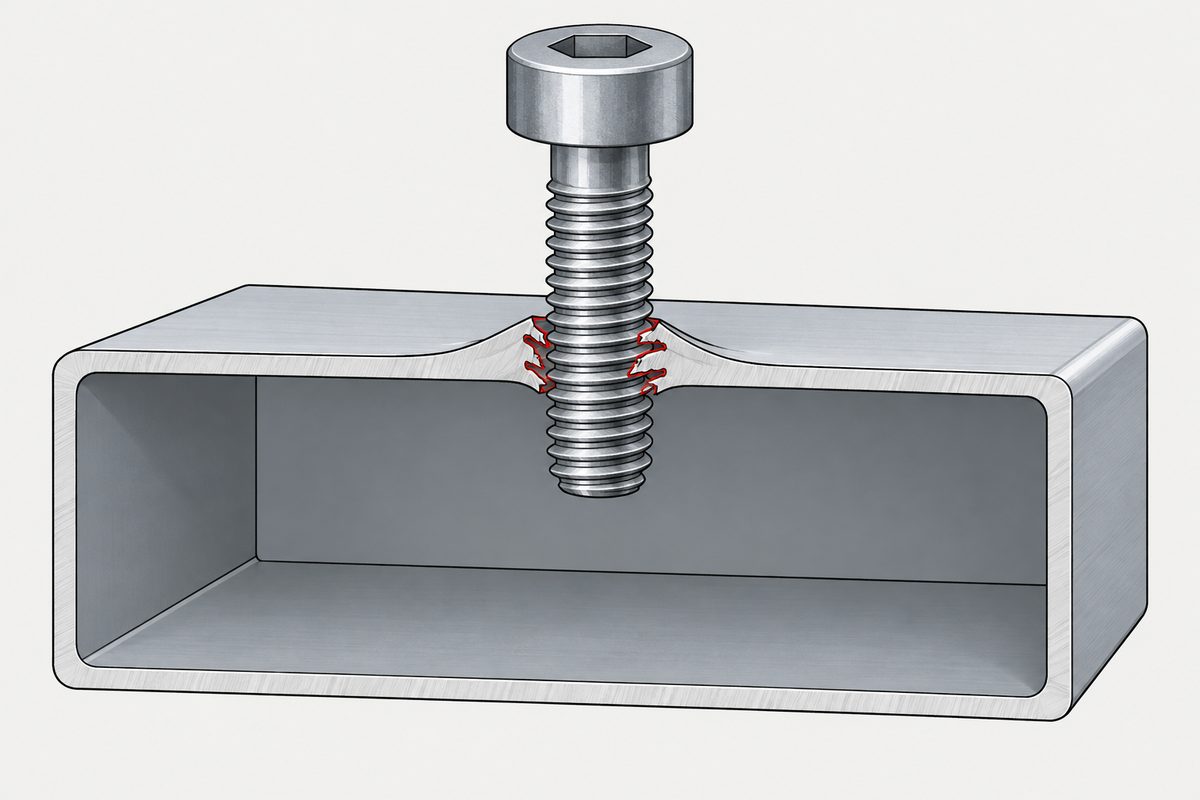
How the test was run
The specimens were 6063-T6 aluminium rectangular tube, 60 × 110 mm with a 2.6 mm wall, sized after commercial solar racking and common rooftop practice according to the paper. Two kinds of screw: self-drilling tapping screws driven straight into the wall, forming their own thread, and machine screws in holes drilled to the minor diameter and hand tapped. Both were tightened with a torque wrench to the maker’s seating torque (no figure is given) and pulled out axially, three specimens per combination.
Two ways to fail
Mode I: the aluminium thread strips. The screw shows no visible damage; the internal thread in the tube wall shears off and the wall bulges outward around the hole, failing suddenly at peak load.
Mode II: the screw breaks under the head. The broken shank stays in the wall, with only slight deformation of the aluminium.
Which happens depends mainly on diameter: the thinnest, 3.58 mm, was Mode II; above about 5 mm all were Mode I.
Eight pull-out results
| Specimen | Diameter D | Pitch p | Fu | Mode |
|---|---|---|---|---|
| Tapping SS-D3 | 3.58 mm | 1.3 | 4.36 kN | II (screw breaks) |
| Tapping SS-D4 | 4.18 mm | 1.3 | 6.92 kN | II (screw breaks) |
| Machine MS-D5 | 4.92 mm | 0.8 | 6.32 kN | I (aluminium strips) |
| Machine MS-D5 | 4.92 mm | 1.1 | 6.71 kN | I |
| Tapping SS-D5 | 4.92 mm | 1.6 | 7.34 kN | I |
| Machine MS-D6 | 5.82 mm | 1.1 | 6.32 kN | I |
| Machine MS-D6 | 6.26 mm | 1.3 | 6.69 kN | I |
| Machine MS-D8 | 7.90 mm | 1.3 | 8.00 kN | I |
Once in Mode I, diameter matters much less. The diameter-squared ratio of 7.90 to 4.92 mm is 2.58; the pull-out ratio is 8.00 ÷ 6.32 = 1.27, or 8.00 ÷ 6.71 = 1.19, about a fifth more (this site’s arithmetic). The model shows why: the peeling stress concentrates in the first two or three engaged threads, and a 2.6 mm wall only holds about that many.
The paper’s sensitivity analysis points the same way: in the elastic range the two strongest variables were the aluminium’s elastic modulus (0.44) and the wall thickness (0.40), both properties of the profile; profile width was negative, because the wall flexes out of plane.
Where the text and the table disagree
Section 2.3.3 says that reducing the pitch of the MS-D5 series from 1.1 mm to 0.8 mm gave a discernible increase in pull-out, because the finer thread engages more turns in the 2.6 mm wall. Table 1 gives 6.71 kN at 1.1 mm and 6.32 kN at 0.8 mm, a decrease. One of them is reversed, and the paper does not let this site say which. Table 1 also lists SS-D4 at 1.3 mm pitch where Table 2 says 1.4.
The reasoning about finer threads is plausible; this data set does not support it. When citing the paper on pitch, cite the table.
For anyone specifying the screws
In thin aluminium, look at the wall before the screw. In this test, above about 5 mm a thicker screw bought little; wall thickness and the aluminium itself were the main variables. That is a result for this 2.6 mm 6063-T6 wall and these screws, not a rule (When the sheet is too thin to hold a thread).
Too thin changes the failure. The 3.58 mm tapping screw broke under the head at 4.36 kN. Save material in that direction and the screw becomes the weak link.
What this page cannot conclude
The table gives test ultimate loads, not design values; no safety factor is applied and no wind load is converted into a screw count. Results belong to a 2.6 mm 6063-T6 tube and these eight screws. The paper gives no installation torque figure.
This page covers step 1, the substrate. The whole order is substrate, thread, head, drive, finish, documentation, and why doing it out of order is rework rather than a tweak is in specifying a screw.
Common questions
How much does a bigger screw add in aluminium racking?
In a 2026 Materials test on 6063-T6 tube with a 2.6 mm wall, screws above about 5 mm all failed by stripping the aluminium thread; from 4.92 to 7.90 mm the pull-out rose from 6.32-6.71 kN to 8.00 kN, about a fifth more. That holds for this set of conditions only.
Does the screw or the aluminium fail in pull-out?
It depends on relative strength. In the same test, a 3.58 mm tapping screw broke under the head at 4.36 kN, while screws above about 5 mm stripped the aluminium thread and stayed intact. Aluminium modulus and wall thickness were the main variables in the sensitivity analysis.
References
- Zhang et al. (2026) — Tensile Pull-Out Behaviour and Global Sensitivity Analysis of Fastening Screws in Photovoltaic Aluminium Support Structures, Materials 19(14):3070 (open access, CC BY)
- When the sheet is too thin to hold a thread
Full text via Europe PMC, read in full; Table 1 figures as published. The ratios are this site’s arithmetic. The pitch contradiction between text and Table 1, and the SS-D4 pitch mismatch between Tables 1 and 2, were found in checking and are reported as is.
Enquiries
For screws into aluminium profiles, give the alloy and temper (for example 6063-T6), wall thickness, required pull-out and whether tapping or tapped.
Request a quotation
Tell us the part and the quantity. We will come back on feasibility, lead time and price.
Or email us directly sales@tigerfasteners.com