 TIGERFASTENERS
The Reference Chapter on Wood Fastenings Has No Entry for a Hole That Has Already Failed
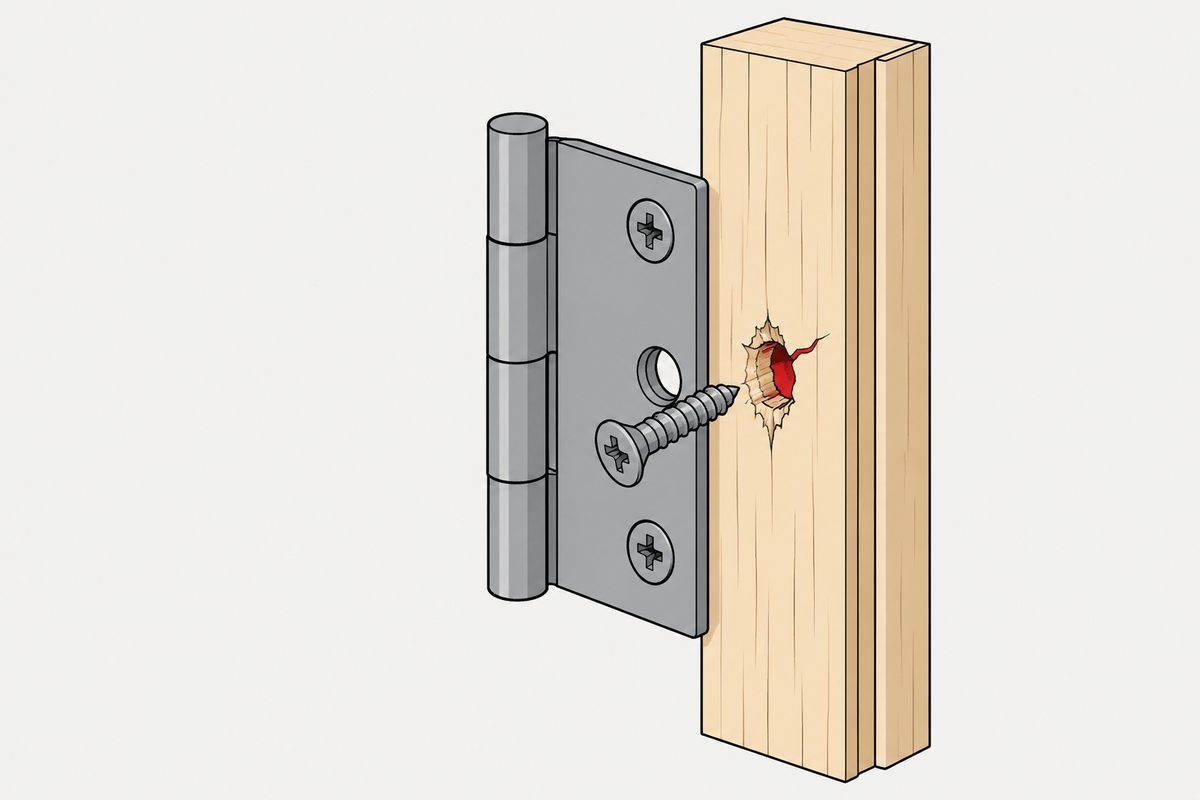
Four questions on the same home improvement site, eighty eight votes between them, all asking one thing in different words: the screw hole has gone, what now. A worn hinge hole in a door. A hole to be filled and used again. A stud hole that opened up under a cabinet. It is one of the most common things that happens to a fastened joint, and the thirty page reference chapter on wood fastenings does not contain the word repair.
Our word counts across the whole of that chapter: repair zero, reuse zero, enlarged zero, redriving zero. The words it does carry, oversize and plug, appear twice each and not in that sense.
This page gives no repair method for anybody's door, stud or cabinet, and nothing from the aircraft document quoted later is transferable to household work. What is reported is which documents have a concept for a failed fastener hole and what that concept turns out to be. The questions came from a public home improvement question site through its open interface, the browser tooling this site normally uses being unavailable again. We read the questions and not their answers, and no username appears here.
What the reference chapter assumes
The fastenings chapter of the wood handbook is thirty pages and it is thorough. It covers nails, spikes, staples, drift bolts, wood screws, lag screws and bolts, with withdrawal and lateral relationships for each. We read it closely a day ago for the pair of withdrawal equations that differ by one exponent, and none of that is repeated here.
What it does not have is any notion of a second attempt. By our count the word repair does not appear in it, nor reuse, nor enlarged, nor redriving. Every relationship in the chapter takes a fastener of a given diameter, driven to a given depth, into wood of a given specific gravity. The hole is a consequence of the fastener, not a thing with a history.
That is not an oversight. It is what a materials reference is for. But it does explain why the four questions get asked and re-asked: the condition they describe sits outside the model the engineering literature uses. A hole that has already been loaded, stripped and emptied is not a smaller version of a fresh hole. It is a different object, and the equations do not have a variable for it.
One document does have the concept
The vocabulary exists elsewhere. In the aircraft inspection and repair advisory circular, by our count elongated appears eighteen times, bolt hole thirty eight times, oversize twenty five and bushing twenty eight. That document is written for exactly this situation, because aircraft are maintained rather than replaced. This is the sixth time this site has used it, and its first chapter, on wood structure, was untouched by the previous five.
Its paragraph on elongated holes is short enough to quote whole, and it is worth reading for what it is not:
“In cases of elongated bolt holes in a spar, or cracks in the vicinity of bolt holes, splice in a new section of spar, or replace the spar entirely. If hole elongation or cracking is minimal and the bolt holes are for noncritical fittings, repair (rather than replacement) may be feasible. Obtain approval for any such repair from the manufacturer or a representative of the FAA.”
It is not a hole repair. It is a decision about the member. The default is to splice in a new section or replace the whole spar. Repair becomes an option only when three conditions hold at once: the elongation is minimal, the holes serve noncritical fittings, and somebody with authority has approved it.
And the repair moves the hole out
The figure on the same page, showing how a solid spar is spliced, carries two notes that complete the picture. One gives the geometry: a minimum splice length expressed as a multiple of the member dimension, with reinforcement plates of plywood, the same material, or material of equal or higher quality, bonded with ends feathered out with a five to one slope.
The other is a single line printed across the drawing: “NO FITTING WITHIN THESE LIMITS.”
No fitting means no fastener, and no fastener means no hole. So even when the repair route is taken, the outcome is not a restored hole in the same place. The repaired zone is explicitly forbidden to carry one. The hole does not come back; the structure is rearranged so that it is not needed there.
The paragraph immediately after it points the same way. Ribs may be replaced, and an owner may produce one, but only from a manufacturer approved drawing or by reference to an existing original rib with sufficient evidence that it is original and that all materials and dimensions can be determined. Throughout this chapter, the answer to damage is a documented new part rather than a restored old one.
Why this is worth knowing away from aircraft
Not because a door hinge is a spar. Because of what the two documents together reveal about the shape of the question.
Nobody has published a strength relationship for a repaired hole. The materials reference does not model one. The maintenance document does not restore one; it replaces the member, and where it permits repair it requires an approval and then bans a fastener from the repaired length. Between the two, the engineering position on a failed fastener hole is that it stops being a calculable joint.
That is a useful thing to know before choosing between the many things people do instead. Whatever is done, the result is not covered by the equations that covered the original, and those equations were about sound wood at a stated density. A repaired hole has a different local density, a different grain condition and an adhesive in it. None of those are inputs the published relationships accept.
We are not saying such repairs do not work. Plenty of them evidently do, which is why the questions have so many answers. We are saying something narrower and checkable: no document we read gives them a number.
What this settles and what it does not
- The thirty page reference chapter on wood fastenings contains no occurrence of repair, reuse, enlarged or redriving, by our count
- Its relationships describe a fastener driven into sound wood, with the hole as a consequence rather than a thing with a history
- The aircraft maintenance document does have the vocabulary, with elongated appearing eighteen times and bolt hole thirty eight
- Its rule for elongated bolt holes is to splice in a new section or replace the member entirely
- Repair is conditional on three things at once: minimal elongation, noncritical fittings, and approval from the manufacturer or the authority
- The splice drawing forbids a fitting within the spliced length, so the repair does not give the hole back
- We did not read the rest of that chapter, and we did not read the figure elsewhere in the document whose title mentions repairing elongated or worn bolt holes, so nothing is said about its contents
- Nothing here is a household repair method, and nothing from an aircraft structural repair transfers to a door, a stud or a cabinet
The residue is a way of holding the problem. A stripped hole is not a weakened joint that can be topped up; in the documents that treat it at all, it is a joint that has left the model. Knowing that does not tell anyone what to do next, but it does explain why no source will tell them either.
This page covers step 1, the substrate. The whole order is substrate, thread, head, drive, finish, documentation, and why doing it out of order is rework rather than a tweak is in specifying a screw.
Common questions
Does the wood fastenings reference say how to repair a stripped screw hole?
No. By our count the thirty page chapter contains no occurrence of repair, reuse, enlarged or redriving. Its relationships take a fastener of a given diameter driven to a given depth into wood of a given specific gravity, and the hole is a consequence of the fastener rather than a thing with a prior history.
Is there any document that treats an enlarged fastener hole?
Yes, an aircraft inspection and repair advisory circular. Its paragraph on elongated holes in spars says to splice in a new section of spar or replace the spar entirely, and allows repair only if the elongation is minimal, the holes serve noncritical fittings, and approval is obtained from the manufacturer or a representative of the authority.
So the aircraft document tells you how to fix the hole?
It does not. It gives a decision about the member rather than a method for the hole. And where the splice route is taken, the accompanying figure carries the note that no fitting may sit within the spliced limits, so the repaired length is not permitted to carry a fastener at all.
Can I use that method on a door hinge?
No, and this page gives no household repair method of any kind. That guidance is for wooden aircraft structure, is conditional on an approval, and nothing in it transfers to a door, a stud or a cabinet.
Why do these questions get so many answers?
This page does not analyse the answers, which we did not read. What it can say is that the condition sits outside the published relationships: a hole that has already been loaded and stripped is not a smaller version of a fresh hole, and the equations have no variable for it.
Does that mean common repairs do not work?
No, and we make no such claim. The narrower and checkable statement is that no document we read gives a repaired hole a number.
What would change about the wood if a hole were repaired?
This page does not model that. The published withdrawal relationships take specific gravity, fastener diameter and depth of penetration as inputs, and a repaired hole differs in local density, grain condition and the presence of an adhesive, none of which are inputs those relationships accept.
Which parts of these documents were read?
The fastenings chapter of the wood handbook, which was read in full for an earlier page and searched for this one, and the paragraph on elongated holes in spars in the first chapter of the advisory circular, with the splice figure and the opening of the following paragraph on the same page. The rest of that chapter was not read.
References
- FAA Advisory Circular 43.13-1B, Acceptable Methods, Techniques, and Practices, Aircraft Inspection and Repair, 8 September 1998 with change 1 of 27 September 2001. Chapter 1, Wood Structure, paragraph 1-45 and Figure 1-6
- Wood Handbook, Wood as an Engineering Material, General Technical Report FPL-GTR-190, Chapter 8, Fastenings. Forest Products Laboratory, USDA Forest Service. Thirty pages, searched for this page
- The question this page starts from, on a public home improvement question site. Thirty two votes, eight answers
- A second question in the same cluster. Twenty seven votes, ten answers
Paragraph 1-45, the splice figure on the same page and the opening of the paragraph after it were read from a rendered image of that page. This is the sixth time this site has used the advisory circular, most recently for its section on bolts, and its first chapter was untouched by all five earlier uses. The figure elsewhere in that document whose title mentions repairing elongated or worn bolt holes was seen only as a contents entry; its contents were not read and nothing about it is described here. The rest of the first chapter was not read. This is the second consecutive page to use the fastenings chapter of the wood handbook, after one on its withdrawal equations; here it is used only as a count of what the chapter does not contain, and those equations are linked rather than repeated. The following are our own counts, not statements by either document: that repair, reuse, enlarged and redriving each appear zero times in the thirty page chapter while oversize and plug appear twice each in other senses; and that elongated appears eighteen times, bolt hole thirty eight, oversize twenty five and bushing twenty eight in the advisory circular. All four question links were checked against the site interface before being written down. This page gives no repair method of any kind, makes no claim that common repairs do or do not work, and nothing from aircraft structural repair guidance transfers to household work. No brand is named. The questions came from a public home improvement question site rather than the forum tooling this site normally uses, which remains unavailable. We read the questions and not their answers, and no username appears here.
Enquiries
If a joint on your drawing is expected to be opened and refastened more than once, that is worth saying in words, because the published strength relationships describe the first time only. Tell us how many cycles the joint has to survive and we will tell you what we can evidence about the fastener across them, and what belongs to the parent material instead.
Request a quotation
Tell us the part and the quantity. We will come back on feasibility, lead time and price.
Or email us directly sales@tigerfasteners.com