 TIGERFASTENERS
The Nail and the Screw Withdrawal Equations Differ by One Exponent
Eighty two votes on a question that has waited here for a long time: is there a case where nails are better than screws, from an engineering standpoint. The document that answers it best has been unreachable for weeks because one government host refuses us. It turns out another one does not. Inside is a pair of equations that look almost identical, and the only real difference between them is the power to which the density of the wood is raised.
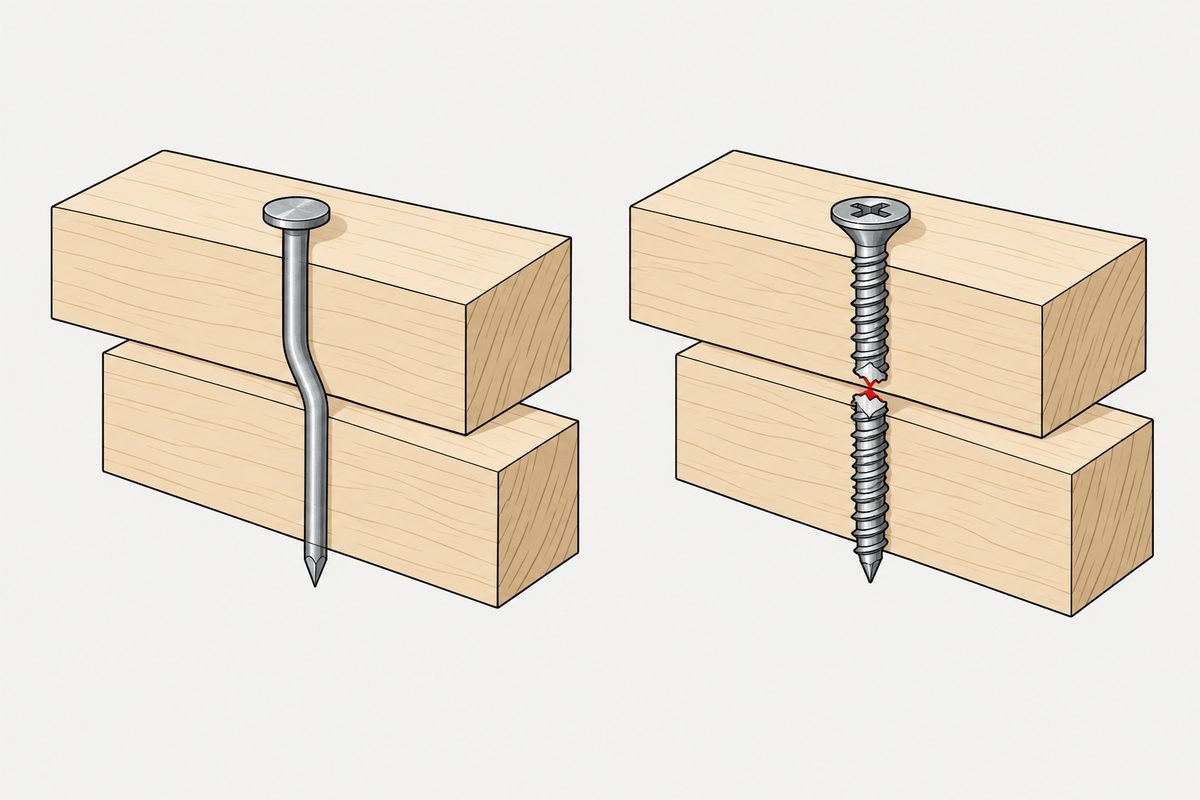
The two empirical withdrawal equations, side by side. For bright common wire nails in side grain: p = 54,12 G5/2 D L. For wood screws in side grain: p = 108,25 G2 D L. Same shape, one different exponent.
These are empirical ultimate test values, not design loads, and this page gives no construction, structural or fastener selection advice. The chapter itself says that lateral design moved from an empirical method to a yield model theory adopted in the 1991 design specification, and we did not read that specification or any building code. The question came from a public home improvement question site through its open interface, the browser tooling this site normally uses being unavailable again. We read the question and not its answers, and no username appears here.
Where the document was hiding
Worth recording because it cost several attempts. The handbook chapter on fastenings lives on a United States Forest Service host that returns a refusal to us, and has done every time we tried. A different Forest Service host serves the same chapter and does not refuse. The publication page loads normally and carries a direct download link, which works.
The chapter is thirty pages, titled Fastenings, credited to a named research general engineer, and covers nails, spikes, staples, drift bolts, wood screws, lag screws and bolts. This site has cited the handbook three times before, twice for the lead hole rule that names the wood, which comes from this same chapter, and once for a friction figure. The withdrawal and lateral equations have not been used here before and everything new on this page comes from them.
One exponent apart
For bright common wire nails driven into the side grain of seasoned wood, or unseasoned wood that remains wet, the maximum withdrawal load is p = 54,12 G5/2 D L in metric units, or 7 850 G5/2 D L in inch and pound units. L is the depth of penetration in the member holding the point, D is the nail diameter, and G is specific gravity based on oven dry weight and volume at twelve percent moisture content.
For wood screws in the side grain of seasoned wood, the ultimate test values are p = 108,25 G2 D L in metric units, or 15 700 G2 D L in inch and pound units. Here D is the shank diameter and L is the length of penetration of the threaded part, which is not the same L as the nail equation uses. The chapter states the screw values are based on reaching ultimate load in five to ten minutes.
Put one over the other and almost everything cancels. By our arithmetic the ratio is two divided by the square root of the specific gravity. In inch and pound units the coefficients divide exactly: 15 700 over 7 850 is two. In metric the same division gives 2,0002, which is rounding.
So the comparison does not depend on the size of the fastener at all, only on the wood:
- At G = 0,35 the screw figure is 3,38 times the nail figure
- At G = 0,42, 3,09 times
- At G = 0,50, 2,83 times
- At G = 0,68, 2,43 times
We are deliberately not attaching those numbers to named species. The chapter points to species tables in a different chapter that we did not read, so the values above are simply substitutions across a plausible range.
The shape of the result is the interesting part. The screw is ahead everywhere, and it is furthest ahead in the lightest wood. The gap narrows as the timber gets denser and would only close at a specific gravity of four, which no wood has. Whatever the case for nails is, direct withdrawal is not it.
Where the screw stops gaining
The chapter then supplies its own limit on the screw, and it is a good one. The withdrawal load rises with penetration only until something else gives: “The screw will fail in tension when its strength is exceeded by the withdrawal strength from the wood. The limiting length to cause a tension failure decreases as the density of the wood increases…”
And the conclusion the chapter draws from that: “The longer lengths of standard screws are therefore superfluous in dense hardwoods.”
That is a real boundary rather than a caution. Past a certain length in dense wood, the equation stops describing the joint because the joint stops being a wood problem and becomes a steel one. It also explains why the ratio narrowing with density matters more than it first appears: in the wood where the screw's margin is smallest, the screw is also the first thing to run out of strength.
One neighbouring figure is worth having. The chapter says type A tapping screws, commonly called sheet metal screws, give withdrawal resistance about ten percent greater than wood screws of comparable diameter and threaded length, with the ratio running from 1,16 in denser woods to 1,05 in lighter ones. That is the opposite trend to the nail comparison, and it is a smaller effect than the exponent.
Three different end grain penalties
End grain is where the chapter stops being tidy, and the untidiness is informative. It gives three different answers for three different fasteners and load directions.
- Nails, lateral. Maximum resistance to lateral displacement in end grain is about two-thirds that in side grain. Average proportional limit loads look about the same, but individual results are more erratic and the minimum loads approach only 75 percent of the side grain values
- Screws, withdrawal. Loads from end grain are somewhat erratic, but where splitting is avoided they should average 75 percent of the side grain load
- Lag screws. Should not be used in end grain, because splitting may develop under lateral load. If they are used anyway, the loads should be taken as two-thirds of the side grain lateral values
Two thirds, seventy five percent, and a prohibition. Notice that in two of the three the chapter reaches for the word erratic before it reaches for a number, which is a way of saying the average is not the thing to design around.
The other equation has no length in it
One more structural difference, and it may be the closest this chapter comes to answering the original question. The pre-1991 empirical equation for the lateral resistance of a wood screw in side grain is p = K D2, where D is the shank diameter and K depends on the species.
There is no length term. The equation applies provided penetration into the member receiving the point is not less than seven times the shank diameter, the two members are of approximately the same density, and the side member is about half the penetration depth thick. Above that threshold, more screw does not buy more lateral capacity in this relationship, and the expected slip is given as 0,18 to 0,25 millimetres.
Set that beside the withdrawal equations, which are linear in length, and the two load directions turn out to reward completely different things. Withdrawal pays for depth. Lateral pays for diameter. A comparison between two fastener types that does not first say which direction it is loading in has not asked a complete question.
What this settles and what it does not
- The two withdrawal equations have the same form and differ in the exponent on specific gravity, five halves for nails against two for screws
- By our arithmetic the screw to nail ratio is two divided by the square root of the specific gravity, with the inch and pound coefficients dividing exactly
- The screw leads everywhere and leads by most in the lightest wood, from about 3,4 times at a specific gravity of 0,35 to about 2,4 at 0,68
- The screw has its own ceiling. It fails in tension once the wood holds harder than the screw, and the chapter says extra length is superfluous in dense hardwoods
- End grain carries three different penalties: two-thirds for nails laterally, 75 percent for screws in withdrawal, and lag screws should not be used there at all
- Lateral resistance for screws has no length term above seven shank diameters of penetration, while withdrawal is linear in length
- None of this is a design value. These are empirical ultimate test relationships, and the chapter says lateral design moved to a yield model theory in 1991
- No specific gravity is attributed to any species here, because the species tables are in a chapter we did not read
- This page gives no construction, structural or selection advice, and does not answer whether to use nails or screws for anything
The honest summary is that the question as asked cannot be settled by the withdrawal equations, because they answer it decisively in one direction. If there is a case for the nail it lives somewhere these two lines do not reach: in what happens after the load, in splitting, in cost, in how the joint fails rather than how much it holds. What the equations do settle is smaller and worth keeping: the answer is a property of the wood, and it moves with the square root of its density.
Every one of those relationships describes a fresh hole in sound wood. What the same chapter says about a hole that has already failed is nothing at all.
This page covers step 1, the substrate. The whole order is substrate, thread, head, drive, finish, documentation, and why doing it out of order is rework rather than a tweak is in specifying a screw.
Common questions
Do nails or screws hold better against direct withdrawal?
By the empirical equations in the fastenings chapter of the wood handbook, screws, and by a wide margin. The nail equation goes as specific gravity to the power five halves and the screw equation as specific gravity squared, and dividing one by the other gives two divided by the square root of the specific gravity.
How big is the difference?
By our arithmetic, about 3,4 times at a specific gravity of 0,35, about 3,1 at 0,42, about 2,8 at 0,50 and about 2,4 at 0,68. We are not attaching those figures to named species, because the species tables are in a chapter we did not read.
Does the advantage depend on the size of the fastener?
Not in this comparison. Diameter and length cancel when the two equations are divided, so only the specific gravity of the wood remains. Note that the two equations do not use the same length: the nail equation uses penetration in the member holding the point, and the screw equation uses the penetration of the threaded part.
Is a longer screw always better?
No, and the chapter says so. The screw will fail in tension once the withdrawal strength of the wood exceeds the strength of the screw, the limiting length falls as density rises, and the chapter concludes that the longer lengths of standard screws are superfluous in dense hardwoods.
What happens in end grain?
Three different things. Nails driven into end grain have about two-thirds the lateral resistance of side grain, with minimum loads approaching only 75 percent and more erratic results. Screw withdrawal from end grain should average 75 percent of the side grain load where splitting is avoided. And lag screws should not be used in end grain at all, because splitting may develop under lateral load.
Does penetration help lateral resistance too?
Not in the pre-1991 empirical relationship for wood screws. That equation is the species coefficient times the square of the shank diameter, with no length term, and it applies once penetration reaches at least seven times the shank diameter.
Are these design values?
No. They are empirical ultimate test relationships. The chapter states that lateral resistance values moved from an empirical method to a yield model theory adopted in the 1991 design specification, and this page did not read that specification or any building code.
What about sheet metal screws in wood?
The chapter says type A tapping screws give withdrawal resistance about ten percent greater than wood screws of comparable diameter and threaded length, with the ratio running from 1,16 in denser woods to 1,05 in lighter ones.
So when are nails better?
This page does not answer that and the withdrawal equations do not support it. If there is a case, it is not in direct withdrawal, and we give no advice about choosing between them.
References
- Wood Handbook, Wood as an Engineering Material, General Technical Report FPL-GTR-190, Chapter 8, Fastenings, by Douglas R. Rammer, Research General Engineer. Forest Products Laboratory, USDA Forest Service. Thirty pages, free and complete
- The question, on a public home improvement question site. Eighty two votes, twelve answers
The chapter was downloaded complete and read for the nail and wood screw sections, the end grain provisions and the lateral resistance relationship. This site has cited the handbook three times before, twice for the lead hole rule that comes from this same chapter and once for a friction figure; the withdrawal and lateral equations have not been used here before, and the lead hole rule is linked rather than repeated. The following are our own arithmetic, not statements by the chapter: that dividing the screw equation by the nail equation gives two divided by the square root of the specific gravity; that the inch and pound coefficients divide exactly while the metric pair gives 2,0002 through rounding; and the four ratios quoted for specific gravities of 0,35, 0,42, 0,50 and 0,68. No specific gravity is attributed to any named species, because the species tables sit in a chapter that was not read. These equations are empirical ultimate test relationships and not design or allowable loads; the chapter itself records that lateral design moved to a yield model theory adopted in the 1991 design specification, which was not read here, and no building code was consulted. The two withdrawal equations do not use the same definition of length, which is stated in the text above rather than glossed over. This page gives no construction, structural, installation or selection advice, and does not say whether to use nails or screws for anything. No brand is named. The question came from a public home improvement question site rather than the forum tooling this site normally uses, which remains unavailable. We read the question and not its answers, and no username appears here.
Enquiries
If a joint you are specifying is loaded in a direction nobody has written down, that is worth settling before the fastener is chosen, because withdrawal and lateral loading reward different geometry. Tell us which way the load runs and what the parts are made of, and we will tell you which properties we can evidence on the fastener itself.
Request a quotation
Tell us the part and the quantity. We will come back on feasibility, lead time and price.
Or email us directly sales@tigerfasteners.com