 TIGERFASTENERS
The Pilot Hole Rule Names the Wood, and Measures From the Root
Somebody on r/woodworking posted that the heads had snapped off a run of number 8 screws going into ash. They had drilled pilot holes. The top reply, at 515 points, blamed hardwood plus an impact driver plus undersized pilots, and the poster answered that it was not an impact driver and that the screws had gone almost all the way in before they twisted off. Another reply, at 105 points, said this happens with a hand screwdriver too, across screws from several manufacturers, which takes a bad batch off the table as the whole explanation. A hundred and ninety comments, and not one of them produced a pilot hole rule that names the species. There is one.
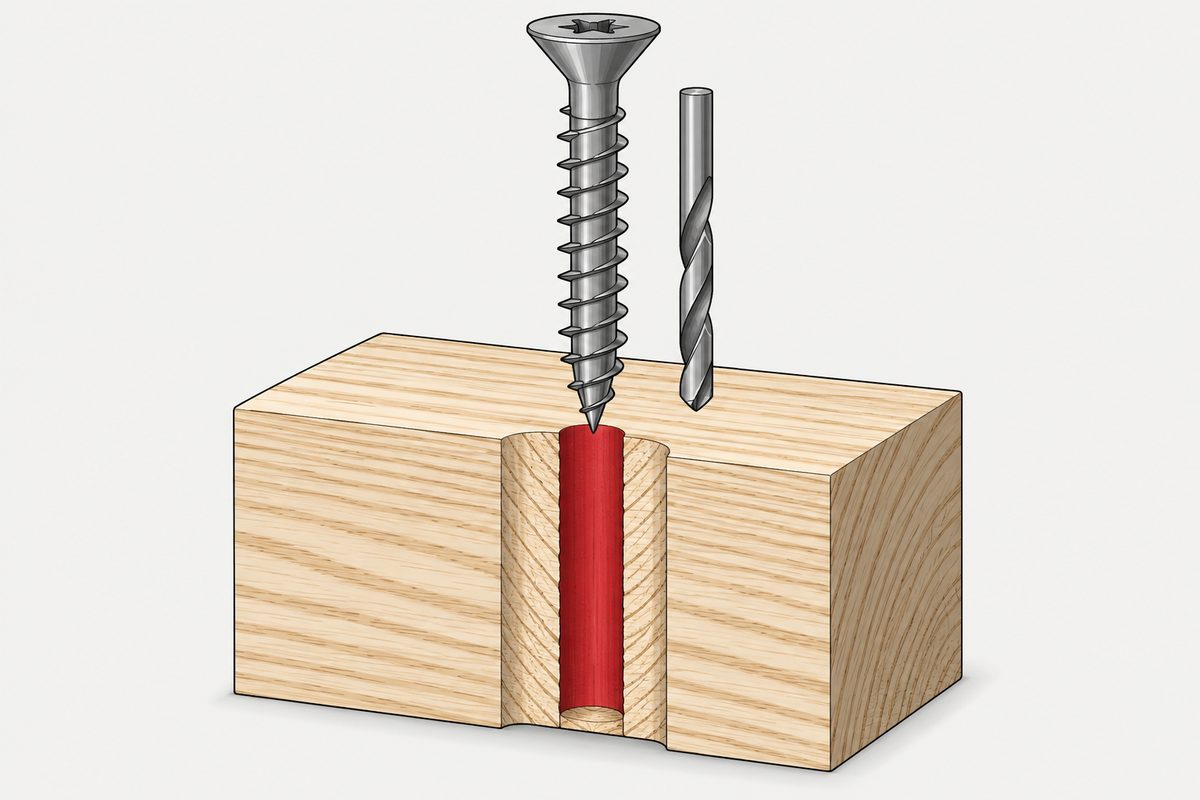
The rule is about 70 per cent of the root diameter in softwoods and about 90 per cent in hardwoods, and there are two separate ways to misapply it. Use the softwood number in a hardwood and the hole is too small, the driving torque climbs and the screw twists off. Measure the percentage from the shank instead of the root and the hole is too large, the screw goes in beautifully and holds less than you think. One sentence, two errors, pointing in opposite directions.
The source is the Wood Handbook, Wood as an Engineering Material, FPL-GTR-190, published by the Forest Products Laboratory of the US Forest Service and free to download. Chapter 8 covers fastenings. The sentence appears as a condition on the withdrawal equation for wood screws: the equation is applicable when screw lead holes have a diameter of about 70 per cent of the root diameter of the threads in softwoods, and about 90 per cent in hardwoods.
Read that as a design rule rather than a footnote and it is doing two things at once. It names a percentage, and it names what the percentage is of. Ash is a hardwood, so the number in play was 90.
The handbook gives you a percentage of one diameter and a table of another
A few pages later the same chapter tabulates screw gauges against diameters, and what it tabulates is the shank:
| Gauge | Shank diameter | Gauge | Shank diameter |
|---|---|---|---|
| 4 | 2,84 mm (0.112 in) | 11 | 5,16 mm (0.203 in) |
| 6 | 3,51 mm (0.138 in) | 12 | 5,49 mm (0.216 in) |
| 8 | 4,17 mm (0.164 in) | 14 | 6,15 mm (0.242 in) |
| 10 | 4,83 mm (0.190 in) | 16 | 6,81 mm (0.268 in) |
Number 8 is 0.164 inch, which is the numbered series behaving exactly as its linear formula says it should. What the handbook does not tabulate anywhere is the root diameter of a wood screw, and we hold no citable source for it either, so this page will not put a millimetre on the pilot for a number 8. That gap is not a complaint about the document. It is the practical problem: the rule is expressed in a diameter that the reader is unlikely to have to hand, sitting a few pages from a table of the diameter they do have.
The root is smaller than the shank, so taking a percentage of the wrong one always gives a larger hole. That is the quiet failure. Nothing snaps, the screw runs in sweetly, and the withdrawal load the equation was written to predict no longer applies, because its stated condition was not met.
And the reference diameter changes within the same chapter
This is where the confusion has an honest source rather than a careless one. A few pages on, the handbook gives the rule for lag screws, and it is written against the shank:
| Wood | Lead hole for the threaded part, as a percentage of shank diameter |
|---|---|
| Low-density softwoods, such as the cedars and white pines | 40 % to 70 % |
| Douglas-fir and Southern Pine | 60 % to 75 % |
| Dense hardwoods, such as oaks | 65 % to 85 % |
The handbook adds that the smaller percentage in each range applies to lag screws of smaller diameters and the larger percentage to larger diameters, and that the lead hole for the shank should be the same diameter as the shank, so a lag screw wants a stepped hole rather than one drill.
So within one chapter there are two families, two sets of percentages, and two different diameters to take them from. A chart on a workshop wall carries the numbers and usually not the sentence that says which diameter they belong to, which is how a reader ends up applying a lag screw band to a wood screw or a root percentage to a shank.
The two errors, side by side
| What went wrong | Effect on the hole | What you see |
|---|---|---|
| Softwood percentage used in a hardwood | Too small | Driving torque climbs, and the screw can fail before it seats. The loud one |
| Percentage taken from the shank instead of the root | Too large | Drives easily and holds less than the equation predicts. The quiet one |
The thread reported the first. The screws went almost all the way in before they went, which is the part worth noticing, because driving torque accumulates as more thread engages. The last turns are where the total is highest, so a hole that was slightly too small produces its failure at the end of the drive rather than at the start. Somebody driving carefully and slowly, with the clutch set part way up, gets the same outcome as somebody leaning on it, just later.
The general form of that gap, between the torque it takes to drive a screw and the torque at which it fails, is worked through for tapping screws in sheet metal, which is a different fastener family with its own standard. The framing carries across. The numbers do not, and this page quotes none of them here.
Two things the handbook actually prescribes, both cheap
- Soap. Lubricating the surface of a screw with soap or a similar lubricant is recommended to facilitate insertion, the handbook says, especially in dense woods, and it will have little effect on ultimate withdrawal resistance. That last clause is the one that matters, because the usual objection to the old shop trick is that a slippery screw must hold less well, and the document addresses it directly
- Go up a little for a long screw. In the lag screw passage the handbook says lead holes slightly larger than those recommended for maximum efficiency should be used with long screws. A number 8 at one and three quarter inches is long for its diameter
- How far in matters too, and it depends on the parent. A building code asks a drywall screw to reach 5/8 inch into wood but only 3/8 into thin steel, which is the same principle running the other way: the softer the material holding the thread, the further the screw has to go
There is a third instruction in the same section that reads as though it were written for a different century and is not: screws should always be turned in, and never started or driven with a hammer, because that tears the wood fibres and injures the screw threads, seriously reducing the load carrying capacity. The reason is worth keeping even where nobody is reaching for a hammer, because it says what the holding is made of. It is intact fibre wrapped around an intact thread, and anything that damages either during installation has already spent some of the number.
The question in the post that nobody answered
The poster asked whether the cold might have done it, the screws having sat outside for a while. It is a better question than it looks, because temperature genuinely does change how a steel fastener fails, and the general form of that is what a strength class does and does not tell you about low temperature.
For this case we will not pretend to settle it. We hold no low temperature data for wood screws, no toughness figure for whatever steel and heat treatment those screws were, and nothing that would let us weigh a cold shed against a pilot hole drilled to a softwood number. What can be said is that the arithmetic available points at the hole: the species was named in the rule, the rule gives a different percentage for it, and the failure arrived at the end of the drive, where driving torque is largest. That is an explanation that fits without needing the weather.
What to settle before the next hole
- Which diameter is the percentage a percentage of? Settle that before arguing about the number. Getting the reference wrong moves the hole further than getting the percentage slightly wrong does
- Is the species in the rule? Softwood and hardwood are different lines, and for lag screws the handbook goes further and names groups
- Is the screw long for its gauge? If so the handbook says go slightly larger than the efficient hole, and accept the trade
- Is there a reason not to use soap? The handbook recommends it in dense woods and says it costs almost nothing in withdrawal
The wider point is one this site keeps arriving at from different directions. A rule of thumb travels well and its conditions do not. The percentage got copied onto a hundred charts; the sentence naming the diameter and the species stayed in the handbook.
The same chapter carries the withdrawal equations, and dividing the screw one by the nail one leaves nothing but the wood.
This page covers step 1, the substrate. The whole order is substrate, thread, head, drive, finish, documentation, and why doing it out of order is rework rather than a tweak is in specifying a screw.
Common questions
What size pilot hole does a wood screw need?
The Wood Handbook states the condition on its withdrawal equation as a lead hole of about 70 per cent of the root diameter of the threads in softwoods and about 90 per cent in hardwoods. Note both halves: the percentage depends on the species group, and it is a percentage of the root diameter rather than the shank. The handbook tabulates shank diameters by gauge but does not tabulate root diameters, so the figure has to come from the screw you are actually using.
Why did my screw twist off near the end of the drive?
Because that is where driving torque is highest. Torque accumulates as more thread engages, so a hole that was slightly too small produces its failure in the last turns rather than at the start. A pilot sized by a softwood rule and used in a hardwood is a common way to arrive there, and it happens with a hand driver as well as a powered one.
Is the pilot hole rule the same for lag screws?
No, and the difference is not just the numbers. The Wood Handbook gives the lag screw lead hole for the threaded part as a percentage of the shank diameter: 40 to 70 per cent for low-density softwoods such as the cedars and white pines, 60 to 75 for Douglas-fir and Southern Pine, and 65 to 85 for dense hardwoods such as oaks, with the smaller percentage in each range for smaller diameters. It also says the lead hole for the shank should be the same diameter as the shank, so a lag screw wants a stepped hole.
Does soap on a screw reduce how well it holds?
The Wood Handbook says lubricating the surface with soap or a similar lubricant is recommended to facilitate insertion, especially in dense woods, and that it will have little effect on ultimate withdrawal resistance. In the lag screw section it repeats the recommendation and adds that lead holes slightly larger than the most efficient ones should be used with long screws.
Can cold make screws snap?
Temperature does change how a steel fastener behaves, and the general form of that question is covered on our page about what a strength class does not tell you about low temperature. For a wood screw in a shed we hold no data: no toughness figure for the steel and heat treatment in question, and nothing that would let us weigh cold against pilot hole size. In the case that prompted this page the available arithmetic points at the hole rather than the weather.
Why do published pilot hole charts disagree with each other?
Largely because they are percentages of different diameters. Within one chapter of the Wood Handbook the wood screw rule is a percentage of the root diameter and the lag screw rule is a percentage of the shank, and a chart usually carries the numbers without the sentence that says which diameter they belong to. Since the root is smaller than the shank, applying the wrong reference always gives a larger hole than intended.
References
- Wood Handbook, Wood as an Engineering Material, FPL-GTR-190, Forest Products Laboratory, US Forest Service, 2010; Chapter 8, Fastenings, for the wood screw lead hole condition, Table 8–9 of shank diameters by gauge, the lag screw lead hole percentages and the lubricant and hammer instructions
- r/woodworking — the thread this began in, including the poster ruling out an impact driver and the reply reporting the same failure by hand
Chapter 8 of the Wood Handbook was read from a complete copy of the document, and the quoted conditions, percentages and instructions are its wording. The handbook does not tabulate root diameters for wood screws and we hold no citable source for them, so no pilot hole diameter in millimetres is given here for any gauge; that gap is part of the point rather than an omission. No specific gravity is quoted for ash, because we did not read the column definitions of the table that would supply one, and nothing on this page depends on a density figure beyond ash being a hardwood. No breaking torque for a wood screw is given: the tapping screw standard covers a different fastener family in sheet metal and its numbers are not transferable. The observation that driving torque peaks near the end of the drive is general mechanics stated as ours, not a handbook sentence. The handbook’s remark about the allowable tensile strength at the net root section belongs to lag screw withdrawal and is not used here as a torsion argument. Nothing on this page diagnoses the screws in the thread or names a manufacturer.
Enquiries
For screws going into timber, the two things worth putting in an enquiry are the species or at least whether it is a softwood or a hardwood, and the length against the gauge. Those are what decide the pilot, and the pilot is what decides whether the driving torque stays below the screw rather than the other way round.
Request a quotation
Tell us the part and the quantity. We will come back on feasibility, lead time and price.
Or email us directly sales@tigerfasteners.com