 TIGERFASTENERS
The Property Class Does Not Tell You It Survives the Cold
A freezer room, an export machine bound for a cold climate, a blast chiller. The bolt is a correct 10.9, and that says less about low temperature than almost anyone expects — though not quite nothing, which is the part usually got wrong in both directions.
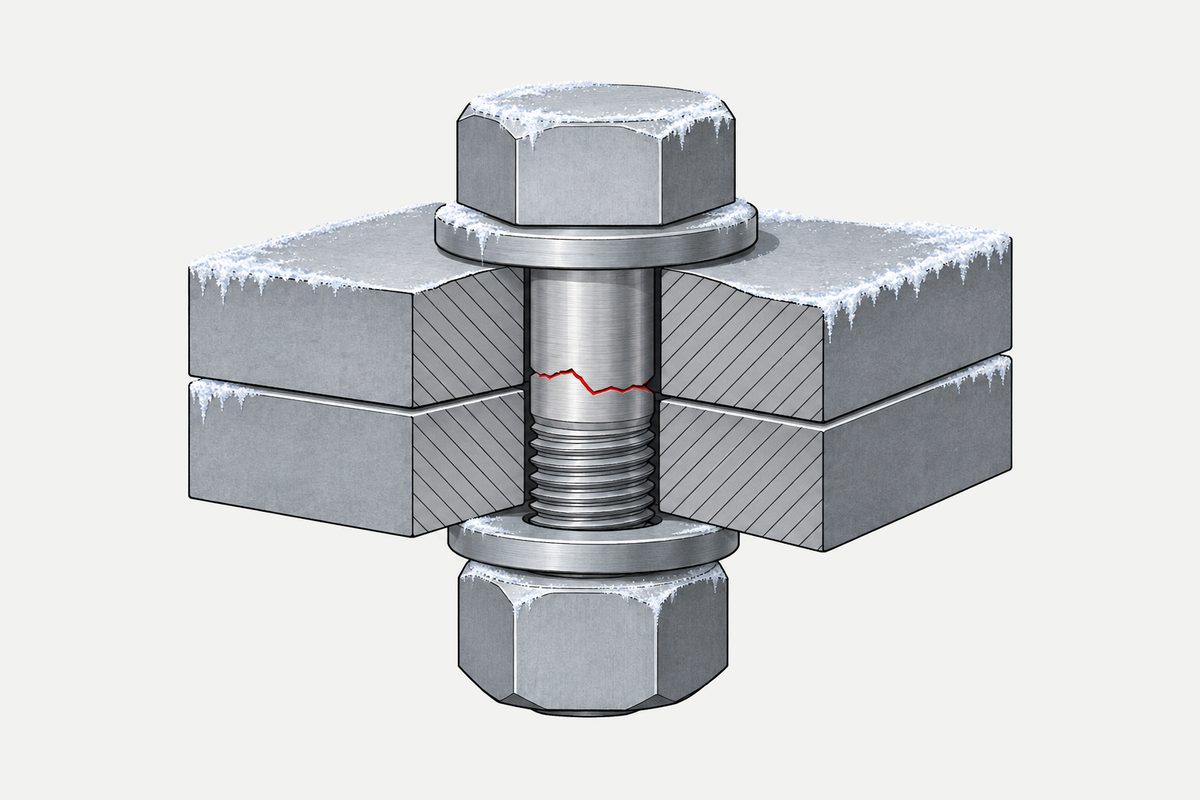
Where the properties were measured
ISO 898-1 determines its mechanical properties at 10 to 35 °C, and the standard states plainly that a compliant fastener may not retain those properties at higher or lower temperatures. So “it is a genuine 10.9” is a statement about a room-temperature test.
The common overcorrection is to say the standard ignores low temperature entirely. It does not. Table 3 carries a Charpy V-notch requirement of 27 J minimum at −20 °C for classes 5.6, 8.8, 9.8 and 10.9. The accurate claim is narrower and more useful: a property class does not prove the batch was tested cold.
Three conditions on that clause
The impact requirement is real but heavily gated, and the gates are what make it almost invisible in ordinary purchasing:
- It is conditional. The test is performed only when the relevant product standard calls for it, or when manufacturer and purchaser agree to it.
- It has a size floor. Specimens are machined from the finished product, and the fastener must be d ≥ 16 mm with a total length of at least 55 mm. Below M16 there is often not enough material to make a standard specimen at all — so for most small screws the clause cannot be invoked even if you want it.
- 12.9 has no value. In Table 3 the figure for 12.9 is marked under investigation. The highest common class is the one the standard declines to put a number against.
Why steel gets brittle, stated carefully
Ferritic steels show a ductile-to-brittle transition: as temperature falls, dislocation motion becomes harder, and cleavage can win at lower stress. Face-centred cubic austenitic stainless typically shows no comparable sharp transition.
Two corrections to the usual shorthand. First, a hardened bolt is not simply “BCC steel”: 8.8, 10.9 and 12.9 are normally tempered martensite, which is strictly body-centred tetragonal, while pearlite and bainite are multi-phase. Second, the transition temperature is not a material constant. It depends on how you define it — an energy threshold, 50% shear fracture appearance, lateral expansion all give different numbers — and it moves with composition, grain and packet size, notch sharpness, specimen thickness, loading rate, orientation and prior cold work.
One mechanism is worth knowing because it breaks the usual trade-off: grain refinement raises strength and lowers the transition temperature at the same time. Strength bought through carbon content or dislocation density generally costs toughness; strength bought through fine grains does not.
Is 12.9 worse in the cold than 8.8?
Usually the trend runs that way, and it is visible in the standard's own elongation figures — roughly 12% for 8.8, 9% for 10.9, 8% for 12.9. Less plastic reserve means less tolerance for a crack, a notch, a hydrogen problem or a heat-treatment anomaly, which is the same trade-off behind what the class numbers actually buy.
But it is a trend, not a ranking rule. You cannot order fasteners by property class and get them ordered by transition temperature. Composition, steel cleanliness, grain size and tempering condition can reverse it, and an alloy steel designed for low-temperature service can be tougher than a commercial-quality 8.8.
Austenitic stainless is the usual answer, with real exceptions
ISO 3506-1 states that austenitic stainless bolts, screws and studs can be used down to −196 °C. That is material-level guidance, not evidence that a particular batch was qualified cold — a distinction worth keeping, because it is the same distinction as the property class above.
And “austenitic does not go brittle” is too strong. Toughness can still fall through cold work; metastable grades such as 304 and some 316 can form α′-martensite under cold work or deformation; hydrogen environments embrittle austenitic steels too; and in welded joints, oxide inclusions and δ-ferrite can severely reduce fracture toughness at cryogenic temperature. Sigma phase, thermal ageing and sensitisation do the same.
The strength question is separate again — austenitic grades are not a like-for-like substitute for a 10.9, which is why the A2/A4 marking carries a strength figure as well.
The specifications that do address cold
Where low temperature genuinely matters, the answer is a bolting specification rather than a property class:
| Spec | Covers | Impact test temperature |
|---|---|---|
| ASTM A320 L7, L7A/B/C, L43 | alloy-steel low-temperature bolting | about −101 °C |
| ASTM A320 L7M, L70–L73, L1 | hardness-limited and related grades | about −73 °C |
| ASTM A320 B8 / B8M | austenitic (304 / 316 based) | mostly exempt above −200 °C |
| EN 10269 | fastener steels with specified low-temperature properties | per material table |
Two traps in that table. L7M is a hardness-limited grade, not a “colder L7” — it exists largely for sour service, and its test temperature is higher. And B8 alone is not a complete call-out: it needs a class, 1, 1A or strain-hardened 2. Note also that A320 exempts bolting of d ≤ 12.5 mm from impact testing unless a supplementary requirement is specified.
At what temperature should you start worrying?
There is no single threshold that applies to all fasteners, and inventing one would be the most dangerous thing this page could do. Thresholds exist inside specific standards for specific equipment. The clearest example is pressure-equipment flange bolting under EN 1515-4: at a minimum metal temperature of −10 °C or above, 40 J at room temperature; below −10 °C, 40 J with the test temperature at or below the metal temperature; below −160 °C, testing at −196 °C. That is a rule for PED flange bolting, not a general rule for bolts.
For context on the temperatures actually involved in Taiwanese cold chain: chilled food is held at 7 °C or below, frozen at −18 °C or below, and blast freezing equipment can reach −40 °C or below. Those are food temperatures, not the minimum design metal temperature of your fasteners — evaporator-adjacent metal, defrost cycles and external members all sit somewhere else.
The usable question is not “how cold is too cold” but what is the minimum design metal temperature of this joint, and does the specification I am buying to say anything about that temperature? If the answer to the second half is no, the property class will not fill the gap.
This page covers step 1, the substrate. The whole order is substrate, thread, head, drive, finish, documentation, and why doing it out of order is rework rather than a tweak is in specifying a screw.
Common questions
Does ISO 898-1 say anything about low-temperature toughness?
Yes, but conditionally, and this is misreported in both directions. Table 3 sets a Charpy V-notch minimum of 27 J at −20°C for classes 5.6, 8.8, 9.8 and 10.9. However the test is only performed when the product standard requires it or the manufacturer and purchaser agree, the specimen must be machined from a finished fastener of at least 16 mm diameter and 55 mm length, and for class 12.9 the table marks the value as under investigation. So the class does not prove a batch was tested cold, but the standard is not silent either.
Is a 12.9 bolt more likely to fail in the cold than an 8.8?
The trend usually runs that way and shows in the standard elongation figures — about 12% for 8.8, 9% for 10.9 and 8% for 12.9 — so higher classes have less plastic reserve and less tolerance for cracks, notches, hydrogen or heat-treatment anomalies. But it is a trend rather than a ranking rule. Transition temperature depends on composition, steel cleanliness, grain and packet size and tempering condition, so an alloy steel designed for low-temperature service can outperform a commercial-quality 8.8.
Can I just use A2 or A4 stainless for cold applications?
Often yes, and ISO 3506-1 states austenitic stainless fasteners can be used down to −196°C, but two cautions apply. That is material-level guidance rather than evidence a particular batch was qualified at temperature, and austenitic stainless is not immune: cold work reduces toughness, metastable grades such as 304 and some 316 can form alpha-prime martensite under deformation, hydrogen environments embrittle it, and weld oxide inclusions or delta-ferrite can badly reduce cryogenic fracture toughness. Strength is a separate question, since austenitic grades do not substitute like-for-like for a 10.9.
Below what temperature do I need to worry?
There is no single threshold covering all fasteners, and any number offered as universal should be treated as invented. Thresholds exist inside particular standards for particular equipment — EN 1515-4, for pressure-equipment flange bolting, requires 40 J at room temperature down to a minimum metal temperature of −10°C, 40 J with the test at or below the metal temperature underneath that, and testing at −196°C below −160°C. The useful question is what the minimum design metal temperature of the joint is, and whether the specification you are buying to addresses that temperature at all.
References
- ISO 898-1:2013 — properties determined at 10–35 °C; clause 9.14 impact test conditions; Table 3 KV values
- ISO 3506-1:2020 — Annex A.3, low-temperature use of austenitic stainless fasteners
- ASTM A320/A320M — alloy-steel and stainless-steel bolting for low-temperature service
- EN 10269 — steels and nickel alloys for fasteners with specified elevated and/or low temperature properties
ASTM A320 clause detail was verified against the 2022 edition; the current purchasing edition is A320/A320M-26 and a contract should be checked against that text. The EN 1515-4 thresholds apply to pressure-equipment flange bolting only and are not a general rule for fasteners. Taiwanese cold-chain figures are food temperatures from the relevant hygiene and abattoir regulations, not minimum design metal temperatures.
Enquiries
If the joint runs below freezing, tell us the minimum design metal temperature rather than the room temperature, and whether an equipment standard applies. A property class cannot answer the question, and the specification that can is a different document.
Request a quotation
Tell us the part and the quantity. We will come back on feasibility, lead time and price.
Or email us directly sales@tigerfasteners.com