 TIGERFASTENERS
Screw, rivet, weld or adhesive: what a threaded joint is for
The short version: threads are unusually good at two things at once — being taken apart and put back with ordinary tools, and being tightened to a clamp force somebody chose. Neither is a monopoly. Riveting develops a clamping force too, and quick-release pins come apart faster. What is distinctive is having both in one joint, repeatedly, with a spanner. So the first question is not which screw. It is which of those two this joint is actually using, because most of the cost of a threaded joint is incurred whether you use them or not.
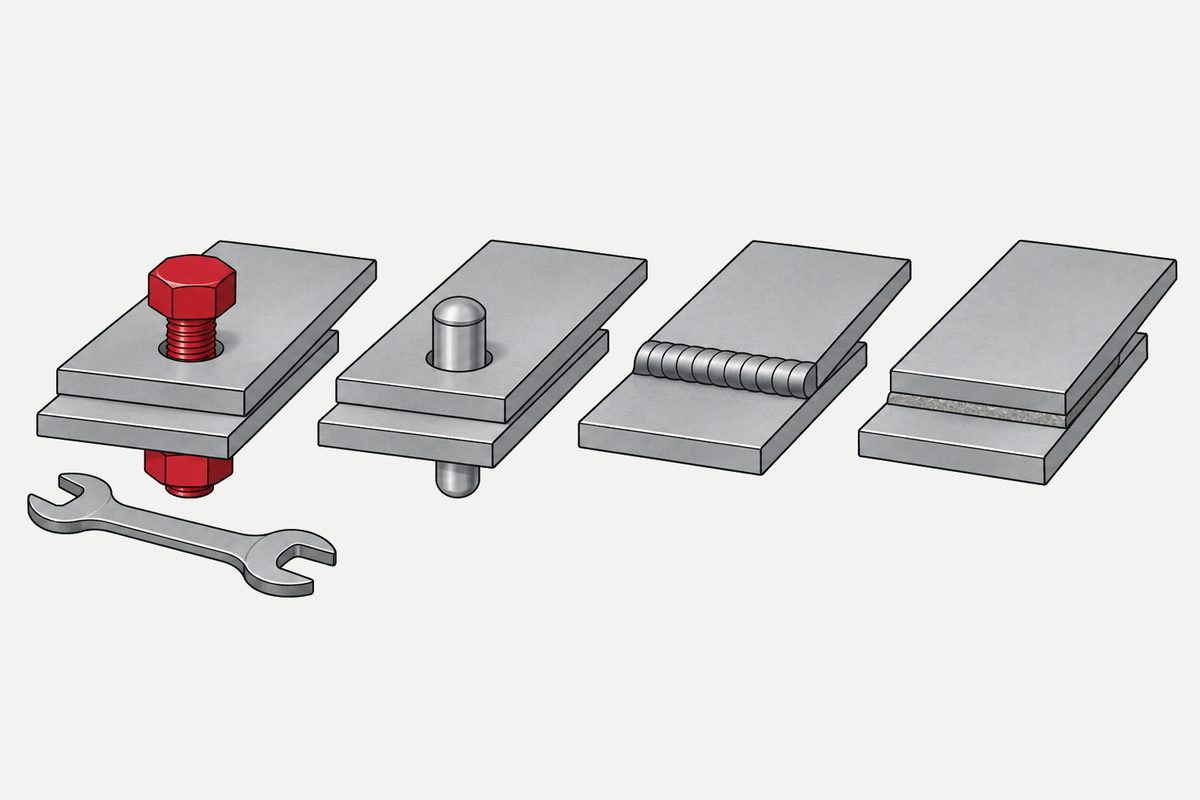
What the threads actually cost
Worth listing plainly, because each item is a whole engineering topic elsewhere on this site and it is easy to meet them one at a time without noticing they share a cause.
- A hole, and an open hole concentrates stress. Kirsch’s 1898 solution gives a factor of three at the edge of a circular hole in an infinite plate under uniaxial tension, measured against the remote stress. Be careful with that number: referred to the net section instead, it falls towards two as the hole grows relative to the width, so quoting “three” without saying which stress it is relative to means very little. What survives is the shape of the problem — an open hole is a place where the stress is higher than the average, and a joint that needed no hole never created one
- Preload is stored energy, and it leaks. Embedding and transverse movement both remove it, and how fast depends on things you may not control, which is why clamped length turns out to be a design variable rather than a leftover
- Assembly becomes a controlled process. A torque figure, sometimes a sequence, sometimes a re-torque — and torque is a poor proxy for the clamp force you actually wanted
- Cost per joint is parts plus insertion plus inspection, repeated for every unit you will ever build
None of that is an argument against screws. It is the invoice for demountability. The mistake is not paying it — the mistake is paying it for a joint that will be opened zero times.
What each alternative buys, and what it charges
| Method | Hole? | What it buys | What it charges |
|---|---|---|---|
| Threaded | Yes | Reversible, field-serviceable, adjustable | Preload maintenance, controlled tightening, cost per joint |
| Rivet | Yes, but filled | Clamping from the setting force, with no thread to unwind; fast to install | Removal is destructive; clamp force is whatever the squeeze produced, not a number you set. Shear and tensile loads are rated, and by strength class |
| Weld | No | No fastener hole, and the parent material carries the load directly | Its own stress raisers at the toe and root, heat-affected zone, distortion, material and access limits |
| Adhesive | No | Load spread over an area instead of into a hole; joins unlike materials | Weak in peel and cleavage, surface prep, cure, temperature, moisture and creep limits, hard to inspect |
| Snap-fit | No | No separate component to buy, handle or insert | Cycle life has to be designed for; polymer creep and relaxation; the geometry is a tooling decision |
The rivet row is where a tidy comparison usually goes wrong. A rivet needs a hole too, but it fills it, and setting the rivet develops both a clamping force and residual stress around the hole — so it is not a free hole and it is not a joint without preload. What it lacks is a thread that can unwind, and a number you can put on a drawing.
The question that decides it
Strength narrows the list before anything else does — an adhesive loaded in peel, a weld on a material that does not weld, a snap-fit at a temperature where the polymer relaxes are all ruled out on capability, not preference. But once more than one method survives that screen, strength usually stops deciding, and the question becomes:
- How many times will this joint be opened, across the product’s life?
- Is the clamp force doing a job? Sealing a gasket, carrying a sideways load by friction, keeping an electrical contact, holding a joint together against a fluctuating load. It does not have to be written on the drawing to be working — but if nobody can say what it is doing, that is worth knowing before arguing about torque values
- By whom, and with what tools? A joint opened once in a factory with a press is a different problem from one opened by a technician on a ladder
- What happens at end of life? If the answer is a recycler separating materials, that is a real opening, and it may be the only one
Zero openings is common and rarely stated. Housings that are assembled once and never serviced, brackets welded in a jig, covers bonded rather than screwed. When a design review asks “which screw” and nobody has asked “how often does it open”, the first question has already been answered by default.
And then the two reasons you chose it start working against each other
A screw is chosen for demountability, and then the joint loosens, and the response is threadlocker. That is worth pausing on, because a permanent-grade adhesive on a screw gives back part of the property that was paid for.
Sometimes that is exactly right — a removable grade holds against vibration and still comes apart with hand tools. A permanent grade is not the end of the world either; manufacturers specify localised heat and hand tools to remove them. But it is worth noticing what has happened: the joint is being made harder to open, which was the thing the threads were bought for, and threadlocker only addresses one of the two ways a screw comes loose in any case. If the answer keeps drifting toward permanence, the question worth revisiting is whether it needed to open at all.
Where the screw genuinely wins
- Service access — anything a technician opens, anything under warranty repair
- Adjustment — alignment that has to be set after assembly, or reset later
- Mixed materials that cannot be welded, where an adhesive would need a cure the line does not have time for
- Regulated disassembly — batteries and other components that must be separable at end of life
- Low volume, where tooling for snap-fits or fixturing for welds does not amortise
In every one of those the threads are buying something specific. That is the test: name what the demountability is for before working through the specification, because the rest of that decision order assumes this one was answered.
This page covers step 1, the substrate. The whole order is substrate, thread, head, drive, finish, documentation, and why doing it out of order is rework rather than a tweak is in specifying a screw.
Common questions
When should you not use a screw?
When neither of the things threads are good at is being used. Threads let a joint be taken apart and put back with ordinary tools, and let the clamp force be set to a figure somebody chose. Most of the cost is incurred either way: a hole, a preload that has to be established and then maintained against embedding and movement, and a tightening process that has to be controlled. If the joint is assembled once and never serviced, and nobody can say what its clamp force is doing, the threads are being paid for and not used.
Does a rivet avoid the stress concentration a screw creates?
Not the same one. A rivet needs a hole, but it fills it, and setting the rivet develops a clamping force and residual stress around the hole — so the free-hole result does not transfer directly. Kirsch's 1898 solution gives a factor of three at the edge of an open circular hole in an infinite plate under uniaxial tension, relative to the remote stress; against the net section it falls towards two as the hole grows relative to the width. A riveted joint does carry clamp force. What it does not have is a thread that can unwind, or a preload figure you can specify and verify.
Why does welding or bonding avoid the hole problem?
They avoid the fastener hole, which is not the same as avoiding stress concentration. A weld has its own, at the toe and the root, and fatigue cracks in welded joints almost always start there — plus a heat-affected zone, distortion, and limits on which materials and geometries can be joined. An adhesive spreads load over an area rather than into a hole edge, and charges for it in surface preparation, cure time, temperature, moisture and creep limits, weakness in peel and cleavage, and a bond that is difficult to inspect once made.
Is using threadlocker a sign the joint should not have been screwed?
Sometimes, and it is a question rather than a verdict. A removable grade holding a joint against vibration is a reasonable design, and even permanent grades can be removed — manufacturers specify localised heat with hand tools. But adding one makes the joint harder to open, which is one of the two things the threads were bought for, so if the specification keeps drifting toward permanence it is worth asking whether it needed to open at all.
What decides between the methods?
Strength narrows the list first — an adhesive loaded in peel, a weld on an unweldable material, a snap-fit at a temperature where the polymer relaxes are ruled out on capability. Once more than one method survives that, it comes down to how many times the joint is opened over the product life, by whom and with what tools, and whether the clamp force is doing a job such as sealing or carrying load by friction. A joint opened once in a factory with a press is a different problem from one opened by a technician on a ladder, and end-of-life separation for recycling counts as an opening even if it is the only one.
References
Enquiries
Not sure the joint needs to be threaded at all? Tell us how often it opens, who opens it, what the two parts are made of, and whether the clamp force is doing a job. We sell screws, so treat the advice accordingly — but a joint that is never opened and has no preload to hold is one we would rather you did not buy screws for, because those are the ones that come back as loosening complaints.
Request a quotation
Tell us the part and the quantity. We will come back on feasibility, lead time and price.
Or email us directly sales@tigerfasteners.com