 TIGERFASTENERS
The joint came loose and the length was correct
A joint has come loose, and the length on the drawing is exactly what the drawing says it should be. That happens often enough to be worth a page. The usual next move — specify a slightly longer screw, to be safe — is the one that can make it worse, and understanding why is the whole of this article. A tightened screw is a stretched spring, and only part of its length is the spring.
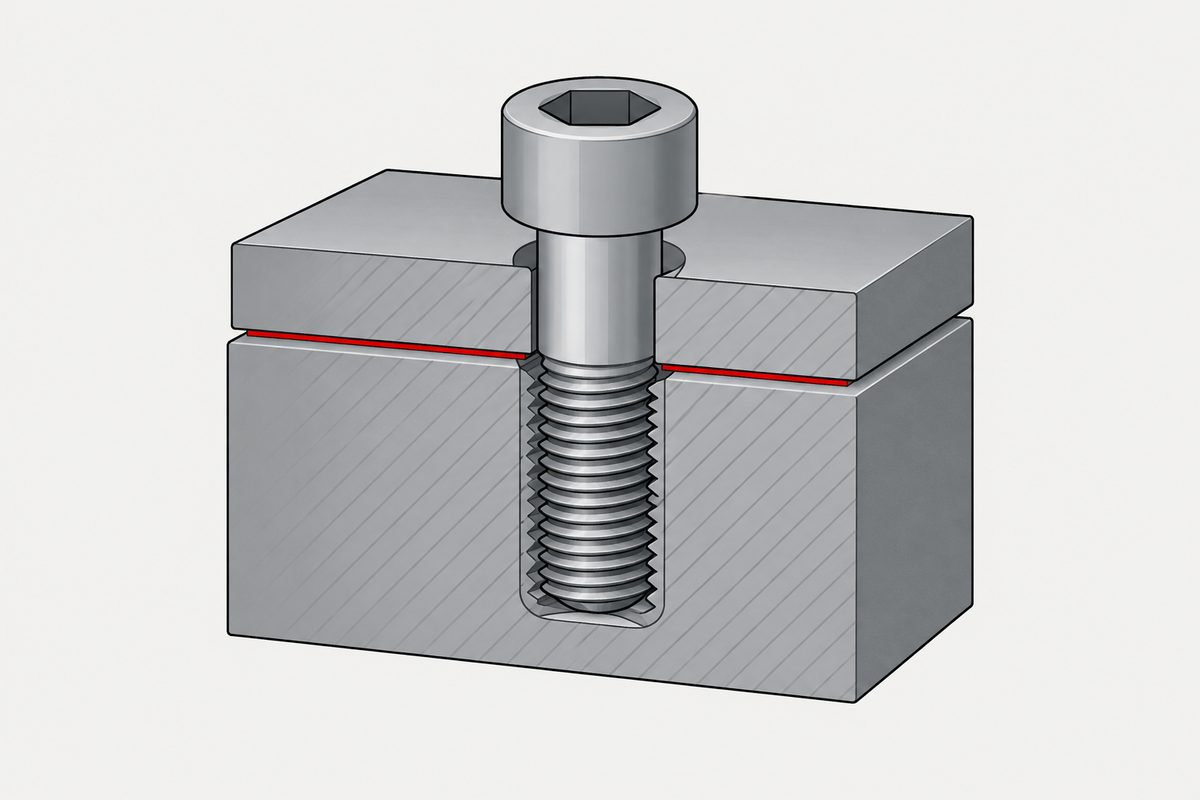
What the length is actually doing
A joint is held by the clamp force the screw is stretched to produce. That stretch is elastic — the screw is a spring that has been pulled and is trying to return — and the part of the screw doing the stretching is the grip, the length clamped between the head and the first engaged thread.
It is not the whole spring, though, and it is worth being exact about that because the approximation gets used as if it were the model. VDI 2230 builds the bolt’s elastic resilience as a series of five parts: the head, the shank, the free loaded thread, the engaged thread, and the nut or tapped-hole region. The clamped length is the largest of them and the one a designer sets directly, which is why it dominates the answer — not because the rest is zero.
So the same screw really is a different component in two joints, but not for the reason people usually give. Two plates and a nut give a clamped length equal to the stack. A blind tapped hole (VDI calls it ESV) clamps only from the head side, and the engaged thread in the component still contributes to the spring through a substitute length. What changes between the two is how the resilience is distributed, not whether the buried part of the screw counts.
Why the short screw loses more of what you gave it
Under the head and in the threads, surface roughness flattens under load. That is embedding, and it is worth understanding because of one property: it is an absolute distance, not a percentage. A few microns of asperity flattening is a few microns whether the screw is M2 or M12.
The stretch that stores the clamp force is not absolute. It scales with the grip. So the same few microns removes a much larger fraction of the preload from a short screw than from a long one — which is the same reason small screws lose a larger share of their preload, seen from the other end.
- Adding grip is usually cheaper than adding diameter. A spacer or a longer boss lengthens the spring without changing the thread, the tooling or the hole
- It is also the fatigue answer. A longer, less stiff screw takes a smaller share of a fluctuating external load, because the load divides between screw and joint according to their relative stiffness
- None of this applies to length that is not grip. A longer screw with the extra length past the nut has the same spring it always had
So specify it longer — and this is where it goes wrong
In a blind tapped hole, a screw that is too long bottoms out: the end reaches the bottom of the hole before the head reaches the surface. The driver still meets resistance, the torque still rises, the wrench still clicks.
And the clamp force is not what the torque says. The torque is being spent driving the screw against the bottom of the hole rather than stretching it against the joint. In the limiting case, where the head never reaches the surface, there is no clamp force at all; short of that the head lands with whatever is left, which is unpredictable and usually far too little. Either way the tool reads a number that describes something other than the joint. This is the specific reason “grab a longer one to be safe” is dangerous rather than merely wasteful, and it is worth checking first when a blind-hole joint comes loose for no reason.
The same arithmetic bites at the other end of the hole. A tapped hole has a bottom, a run-out where the tap stopped, and a usable threaded depth that is shorter than the drilled depth — and engagement is counted in working threads, not in millimetres of hole.
Two places the length is not where you think it is
- The datum moves with the head. For a countersunk screw the stated length is overall, head included; for most other heads it is measured under the head. So “M3 × 10” is a different amount of usable screw depending on the head, which is one of the things a designation quietly assumes you know
- Thread run-out is not thread. Where the thread meets the shank there are incomplete turns that will not carry load. If the run-out sits inside the nut or the tapped hole, the engagement is shorter than the drawing suggests, and it is short at the most highly stressed end
This is where the protrusion conventions come from, and they are conventions rather than one rule: different codes ask for flush, for one pitch, or for two, and the familiar “two full threads” is a workshop habit rather than an ISO requirement. What they have in common is the reason. A screw finishing flush with the nut face tells you nothing on its own, because the turns nearest the end are the incomplete ones — so the check is asking for enough visible thread that the incomplete portion is demonstrably past the nut. Which convention applies is a question for the governing specification, not for the rule of thumb.
So the question is not how long
- How much of this length is grip? If the answer is most of it, the joint behaves well. If most of it is inside a tapped hole or hanging past a nut, the length is not buying what it looks like it is buying
- Is the hole blind, and what is the usable thread depth? Not the drilled depth — the depth before the tap ran out
- Which datum does the callout use? Countersunk heads are measured overall and the rest under the head
- What sets the ceiling on the preload you are trying to keep? Length decides how much of it survives; the property class decides how much you were allowed to put in. They are two halves of one question
- Is this joint expected to see a fluctuating load? If so, grip length is a fatigue variable and not just an assembly one, and it belongs earlier in the decision order than it usually gets
An aside: the shear question, which is usually the wrong question
There are two legitimate designs here and they are not interchangeable. A slip-critical joint carries a sideways load by friction between the clamped faces, generated by the clamp force, and is designed on the basis that it must not slip. A bearing-type joint carries it through shear in the fastener and bearing on the hole wall, and AISC is explicit that the same high-strength bolt serves both — snug-tight bolts are acceptable for most bearing-type connections.
The question is therefore not “is the screw acting as a pin” but which of the two this joint was designed as. A slip-critical joint that has slipped has lost the thing it was designed around, and movement across the interface is the mechanism that undoes preload. A bearing-type joint has not failed by bearing on its bolts; that is its job.
Where the fastener does carry shear, putting the unthreaded shank in the shear plane gives more section and no thread root to concentrate stress — AISC 360 gives a higher nominal shear stress for threads excluded from the shear plane than for threads included, roughly a 0.83 ratio the other way. Both are permitted; designing to the threads-included value is a legitimate choice, not an oversight. It does mean the shank length is a deliberate dimension rather than whatever is left over.
What that dimension actually comes to is not a free choice either: the product standard subtracts the thread length and then five pitches on top, which is why a short partially threaded bolt has less shank than the subtraction people usually do.
This page covers step 2, the thread. The whole order is substrate, thread, head, drive, finish, documentation, and why doing it out of order is rework rather than a tweak is in specifying a screw.
Common questions
Is a longer screw stronger?
Only if the extra length is clamped length. VDI 2230 builds the bolt spring from five parts in series — head, shank, free thread, engaged thread, and the nut or tapped-hole region — and the clamped length is the largest of them and the one a designer sets directly. A longer clamped length stores the same clamp force in more stretch, which makes the joint less sensitive to embedding and gives the screw a smaller share of any fluctuating external load. Thread hanging past the nut adds nothing; thread engaged inside a tapped hole does contribute, through a substitute length.
What happens if a screw is too long for a blind hole?
It bottoms out. The end of the screw reaches the bottom of the hole before the head reaches the surface, so the torque goes into driving the screw against the hole bottom rather than stretching it against the joint. In the limiting case, where the head never touches, there is no clamp force at all; short of that the preload is whatever is left over, which is unpredictable and usually far too little. Either way the tool reads a number describing something other than the joint, which is why it is worth checking first when a blind-hole joint loosens without an obvious cause.
Why do small screws lose more preload than large ones?
Because embedding is an absolute distance and elastic stretch is not. A few microns of surface roughness flattening under the head and in the threads is a few microns regardless of size, while the stretch storing the clamp force scales with the grip length. The same loss therefore removes a much larger fraction of a short screw preload. It is a geometric consequence rather than a quality problem, and lengthening the grip is the direct fix.
How many threads should stick out past the nut?
There is no single rule. Different specifications ask for flush, for one pitch, or for two, and the familiar "two full threads" is a workshop habit rather than an ISO requirement. What they share is the reason: the turns nearest the end of a screw are the incomplete ones, so a screw finishing flush with the nut face does not on its own show that the nut is fully engaged. Which convention applies is a question for the governing specification.
Should the unthreaded shank be in the shear plane?
It gives more shear capacity: the shank has more section than the thread and no thread root to concentrate stress, and AISC 360 assigns a higher nominal shear stress to threads excluded from the shear plane. But both are permitted, and designing to the lower threads-included value is a legitimate choice. The prior question is which kind of joint this is — a slip-critical joint carries the load by friction between the clamped faces and is designed not to slip, while a bearing-type joint is designed to carry shear through the fastener, and the same high-strength bolt serves both.
References
Enquiries
Joint coming loose in a blind hole for no apparent reason? Send the hole depth, the usable thread depth, and the screw length and head type. Bottoming out and preload loss look identical from the outside and are fixed by opposite changes — so it is worth establishing which before ordering anything different.
Request a quotation
Tell us the part and the quantity. We will come back on feasibility, lead time and price.
Or email us directly sales@tigerfasteners.com