 TIGERFASTENERS
Five Pitches of That Bolt Are Neither Thread Nor Shank
Somebody on r/AskEngineers asked a careful question: the usual guidance is one to two diameters of thread engagement, but does that still apply to a bolt loaded in pure shear, where the bolt is acting as a pin rather than clamping anything? The best answer, from a senior engineer, said no engagement is needed for pure shear and then asked why a bolt at all, when a pin would do. Others suggested shoulder bolts and dowel pins. All of that is sound. Forty-one comments went by without anybody asking how much plain shank the bolt actually has, and that number is not chosen by the designer. The product standard subtracts it, twice.
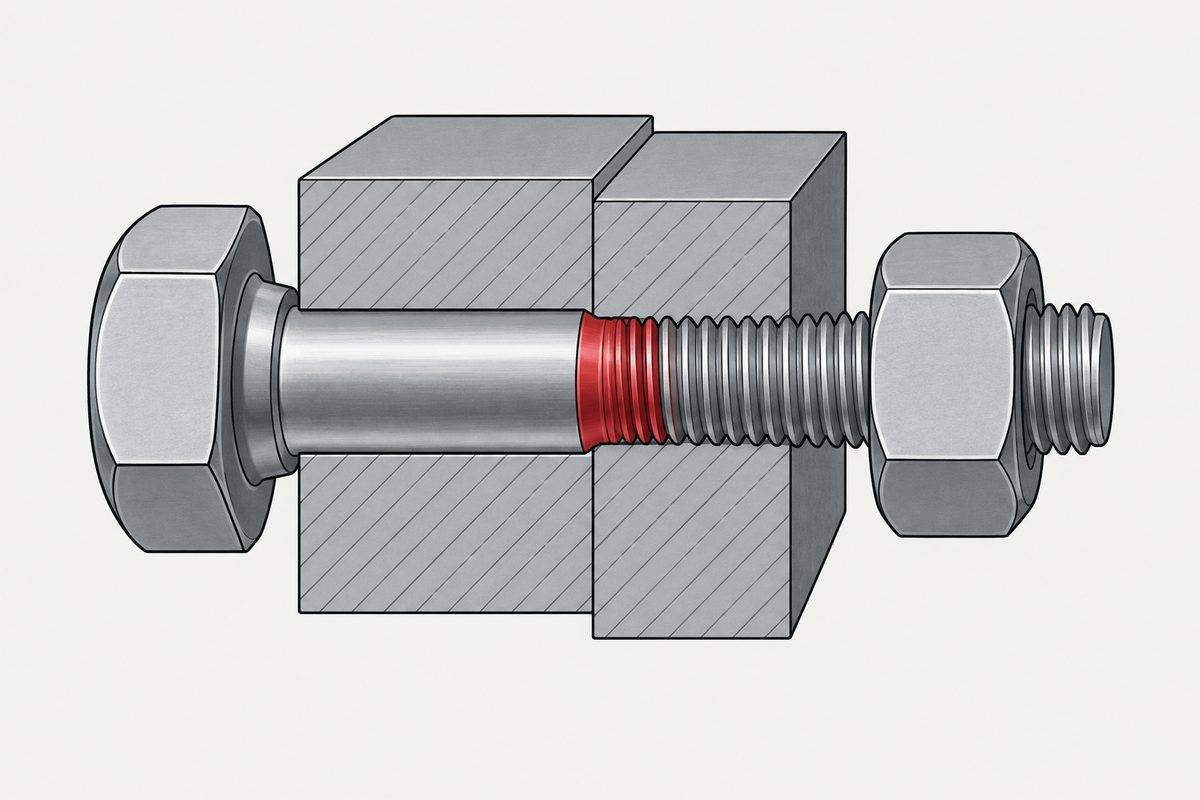
ISO 4014 prints two relations in one line: lg,max = lnom − b and ls,min = lg,max − 5P. The first subtraction is the thread length. The second one is five pitches, and it is the one nobody expects. The guaranteed full-diameter shank is not the bolt minus the thread. It is the bolt minus the thread minus five turns.
The document is ISO 4014:2022, Fasteners, Hexagon head bolts, product grades A and B, the fifth edition, covering steel and stainless in metric coarse pitch from M1,6 to M64. It is the partially threaded hexagon bolt; the fully threaded one has its own standard, and the reason that matters shows up further down this page.
The first subtraction, which is a table not a choice
Thread length b is fixed by diameter, not by the designer, and for nominal lengths up to 125 mm the standard tabulates it like this:
| d | b | d | b | d | b |
|---|---|---|---|---|---|
| M3 | 12 | M8 | 22 | M16 | 38 |
| M4 | 14 | M10 | 26 | M20 | 46 |
| M5 | 16 | M12 | 30 | M24 | 54 |
| M6 | 18 | M14 | 34 |
Two further bands exist: a longer thread for nominal lengths between 125 and 200 mm, and a longer one again above 200. So within the whole range most people work in, b does not move with length at all. Every extra millimetre of bolt below 125 mm is an extra millimetre of grip, which is the only lever the drawing has. (Our own check on the readable sizes: those figures are 2d + 6 exactly from M2 to M24, and the second band is 2d + 12.)
The second subtraction, which is the one that surprises people
Take an M12 at 50 mm nominal. Thread length is 30, so the maximum grip is 20. Most people stop there and treat 20 mm as available shank. The standard does not. The minimum shank is the grip minus five pitches, and M12 coarse is 1,75, so five pitches is 8,75 and the shank is 11,25 mm.
That figure is not our arithmetic. It is printed in the table, and our arithmetic merely reproduces it, which is how we checked we had read the relation correctly:
| Bolt | b | lg max | 5P | ls min, tabulated |
|---|---|---|---|---|
| M8 × 40 | 22 | 18,0 | 6,25 | 11,75 |
| M8 × 50 | 22 | 28,0 | 6,25 | 21,75 |
| M10 × 45 | 26 | 19,0 | 7,5 | 11,5 |
| M10 × 50 | 26 | 24,0 | 7,5 | 16,5 |
| M12 × 50 | 30 | 20,0 | 8,75 | 11,25 |
| M12 × 60 | 30 | 30,0 | 8,75 | 21,25 |
Read the last column against the third. On an M12 at 50, nearly half the grip is not guaranteed to be full diameter. On an M10 at 45 it is closer to two fifths. The gap does not shrink as the bolt gets longer in absolute terms, because five pitches is a constant for the diameter, but it becomes a smaller fraction, which is exactly why a longer bolt buys usable shank and a shorter one does not.
One thing to be careful about, because it is easy to over-read. The standard gives the relation and the numbers; it does not say that the incomplete thread at the end of the bolt physically measures five pitches. What it says is that the shank you are entitled to count on is five pitches short of the grip. Treat that as a guarantee rather than as a description of the geometry.
There is a second number that makes the distinction worth keeping. A different standard bounds the incomplete thread at the end of a bolt at two pitches, not five, which is a separate statement in a separate document and cannot be derived from this one.
And below a certain length the part stops existing
The most useful thing in that table is a sentence rather than a number. Down in the short-length corner, where the columns for the larger diameters would be, the standard prints fully threaded screws specified in ISO 4017. There is no partially threaded M12 at 40 mm in this document. The columns begin where they begin: M8 at 40, M10 at 45, M12 at 50 in the block we read.
So the question of what happens when you ask for a short partially threaded bolt has an answer, and it is not that you get a bolt with a sliver of shank. It is that the standard hands you a different part, from a different standard, with no shank at all. Whether the buyer notices depends entirely on whether the drawing said which one it wanted.
Which is the number missing from the shear argument
This site has already been through the design side of the thread in the shear plane: the two joint types are not interchangeable, and where the fastener does carry shear, putting the unthreaded shank across the plane gives more section and no thread root, which is why the design codes give the two cases different allowables. That page ends by saying the shank length is a deliberate dimension rather than whatever is left over. This is the dimension it was talking about, and now it has a value.
Put the two together and the design step becomes concrete. Decide the grip from the parts. Add the thread length for that diameter. Then, if the shank has to reach across a shear plane, add five pitches on top, because that is what the standard has already subtracted. Skipping the third step is how a joint ends up with the run-out sitting exactly where the section was supposed to be.
None of that argues with the thread. If the load really is pure shear, the reply that said to use a pin is the better engineering, and the site has written about which pin standards publish a shear figure and which do not and about the hole those pins need. The point here is narrower: if the answer is going to be a bolt, the amount of bolt that is actually a pin is a number you can look up, and almost nobody does.
Four things to settle before the length goes on the drawing
- Is the thread or the shank meant to be in the shear plane? That is a design decision with different allowables, not a detail
- Have you added the five pitches? Grip plus thread length is not enough if the shank has to do work
- Is the length inside the band? Thread length steps at 125 and 200 mm nominal, and a length that crosses a step gets a longer thread than the one below it
- Did the drawing say partially threaded? Below the shortest listed length the standard points at the fully threaded part, which has no shank to argue about
Bracketed entries are a habit across this family of tables. The general plan for metric threads marks some pitches the same way, and the same clause is where you find that coarse and fine carry no concept of quality.
This page covers step 2, the thread. The whole order is substrate, thread, head, drive, finish, documentation, and why doing it out of order is rework rather than a tweak is in specifying a screw.
Common questions
How much plain shank does a partially threaded bolt actually have?
Less than the bolt length minus the thread length. ISO 4014 states two relations: the maximum grip length is the nominal length minus the thread length, and the minimum shank length is that grip minus five pitches. An M12 at 50 mm has a thread length of 30, so the grip is 20 mm and the tabulated minimum shank is 11,25 mm. The same table gives 11,75 mm for an M8 at 40 and 11,5 mm for an M10 at 45.
Why five pitches?
That is what the standard subtracts, and it prints the relation rather than an explanation. The transition at the end of a rolled thread is not a clean step, so the diameter is not guaranteed to be full over the last part of the grip. Read the five pitches as the guarantee you are given rather than as a measurement of the incomplete thread, because the standard states the arithmetic and not the geometry.
Can I choose the thread length on a bolt?
Not from this standard. Thread length b is set by the diameter, and for nominal lengths up to 125 mm it does not change with length at all: 22 mm on an M8, 26 on an M10, 30 on an M12, 38 on an M16. There are two longer bands, above 125 mm and above 200 mm. So within the range most work sits in, the only way to get more shank is a longer bolt, and every millimetre of extra length is a millimetre of extra grip.
What happens if I order a short partially threaded bolt?
The standard stops offering one. In the short-length corner of the dimension table it prints that fully threaded screws are specified in ISO 4017, a separate standard. In the block we read, the columns start at 40 mm for M8, 45 for M10 and 50 for M12. Below that you are being handed a different part with no shank at all, which matters if the drawing was relying on shank in a shear plane and did not say so.
Does this change anything for a bolt in pure shear?
It changes what you have to specify rather than what the bolt does. Whether the thread or the shank crosses the shear plane is a design decision the codes treat differently, and this page supplies the missing number: how far the shank actually reaches. If the shank has to span the plane, the length has to cover the grip, the thread length, and the five pitches on top. If the load really is pure shear, a pin may be the better part, which is a separate question with its own standards.
Is the thread length formula 2d plus 6?
The tabulated values match that exactly for every readable size from M2 to M24, and the second band matches 2d plus 12. That is our arithmetic on the published table rather than a formula the standard prints in this document, and the smallest size, M1,6, is tabulated at 9 where the expression gives 9,2. Use the table rather than the expression, since the table is what the product has to meet.
References
- ISO 4014:2022 — Fasteners, hexagon head bolts, product grades A and B. Clause 1, clause 4 and the dimension tables, for the thread lengths, the two length relations and the tabulated minimum shank and maximum grip
- r/AskEngineers — the thread this began in, on thread engagement for a bolt loaded in pure shear
ISO 4014:2022 was read from the publicly available preview. The two relations, the thread lengths and the tabulated minimum shank and maximum grip figures are that document’s, and our arithmetic is shown only to demonstrate that the published table and the published relation agree. Two rows of the length table were misaligned in our copy and are not quoted. We give no dimension from ISO 4017, the fully threaded standard the table points at, and none from ISO 888, which this standard names as the source for nominal lengths and thread lengths. Correction, added later: we have since read the withdrawn first edition of ISO 888 in full and it is covered on its own page. No figure from it is used here, because this page is about ISO 4014. The five pitches are described as what the standard subtracts, not as a measurement of the incomplete thread, because the document states the arithmetic and not the geometry. The design treatment of threads in the shear plane, including the different allowables the codes give the two cases, is on our earlier page and is not restated here. No figure is given for any shoulder bolt or pin, and this page does not recommend a part for the situation in the source thread.
Enquiries
If a bolt has to present plain shank across a shear plane, send the grip you need and say so explicitly, rather than sending a length. The length that delivers it is the grip plus the thread length for that diameter plus five pitches, and the last term is the one that gets left out.
Request a quotation
Tell us the part and the quantity. We will come back on feasibility, lead time and price.
Or email us directly sales@tigerfasteners.com