 TIGERFASTENERS
The End of the Bolt Has a Two-Letter Name, and Two of Them Make It Longer
A novice on r/MechanicAdvice put the crossmember bolts back into an Impreza by hand, to avoid cross threading, and then found one going tighter and then looser under the wrench. The thread did something unusually good: the top reply doubted the 103 lbf·ft figure and suggested a unit mix-up, and the poster went and checked, and came back to say the service manual really does say 140 N·m. A hypothesis raised and then killed with evidence, in public. What none of the hundred and seventy comments touched is the habit in the title. Starting a bolt by hand works because of a feature at the end of it, and that feature has a name, a two-letter code, and a clause saying you are supposed to write it down.
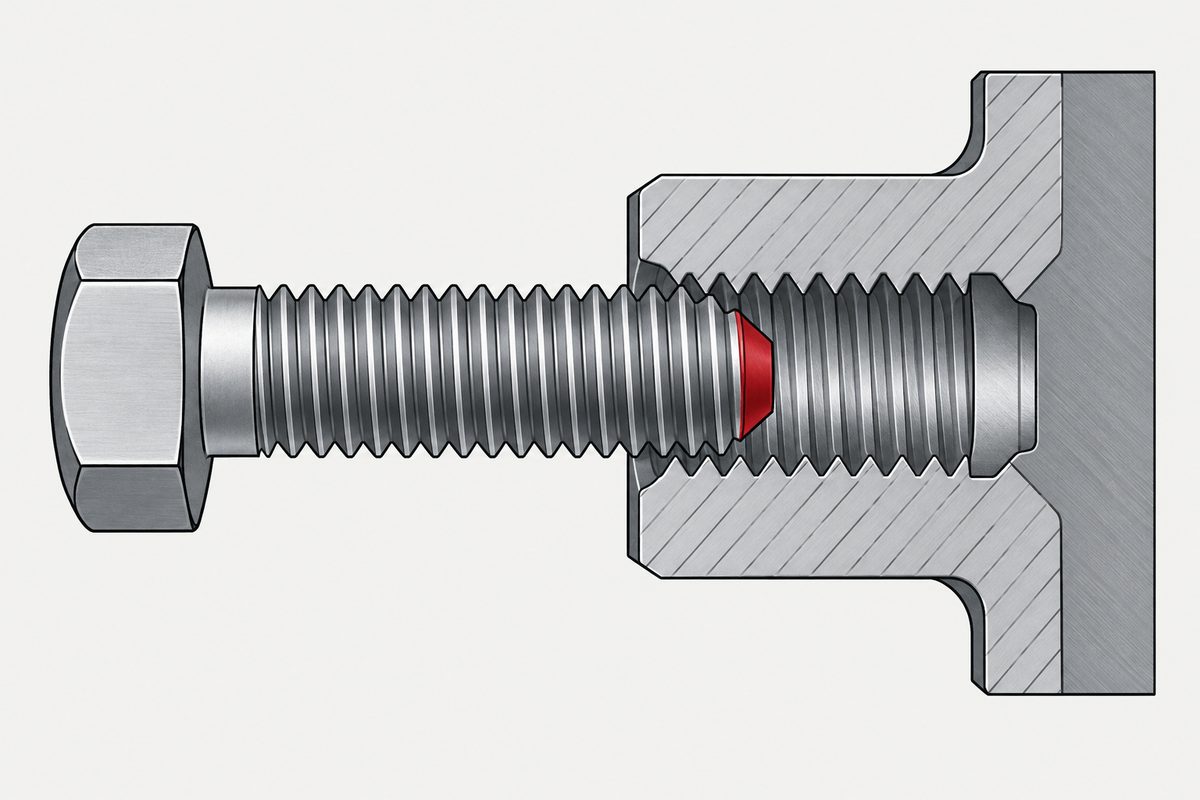
ISO 4753 defines thirteen end types and splits them into two groups: eleven that are included in the nominal length of the fastener, and two that are added to it. Specify one of the second pair on an M8 and the screw is four millimetres longer than the length you ordered. Each type has a symbol, and the standard says plainly that the symbols are intended to be used when specifying an end.
The document is ISO 4753:2011, Fasteners, Ends of parts with external ISO metric thread, a third edition from ISO/TC 2. Its scope is short and wider than people expect: it gives the form and dimensions of the ends recommended for use, and it applies to standardized or non-standardized threaded parts. So it is not a list of what the hex bolt standards happen to do. It is a vocabulary for an end you are choosing.
This page is about that end and nothing else. The thread it came from is about a stripped hole, which is a different subject this site has already covered, and nothing here diagnoses it.
Eleven ends inside the length
| Symbol | End | Symbol | End |
|---|---|---|---|
| RL | As-rolled end | CA | Threaded cone point |
| CH | Chamfered end | TC | Truncated cone point |
| RN | Rounded end | CP | Cup point |
| FL | Flat point | SC | Scrape point |
| SD | Short dog point | CN | Cone point |
| LD | Long dog point |
The first two are the ones on ordinary bolts, and the difference between them is worth knowing. A chamfered end has been given a lead-in; an as-rolled end has not, it is simply where the thread rolling stopped. Which you get is not always your choice, and the hex bolt standard says so: ISO 4014 calls for a chamfered end in accordance with ISO 4753, but adds that for sizes up to and including M4 an as-rolled end is also allowed. Below M4, a bolt with no chamfer at all is a conforming bolt.
The rest of that list is mostly set screw and stud territory, and the site has been through what the points do in the set screw standard that never mentions the shaft. What matters here is that all eleven live inside the nominal length. Whatever shape the end has, the bolt is as long as it says it is.
And two that are added to it
Clause 3.3 has its own heading, and the heading is the whole point: ends which are added to the specified nominal length of the fastener. There are two, both pilot points, and the standard tabulates how much they add:
| Thread | M4 | M6 | M8 | M10 | M12 | M16 | M20 | M24 |
|---|---|---|---|---|---|---|---|---|
| Added length, mm | 2,0 | 3,0 | 4,0 | 5,0 | 6,0 | 8,0 | 10,0 | 12,0 |
| Pilot diameter, max | 2,9 | 4,5 | 6,1 | 7,8 | 9,4 | 13,1 | 16,3 | 19,6 |
An M8 with a pilot point is four millimetres longer than its nominal length. An M24 is twelve. The truncated cone version adds the same amount and carries a second dimension for the cone itself, from 1,00 mm maximum at M4 to 6,00 at M24. And the standard adds a note worth reading before anybody assumes the pilot diameter is a free variable: if a smaller diameter is required in special cases, that is to be agreed separately.
The consequence is a clearance question rather than a strength one. Four extra millimetres of M8 protruding into a cavity, or reaching for the bottom of a blind hole, is exactly the kind of length that is not on the drawing because the drawing named a nominal length and assumed it meant the whole part. What happens when a screw reaches the bottom before the head reaches the surface is a torque reading that describes something other than the joint.
Two pitches, and not five
One of the notes attached to the figures in ISO 4753 bounds the incomplete thread at u ≤ 2P, two pitches. That is worth putting beside a number from a different standard, because they sound like the same thing and are not.
ISO 4014 defines the guaranteed plain shank by subtracting five pitches from the maximum grip, which this site went through yesterday, and was careful to describe as what the standard subtracts rather than as a measurement of the incomplete thread. Here is the reason that care was warranted. One document bounds the incomplete thread at two pitches; the other withholds five from the shank guarantee. They are two different quantities in two different documents, and neither can be derived from the other.
The clause that reads like a person wrote it
Among the notes to the figures, between the tolerance fields and the angles, sits this: the end shall not be sharp to the touch.
There is no dimension attached and no test method. In a document that otherwise spends its length on h14 and IT17 and cone angles of 120 degrees plus or minus two, somebody decided that the way a fastener end feels in a hand is a requirement worth stating, and that no number would state it better. It sits alongside a second note in the same family: for threads up to and including M5, no flat part on the cone is required, and the point may be slightly rounded.
Both are the standard admitting that below a certain size the geometry stops being the thing that matters and handling starts.
What to do with this on a drawing
- If the end matters, write the code. The standard says the symbols exist to be used when specifying an end, and two letters after the designation is the whole cost
- If you specified a pilot point, add its length to your clearance. It is not inside the nominal length, and the table says how much: 4,0 mm at M8, 12,0 at M24
- Below M4, do not assume a chamfer. ISO 4014 permits an as-rolled end at those sizes, so if a lead-in is what makes assembly work, that is something to ask for rather than expect
- Do not read one standard’s pitch count into another’s. Two pitches of incomplete thread and five pitches withheld from the shank are different statements by different documents
None of this would have saved the crossmember bolt in that thread, and this page has not claimed otherwise. What it does is give a name to the thing the poster was relying on when he decided to start those bolts by hand, which is a habit worth keeping and, as it turns out, a specification worth writing down.
This page covers step 2, the thread. The whole order is substrate, thread, head, drive, finish, documentation, and why doing it out of order is rework rather than a tweak is in specifying a screw.
Common questions
Does the end of a bolt have a standard designation?
Yes. ISO 4753 defines thirteen end types, each with a two-letter symbol, and states that the symbols are intended to be used when specifying one of the ends for threaded fasteners. They include the as-rolled end RL, the chamfered end CH, the rounded end RN, flat, cone, cup and scrape points, short and long dog points, and two pilot points. The standard applies to standardized and non-standardized threaded parts alike.
Is a bolt always chamfered at the end?
Not necessarily, and the size is what decides it. ISO 4014 calls for a chamfered end in accordance with ISO 4753, but adds that for sizes up to and including M4 an as-rolled end is also allowed. An as-rolled end is simply where the thread rolling stopped, with no lead-in cut on it. Below M4, a bolt without a chamfer is conforming, so if a lead-in matters for assembly it has to be specified rather than assumed.
Does a pilot point make the screw longer?
Yes, and that is how the standard organises the whole subject. ISO 4753 has two headings: ends included in the nominal length, and ends added to the specified nominal length. The two pilot points are in the second group. The tabulated addition is 2,0 mm at M4, 4,0 at M8, 6,0 at M12, 8,0 at M16 and 12,0 at M24, so a pilot-pointed M8 is four millimetres longer than the length on the order.
What is the incomplete thread at the end of a bolt?
ISO 4753 carries a note bounding it at two pitches, u less than or equal to 2P. Keep that separate from a different number in a different document: ISO 4014 defines the guaranteed plain shank by subtracting five pitches from the maximum grip length. Two pitches of incomplete thread and five pitches withheld from a shank guarantee are two different quantities, and neither follows from the other.
Why does the standard say the end must not be sharp to the touch?
Because at small sizes handling matters more than geometry, and no dimension would say it better. The note sits among the figure notes with no number and no test method attached, in a document that otherwise deals in tolerance fields and cone angles. A companion note runs the same way: for threads up to and including M5, no flat part on the cone is required and the point may be slightly rounded.
Does the end type change how easily a bolt starts by hand?
A chamfer is a lead-in and an as-rolled end is not, which is the difference the standard draws. Beyond that this page makes no comparison, because ISO 4753 does not rank the end types for ease of starting and we hold no measurement that would. What the standard does give you is the vocabulary and the symbols, so that whichever end matters to your assembly can be asked for by name.
References
- ISO 4753:2011 — Fasteners, ends of parts with external ISO metric thread. Clause 1, clause 3.2 and 3.3, the figure notes and Tables 2 and 3
- ISO 4014:2022 — hexagon head bolts, for the sentence permitting an as-rolled end at sizes up to and including M4
- r/MechanicAdvice — the thread this began in, including the reply that questioned the torque figure and the poster checking the manual
ISO 4753:2011 was read from the publicly available preview, and the end types, the two clause headings, the figure notes and the pilot point dimensions are that document’s. No value from its Table 1 is quoted here, because the middle rows of that table were misaligned in our copy. The note bounding the incomplete thread at two pitches is quoted as one of the notes to the figures, without attaching it to a particular end type, since we could not verify which figure its superscript belongs to. Two pitches and five pitches are presented as separate statements by separate documents and neither is derived from the other. The as-rolled end permission at M4 and below is from ISO 4014:2022. Nothing from ISO 4027 is quoted, which ISO 4753 names for the cone angle on short screws but which we have not read. This page does not rank end types for ease of starting or resistance to cross threading, because the standard does not and we hold no measurement that would. It also does not diagnose the stripped hole in the source thread; that subject is on our earlier page.
Enquiries
If the end of the fastener does a job in your assembly, whether that is finding a hole, clearing a cavity or simply being handled, say which end you want by its symbol. And if it is a pilot point, tell us the clearance you have, because that length sits outside the nominal one.
Request a quotation
Tell us the part and the quantity. We will come back on feasibility, lead time and price.
Or email us directly sales@tigerfasteners.com