 TIGERFASTENERS
A Torque Wrench Measures Resistance and Cannot Tell You What Is Providing It
Somebody on r/MechanicAdvice had the locking wheel nuts that came with the car shear off, twice, well below the factory figure. The dealership replaced all four under warranty and, when he checked them at home, found they had not been tightened much at all. The technician told him they never torque those down, because they know they tend to shear, and declined to call it a factory defect. A hundred and thirty comments followed. The top one, at 127 points, explained that wheel locks do not stop thieves anyway. The answer to the actual question was sitting at six points, and the poster later confirmed it with the manufacturer.
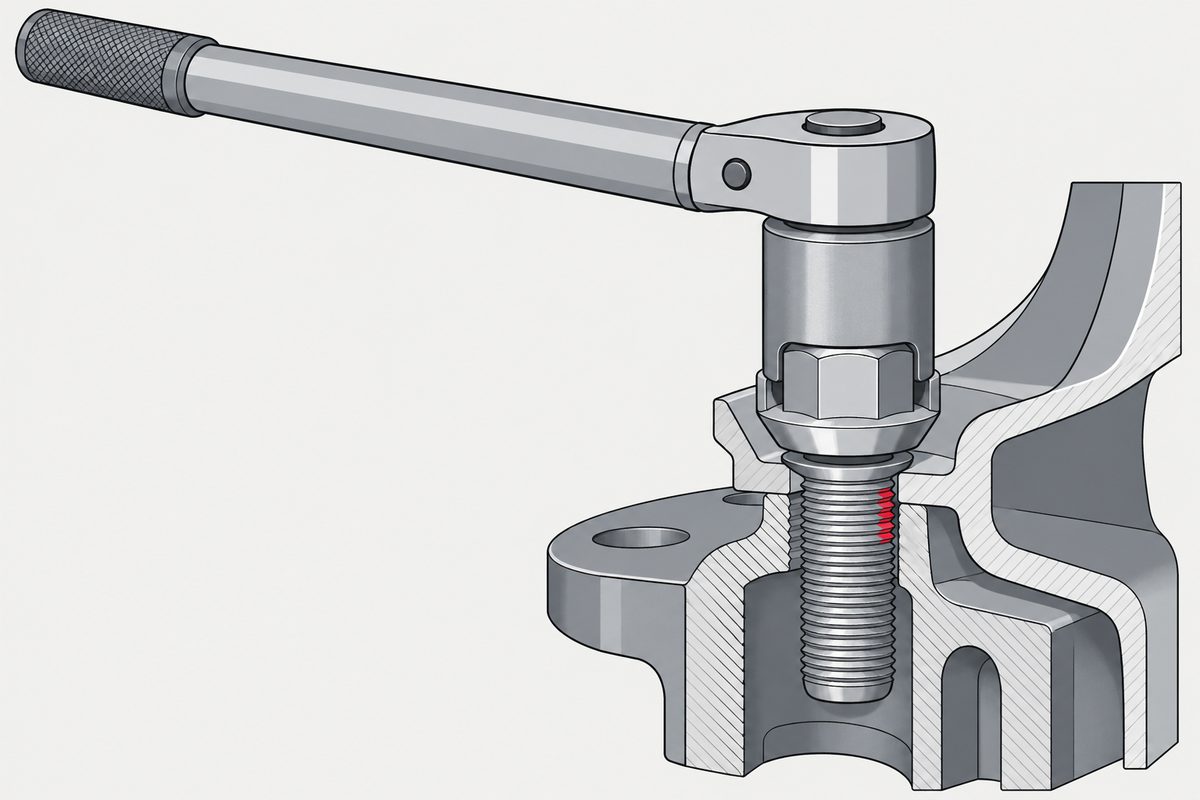
The nut was bottoming out. It had run out of usable thread before its seat was pulled up tight, so the torque was being resisted by the end of the stud pressing against the closed top of the nut rather than by the wheel against the hub. A torque wrench cannot see that difference. The reading climbs the same way and the tool clicks at the same number, while almost none of the clamp force you paid for exists.
The figures in the thread are reported rather than measured, and worth keeping in that box: a factory specification of 89 lbf·ft, roughly 121 N·m, and a failure the poster judged by feel at under 60, roughly 81. The replacement set came back from the dealership at, on his check, under 50, roughly 68. What matters is not the exact numbers but the shape they make, which is a fastener failing in a place the specification never pointed at.
The one thing a torque wrench does not measure
It measures a moment about the axis. That is the whole of it. Whatever is opposing rotation contributes, and the tool has no way to separate the contributions. In an ordinary tightening, the moment comes from three places and the site has been through the split before: friction in the threads, friction under the bearing face, and the small remainder that actually becomes clamp force, which is why a torque specification is silently a friction specification.
Add a fourth source and nothing about the reading announces it. If the stud reaches the closed end of the nut before the seat has closed, the crown of the nut becomes a hard stop. From that instant the torque is being carried by a metal-to-metal contact inside the nut, at a radius near the axis, and it rises steeply because nothing is yielding. Steeply rising resistance is exactly what the end of a correct tightening feels like.
Which is why the shear is not evidence about the nut’s strength. The drive gave up while carrying a moment that was going somewhere useless. Whether the same nut would have reached the specification on a joint that closed properly is a separate question, and the thread never asked it.
Why a closed nut can do this and an open one cannot
An ordinary hexagon nut is open. If the stud is longer than the nut, the stud comes out of the top and nothing stops the nut travelling. The height of the nut therefore sets how much thread engages, not how far it can go.
A domed or capped nut closes that exit. Every millimetre of stud beyond the usable thread depth inside the cap is a millimetre the nut cannot travel, and it does not have to be much: from ISO 4032, a standard hexagon nut is not very tall to begin with.
| Thread | Pitch P | Nut height m, max | Height in pitches |
|---|---|---|---|
| M8 | 1,25 | 6,80 | about 5,4 |
| M10 | 1,5 | 8,40 | about 5,6 |
| M12 | 1,75 | 10,80 | about 6,2 |
Between five and a half and six turns of thread, top to bottom. The last column is our arithmetic on the two tabulated ones. The same table carries a second, smaller height whose definition lives in a figure the public preview does not include, so we are not using it, but its presence is a reminder that the outside height of a nut and the part of it doing work are two different numbers even in the simple case.
And here is the gap that made the poster’s question unanswerable. We could not find an ISO standard for domed or closed-end nuts at all. The dimension that decides whether one bottoms, the usable thread depth inside the cap, is not published in any document we can read. So a buyer holding a wheel lock has the thread size, the seat angle and a torque figure that belongs to a different nut, and no way to check the one number that matters.
The same mechanism this site has praised, with the sign reversed
We have written about deliberate bottoming approvingly. A screw that tightens until it reaches a designed hard stop stops caring about friction, because load control has moved from torque to displacement. That is a good trade and a real design technique.
The difference is not whether the fastener stops. It is what the stop is bearing on.
| Designed hard stop | A nut bottoming on a stud | |
|---|---|---|
| Where the stop is | In the clamp path, by design, at a known distance | Inside the nut, off the clamp path, at whatever distance the stud happens to give |
| What it sets | A displacement, and through the spring rate, a force | Nothing. The clamp force stays wherever it was when the stop arrived |
| What the torque reading means afterwards | Nothing, and that is the point; the load was already set | Nothing, and that is the problem; the load was never set |
Read the bottom row twice. In both cases the torque figure stops carrying information once the stop is reached. In one case a designer arranged for something else to carry it. In the other, nothing does.
What the technician said, read carefully
The workshop’s answer was that they never torque those down. Taken as a practice that is defensible and probably keeps the nuts intact. Taken as an answer it does something worse than being wrong: it converts a cause that could have been measured into a habit that cannot be checked. Nobody downstream can tell whether a given wheel was left correct, loose, or fine by luck, and the next person to touch it inherits all three possibilities at once.
The measurable version of the same suspicion is short. If a nut is suspected of bottoming, run it down on the stud without the wheel and see whether it reaches the seat position with thread to spare, or compare how far it turns freely against the others in the set. That is a length question, and length is the one quantity in a bolted joint that does not depend on friction.
One boundary on this page. It does not say the locks were defective, it does not say wheel locks are weaker than ordinary nuts, and it names no manufacturer. The poster reported that the maker confirmed bottoming as the likely cause, which is a report of a conversation rather than a measurement, and this page treats it as such. What is not in doubt is the mechanism, because that part is arithmetic about where a moment goes.
The general form, worth carrying off this page
- A torque figure is a claim about a joint, not about a nut. Moving it to a different nut on the same stud carries an assumption that nobody wrote down
- Rising resistance is not evidence of rising clamp force. The wrench cannot distinguish a seat pulling up from a stud hitting a crown
- If the fastener stops, ask what it stopped against. A designed stop in the clamp path is a control method; an accidental one outside it is a joint with no load in it
- When a dimension decides the outcome and no document publishes it, the honest position is that the question cannot be settled from the paperwork, which is a different situation from the paperwork disagreeing
This is not one of the six steps. It shows up across them, or after assembly. Where the decisions that lead here were made is in specifying a screw, which sets out the order and why doing it out of order is rework.
Common questions
Why would a locking wheel nut shear below the torque specification?
One documented possibility, and the one the poster in the source thread had confirmed by the maker, is that the nut bottoms out: the stud reaches the closed end of the nut before the seat pulls up, so the torque is resisted by metal inside the nut rather than by the joint. The wrench reads a rising moment either way and clicks at the set value, so the drive can fail while carrying a load that was never reaching the clamp path. That is a fit problem rather than evidence about the nut material.
Can a torque wrench tell whether the clamp force is actually there?
No. It measures a moment about the axis and cannot separate the sources of that moment. In normal tightening most of it is friction in the threads and under the bearing face, and only a small remainder becomes clamp force. If a hard contact appears anywhere in the assembly, that contributes too and feels the same. A rising, then sharply rising, resistance is what a correct tightening feels like and also what bottoming out feels like.
How tall is a standard hexagon nut, in threads?
Between about five and a half and six pitches. Taking ISO 4032 maximum nut heights against the coarse pitch, an M8 nut at 6,80 mm and 1,25 mm pitch is about 5,4 pitches, an M10 at 8,40 and 1,5 is about 5,6, and an M12 at 10,80 and 1,75 is about 6,2. That is the arithmetic on two published columns, and it is a useful sense of how little stud a closed-end nut has to swallow before it runs out of room.
Is a domed or closed-end nut dimensioned by a standard?
We could not find an ISO standard for them. There are ISO standards for hexagon regular nuts, flange nuts and several prevailing torque types, but the closed-end family did not appear in our search, and the German standard covering it is not one we hold. The consequence is practical: the usable thread depth inside the cap, which is the dimension that decides whether the nut bottoms, is not available to a buyer from any document we can read.
My workshop says they never torque wheel locks. Is that reasonable?
As a practice it is understandable and it probably stops them shearing. As an answer it replaces a cause that could be measured with a habit that cannot be checked, because nobody afterwards can tell whether a particular nut was left correct, loose, or right by accident. If bottoming is the suspicion, it can be tested as a length: run the nut down on the stud without the wheel and see whether it reaches the seat position with thread left, or compare its free travel with the other nuts in the set.
Is bottoming out always bad?
No, and the distinction is where the stop sits. A designed hard stop in the clamp path is a control method: it fixes a displacement, and through a spring rate it fixes a force, which removes the friction scatter that makes torque unreliable. A nut bottoming on a stud puts the stop inside the nut and outside the clamp path, so it fixes nothing and leaves the clamp force wherever it happened to be. In both cases the torque reading stops carrying information; in only one of them does something else start carrying it.
References
- ISO 4032:1999 — hexagon nuts, style 1. Table 1, for the pitch and nut height figures used in the arithmetic above
- r/MechanicAdvice — the thread this began in, including the six-point comment that identified the cause and the poster’s follow-up confirming it
The nut heights and pitches come from Table 1 of ISO 4032:1999, read from the public preview; the conversion of those heights into a number of pitches is our own arithmetic on two published columns. The same table carries a second, smaller height whose definition sits in a figure the preview does not include, so it is mentioned but not used. We searched for an ISO standard covering domed or closed-end nuts and did not find one; the German standard that covers them is not a document we hold, and no dimension for the usable thread depth inside a cap appears anywhere on this page. Every figure quoted from the thread is reported rather than measured: the torque specification, the levels at which the poster judged the failures, and the fractions of an inch estimated by a commenter. No manufacturer is named, no claim is made that any product is defective or that wheel locks are weaker than ordinary nuts, and the maker’s confirmation of bottoming is treated as a reported conversation. No wheel nut torque figure for any vehicle is given, and this page offers no advice on vehicle security or on whether to keep such nuts fitted.
Enquiries
If a nut in your assembly is closed at one end, the dimension to agree is the usable thread depth, not the height, and it should be checked against the longest stud or screw the joint can present. That is the number that decides whether a torque figure means anything once the tool clicks.
Request a quotation
Tell us the part and the quantity. We will come back on feasibility, lead time and price.
Or email us directly sales@tigerfasteners.com