 TIGERFASTENERS
A torque figure assumes a friction condition
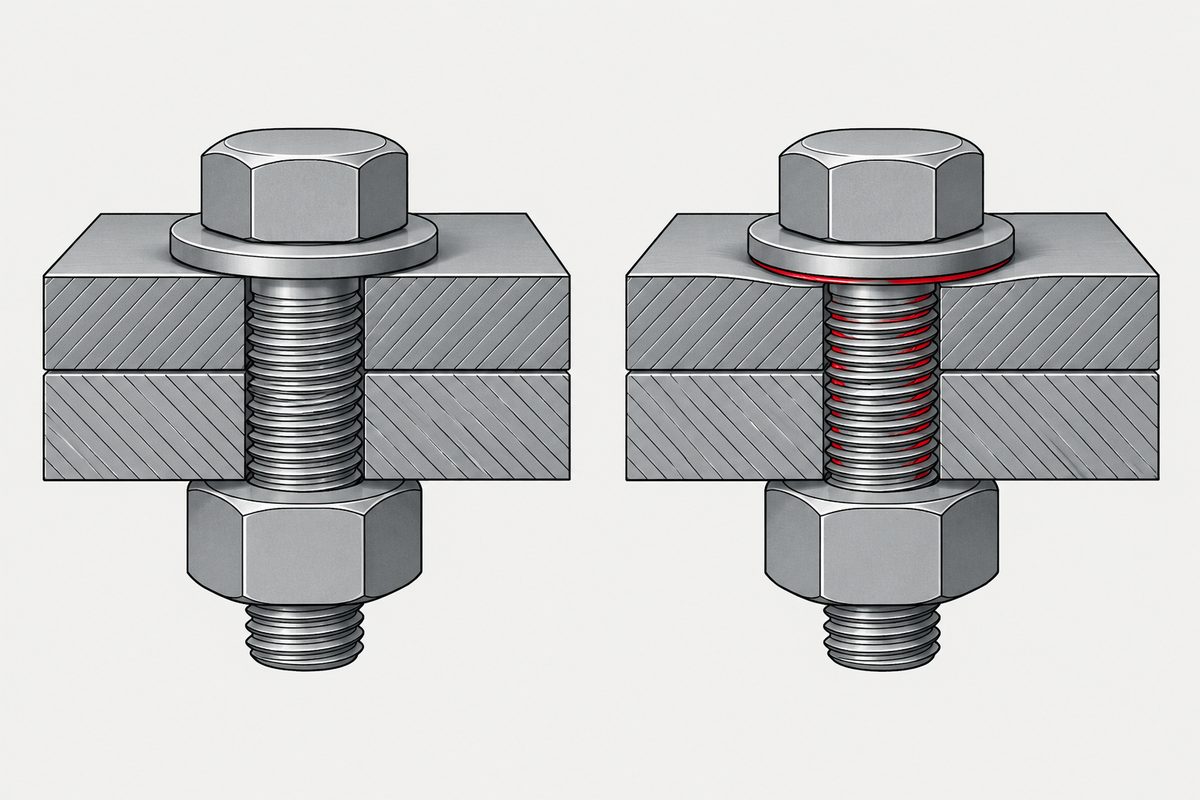
The short version: a torque number is only half a specification. The other half is the surface condition it was calibrated against. Take an M8×1.25 and drop the friction coefficient from 0.15 to 0.08 — roughly what a light oil does — and the same torque delivers 1.70 times the preload. Nothing about the tool or the number changed. The joint did.
The question, asked eighty thousand times
“Grease on wheel bolts or not?” has been read over 82,000 times on Mechanics Stack Exchange, and the answers split. One camp says never; another says a light film prevents seizing. Both camps are arguing about the wrong thing, because the disagreement is downstream of a number nobody is examining: the torque figure itself.
What the torque is buying
Torque does three jobs at once, and only the first is the one you want:
T = F · [ nP/(2π) + μt·d2/(2·cos 30°) + μn·rn ]
The first term climbs the thread and produces clamp force. The other two are friction — at the thread flanks and under the head or nut face — and they are spent, not stored. This is the same relation VDI 2230 gives as MA = FM(0.16P + 0.58μGd2 + μKDKm/2).
Now run an M8×1.25 through it twice, changing only the friction:
| μ | Lead term | Thread friction | Face friction | Total | Preload at same T |
|---|---|---|---|---|---|
| 0.15 | 0.199 | 0.623 | 0.825 | 1.646 | 1.00× |
| 0.08 | 0.199 | 0.332 | 0.440 | 0.971 | 1.70× |
Seventy percent more clamp force, from the same click of the same wrench. The simplified form gives the same picture: NASA's design guidance quotes a nut factor of about 0.20 dry against 0.11–0.15 lubricated, which is a 33% to 82% swing on its own.
The standard says so explicitly. ISO 16047, which governs torque-tension testing, states that the nut factor is only valid for the same friction conditions, and requires the test report to record the surface coating and the lubricant. NASA's fastener design manual makes the same point: torque tables must be adjusted when your surfaces differ from the table's.
So what does the manufacturer actually say
For ordinary passenger cars, the position is consistent across the makers we checked, and it is not folklore:
- Toyota prohibits grease on wheel bolts and nuts, citing over-tightening and damage to the bolt or the wheel.
- BMW's workshop procedure states plainly: do not apply oil to wheel bolts. Corroded bolts are replaced, not lubricated.
- SEAT requires the bolts and threads to be clean and free of oil and grease.
Note what that is not. It is not a universal rule handed down by a standard — SAE J2316 explicitly defers to the vehicle manufacturer's specification rather than setting one dry torque for everyone. It is a set of specs each calibrated dry, and a warning not to leave the condition they were calibrated for.
Which is why the exceptions exist, and they do
If “never lubricate” were a law of physics, there would be no counterexamples. There are.
- Chevrolet's medium-duty trucks specify two drops of SAE 30 oil on the stud end threads and at the nut-to-floating-washer interface — and the 610–678 N·m torque figure corresponds to that lubricated state.
- Ford E-Series two-piece flat nuts take one drop of oil between the nut body and the floating washer, while explicitly requiring the nut and stud threads to stay dry.
- BMW greases the wheel centring surface while keeping the bolts dry; Bentley allows no more than 0.25 cc of copper grease on the centring diameter and specifically requires it be kept off the clamping face.
Read those together and the rule emerges properly formed: lubricate exactly where the specification says to, because the torque figure was calibrated with that lubrication present. The last two are the sharpest case — grease on one surface, dry on another, a few millimetres apart, because only one of them is in the torque path.
What actually goes wrong, stated carefully
Over-tension from unintended lubrication has more than one way to hurt you, and we should not pretend to know which comes first.
- The stud yields, or the seat crushes. These are parallel limit states, not a sequence. Which one arrives first depends on stud strength, seat geometry and wheel material. SAE J2315 exists specifically to specify wheel-nut seat strength, which tells you the seat is an independent design limit rather than an afterthought. Toyota's own warning lists bolt damage and wheel damage side by side.
- Fatigue follows. Permanent stretch, a damaged seat or embedment relaxation all change the residual clamp force and therefore the cyclic stress. Published finite-element work on cast aluminium wheels shows clamp load shifting mean stress, the critical location and predicted life.
And one claim we are not going to make. “Oil makes them work loose while driving” does not follow from the torque-tension relationship — a lower removal torque means lower friction, which is not the same as self-loosening. Toyota does warn that grease can cause nuts to loosen, but we found no experimental basis for ranking that mechanism above the others, and NTSB wheel-separation work found both under- and over-tightening, attributing stud failures to fatigue after incorrect tightening rather than to lubrication acting on its own.
The general form
One condition worth naming explicitly: the friction can change in the warehouse. Zinc flake bolts tightened straight out of cold storage needed 11% to 30% less torque for the same clamp force.
None of this is really about wheels. A torque figure carries a torque-tension calibration for a particular surface condition, and anything that changes that condition — oil, a different coating, corrosion, or simply cleaning off what was there — moves you off the calibration while the number on the drawing stays the same.
That cuts both ways, which is the part worth remembering. Some specifications require lubrication deliberately, because it lowers the torque needed and, more importantly, reduces the scatter in the preload you actually achieve. Friction is not the enemy. Unrecorded friction is.
Where the number on the drawing was generated in the first place is worth checking too: on a torque table indexed by property class, the two figures for the same thread differ by the class ratio and by nothing else.
What torque control can and cannot deliver in the first place is in torque and clamp force; the order in which anything gets added to a validated joint is in revalidating a screw change; and where assembly sits among the other decisions is in specifying a screw.
References
- VDI 2230 Part 1 — tightening torque relation, eqs. 5.4/17–5.4/20
- ISO 16047 — Fasteners: torque/clamp force testing (nut factor valid only for the same friction conditions; coating and lubricant to be reported)
- NASA TM-106943 — Preloaded Joint Analysis Methodology (nut factor about 0.20 dry, 0.11–0.15 lubricated)
- NASA RP-1228 — Fastener Design Manual, fastener torque
- NASA-STD-5020B — requires test-derived installation parameters rather than fixed factors
- SAE J2315 — wheel nut seat strength; SAE J2316 — aftermarket wheel fastening systems
- Vehicle manufacturer instructions: Toyota, BMW workshop procedure 36 10 300, SEAT, Chevrolet medium duty, Ford E-Series, Bentley technical bulletin
- “Grease on wheel bolts or not?”, Mechanics Stack Exchange
This page explains a relationship and cites manufacturer instructions as examples of it. For any actual vehicle or joint, the governing document is that manufacturer's specification, not this page.
This is not one of the six steps. It shows up across them, or after assembly. Where the decisions that lead here were made is in specifying a screw, which sets out the order and why doing it out of order is rework.
Common questions
How much does oil change the clamp force at the same torque?
For an M8x1.25 with the friction coefficient dropping from 0.15 to 0.08, the same torque delivers 1.70 times the preload — about 70% more. Using the simplified nut factor instead, NASA design guidance quotes about 0.20 dry against 0.11 to 0.15 lubricated, which is a 33% to 82% increase. There is no single universal figure because it depends on the friction conditions being compared.
Should I put grease on wheel bolts?
For ordinary passenger cars the manufacturers we checked say no. Toyota prohibits grease on wheel bolts and nuts, citing over-tightening and damage to the bolt or wheel. BMW workshop procedure states not to apply oil to wheel bolts. SEAT requires threads clean and free of oil and grease. The governing document is your vehicle manufacturer specification, not a general rule.
Are there cases where lubrication is specified?
Yes, and they are instructive. Chevrolet medium-duty trucks specify two drops of SAE 30 oil at the stud end threads and the nut-to-washer interface, with the torque figure corresponding to that lubricated state. Ford E-Series two-piece nuts take a drop of oil between nut body and floating washer while requiring the threads to stay dry. BMW greases the wheel centring surface but not the bolts. The rule is to lubricate exactly where the specification says, because the torque was calibrated with that lubrication present.
What actually fails if the bolts are over-tensioned?
The stud yielding and the seat crushing are parallel limit states rather than a sequence, and which arrives first depends on stud strength, seat geometry and wheel material. SAE J2315 specifies wheel nut seat strength as an independent design limit. Fatigue follows from either: permanent stretch, a damaged seat or embedment relaxation all change the residual clamp force and the cyclic stress.
Does grease make wheel nuts work loose while driving?
That does not follow from the torque-tension relationship. A lower removal torque means lower friction, which is not the same as self-loosening. Toyota does warn that grease can cause nuts to loosen, but we found no experimental basis for ranking that mechanism above over-tension and seat damage, and NTSB wheel-separation work found both under- and over-tightening, attributing stud failures to fatigue after incorrect tightening.
Enquiries
If a torque figure has reached you without a stated surface condition, that is the thing to resolve before anything is assembled. Tell us the coating, whether anything is applied to the threads, and what the joint has to hold, and we will tell you what the number is missing.
Request a quotation
Tell us the part and the quantity. We will come back on feasibility, lead time and price.
Or email us directly sales@tigerfasteners.com