 TIGERFASTENERS
The Torque Number Came From the Class, Not From Your Joint
Someone on r/AskEngineers opened a box expecting property class 8.8 and found 12.9. His company sets torque by class rather than joint by joint, so the drawing offered him two numbers for the same M12: 95 N·m and 160 N·m. He asked whether running the stronger bolt at the lower figure would cause a problem. The thread answered him well. Nobody asked where 95 and 160 had come from, and that turns out to be the more useful question.
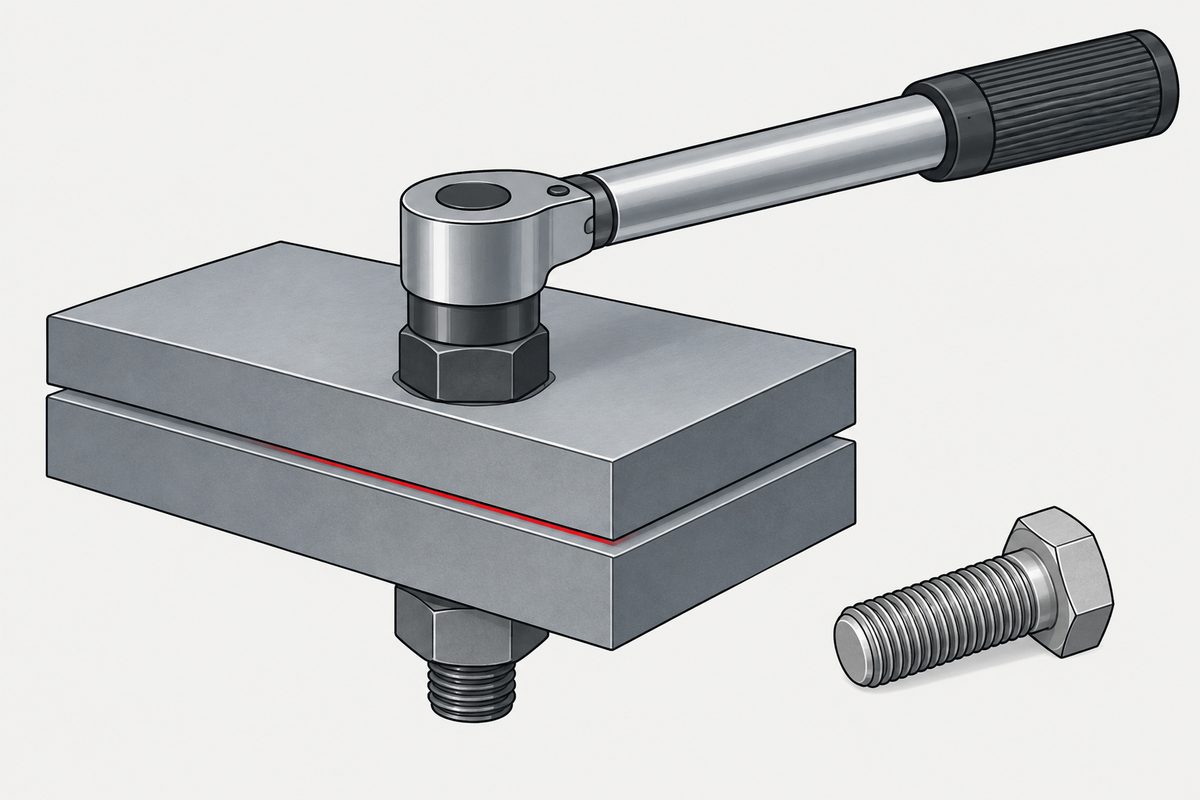
Two numbers, and one standard behind both
ISO 898-1 tabulates a proof load for every property class at every thread size. It is the axial force the fastener has to carry in a defined test without measurable permanent set, and it is simply the nominal stress area multiplied by a stress the standard names for that class. For M12 the stress area is 84,3 mm², and Table 5 gives:
| Property class | Proof stress Sp,nom | Proof load, M12 | Torque on that drawing |
|---|---|---|---|
| 8.8 | 580 MPa | 48 900 N | 95 N·m |
| 10.9 | 830 MPa | 70 000 N | — |
| 12.9 | 970 MPa | 81 800 N | 160 N·m |
Torque relates to preload through a product of the form T = K · d · F, where d is the nominal diameter and K collects everything about friction and thread geometry. Divide each torque by d · Fp and see what falls out:
| Class | T | d · Fp | T / (d · Fp) |
|---|---|---|---|
| 8.8 | 95 N·m | 587 N·m | 0,162 |
| 12.9 | 160 N·m | 982 N·m | 0,163 |
One constant reproduces both figures to within one per cent. That constant is not a coefficient of friction; it is whatever friction assumption the table used multiplied by whatever fraction of the proof load it aimed at, and two numbers cannot pull those apart. What matters is that a single value covers both rows.
The ratio proves it without any assumption at all
160 / 95 = 1,684. The M12 proof-load ratio between 12.9 and 8.8 is 81 800 / 48 900 = 1,673, and the nominal yield ratio is 1 080 / 640 = 1,688. The two torque figures differ by the class and by nothing else.
This part needs no fitting. In the ratio, K cancels, the utilisation fraction cancels, the diameter cancels. Whatever assumptions went into the table, they were the same assumptions in both rows, so the only thing that moved between 95 and 160 was the number stamped on the head.
Which is worth stating plainly: the joint is not in that calculation. Not its material, not its grip length, not its clamped-part stiffness, not the load it carries. A torque table indexed by property class is a table of what the fastener can take, dressed up as a table of what the joint needs.
So the substitution is safe, and the reason it is safe is the finding
Run the 12.9 at 95 N·m with the same surfaces and the same lubricant, and the preload is very nearly the one the 8.8 was getting. The thread had this right in a single line, at 51 points: the elastic modulus is the same for both, so the bolt stretches the same amount at the same tension. Quenching and tempering moves yield and tensile strength. It does not move stiffness. A comment above it had wondered whether the “spring effect” might change with the class, and that answer settles it. How that spring behaves once a working load arrives is a separate model worth having.
What did change is utilisation. At 95 N·m the 8.8 was sitting at its proof load; the same torque puts the 12.9 at about sixty per cent of its. The bolt is loafing. That is normally a good place to be, and it is also the uncomfortable part of the answer, because it means the 160 N·m figure was never a requirement of the joint either. If the assembly worked on 8.8 at 95, then the 12.9 row exists to use up the fastener, not to hold the parts together.
The preload you actually land on has a wider spread than any of this arithmetic suggests, and the spread comes from the method rather than the class: how badly your tightening method controls preload. What the torque is buying, and the friction it silently assumes, are torque and clamp force and a torque spec assumes a friction condition.
Four things the swap does change
None of them is preload, and all four are worth checking before the parts go in.
| What moves | Where it bites |
|---|---|
| Ductility | Minimum elongation after fracture falls from 12 % at 8.8 to 8 % at 12.9 in the same table. A joint that has to survive one over-torque or a shock is spending the part of the curve being traded away |
| Plating | ISO 4042 draws its line by class: below 10.9 no supplemental verification, at 12.9 verification and baking. A plated 12.9 is a controlled process, not a stock item. See hydrogen embrittlement |
| The female thread | A stronger screw does not make the nut or the tapped hole stronger, and the design intent that the screw fails first can invert. See the nut has one number and the reason is the tapped hole |
| The marking | The head now says 12.9 where the drawing says 8.8. That is an incoming-inspection finding and a change record, whatever the engineering says. See what a screw change costs to re-validate |
The first two of those were the top answer on the thread, at 98 points, and the person who wrote it was right. Where the trade-offs of reaching for a higher class are worked through in full is what the property class numbers mean.
The footnote the standard puts on 12.9
Table 2 of ISO 898-1 lists the permitted steels and the minimum tempering temperature for each class. Hanging off the 12.9 row is a footnote that does not appear on any of the others. It advises caution when 12.9 is being considered, and asks that three things be weighed: the capability of the fastener manufacturer, the service conditions, and the wrenching methods. It closes by noting that environments can cause stress corrosion cracking in fasteners as processed as well as coated ones.
Read that against the question being asked. Someone is about to change the wrenching method for a 12.9 fastener, on the reasoning that the number on the head is bigger. The standard that supplies the number has a note attached to it asking for exactly that decision to be considered rather than assumed. Nothing in the footnote forbids the substitution. It does mean the class is not the free upgrade it looks like.
What the class number never claimed
Clause 1 of ISO 898-1 ends with a list of properties the standard does not specify. There are five, and two of them are the ones people reach for a higher class to buy:
- weldability
- corrosion resistance
- resistance to shear stress
- torque/clamp force performance, with the test method handed to ISO 16047
- fatigue resistance
A torque table indexed by property class is therefore built on a quantity the standard behind that class states it does not cover. That is not an accusation; the arithmetic is a reasonable first approximation and everybody uses it. It does mean the number is the table’s, not the standard’s, and when it is wrong the standard is not the thing that was misread.
The two exclusions also answer the general form of the question. In a joint loaded across the bolt rather than along it, and in a joint that cycles, the class change reports nothing either way. We looked for a published comparison of fatigue life across property classes at equal preload and did not find one worth citing. What the axial model does say about cyclic loading is in the bolt is a spring, and the case where more torque stops helping is tighter is not always longer.
This is not one of the six steps. It shows up across them, or after assembly. Where the decisions that lead here were made is in specifying a screw, which sets out the order and why doing it out of order is rework.
Common questions
I ordered 8.8 and received 12.9. Can I fit them at the 8.8 torque?
Mechanically the preload is very nearly unchanged, because torque relates to preload through friction and geometry and none of those terms contains the property class. The elastic modulus is the same, so the bolt stretches the same amount at the same tension. Four things do move: minimum elongation after fracture falls from 12 per cent to 8 per cent, ISO 4042 requires baking for plated 12.9 where it requires nothing below 10.9, the nut or tapped hole has not become stronger, and the head marking no longer matches the drawing. The last one is a change record whatever the engineering concludes.
Does a 12.9 bolt stretch less than an 8.8 at the same torque?
No. Quenching and tempering raises yield and tensile strength and leaves the elastic modulus where it was, so at equal tension both bolts elongate by the same amount. What the higher class buys is how far it can be stretched before yielding, not how stiffly it resists being stretched. This came up on the source thread and the correct answer was the second reply.
Where does the number in a class-indexed torque table come from?
It is normally the nominal stress area multiplied by a stress the class defines, multiplied by a friction assumption and a nominal diameter. On the table discussed here, 95 N·m at 8.8 and 160 N·m at 12.9 for M12 are reproduced within one per cent by a single constant of 0,162 applied to the ISO 898-1 proof loads of 48 900 N and 81 800 N. That constant is a friction assumption times a utilisation fraction and two numbers cannot separate them, but the ratio between the two torques needs no assumption at all: it is the class ratio.
Is a higher property class the safe choice when I am not sure?
It is the choice that raises what the fastener can take and lowers what it can absorb before it breaks. ISO 898-1 gives 12 per cent minimum elongation at 8.8 and 8 per cent at 12.9, and its Table 2 attaches a caution to 12.9 alone, asking that manufacturer capability, service conditions and wrenching methods be considered, and noting stress corrosion cracking. Where the joint needs 12.9 it needs it. Reaching for it as margin buys static capacity and spends ductility.
Does ISO 898-1 give tightening torques?
No, and it says so. Clause 1 lists torque/clamp force performance among the properties the standard does not specify, and points to ISO 16047 for the test method. Fatigue resistance, shear resistance, weldability and corrosion resistance are on the same list. Torque tables indexed by property class are built by others on top of the standard, using its proof loads and an assumed friction condition.
References
- ISO 898-1:2013 — mechanical properties of fasteners of carbon steel and alloy steel; clause 1 scope exclusions, Table 2 and its footnote on class 12.9, Table 3 rows 3 and 6, Table 5 proof loads
- ISO 16047 — fasteners, torque/clamp force testing; the method ISO 898-1 points to for the property it does not specify
- ISO 4042 — fasteners, electroplated coating systems; the class boundaries for hydrogen embrittlement relief
- r/AskEngineers — the thread this began in, including the two torque figures and the reply about elastic modulus
ISO 898-1:2013 was read from the publicly available preview PDF, which carries clause 1, Table 2 with all of its footnotes, Table 3 and Table 5 in full; every figure quoted above is from those tables. The pair 95 and 160 N·m is not from a published table we can name. It is what the person asking the question said his own drawings carry, so the reconstruction here shows which pair of assumptions reproduces those two numbers and does not claim to be the calculation his company performed. The constant 0,162 is a friction assumption multiplied by a utilisation fraction, and two data points cannot separate the two, so it should not be read as a coefficient of friction. The ratio argument does not depend on any of that. On fatigue we say only that ISO 898-1 excludes it; we looked for a published comparison of fatigue life across property classes at equal preload and found none we were willing to cite.
Enquiries
If an enquiry changes a property class, send the mating thread as well as the screw. The class of the nut or the tapped hole is the half of the joint that does not change by itself, and it decides which side gives up first.
Request a quotation
Tell us the part and the quantity. We will come back on feasibility, lead time and price.
Or email us directly sales@tigerfasteners.com