 TIGERFASTENERS
The bolt is a spring, and so is the joint
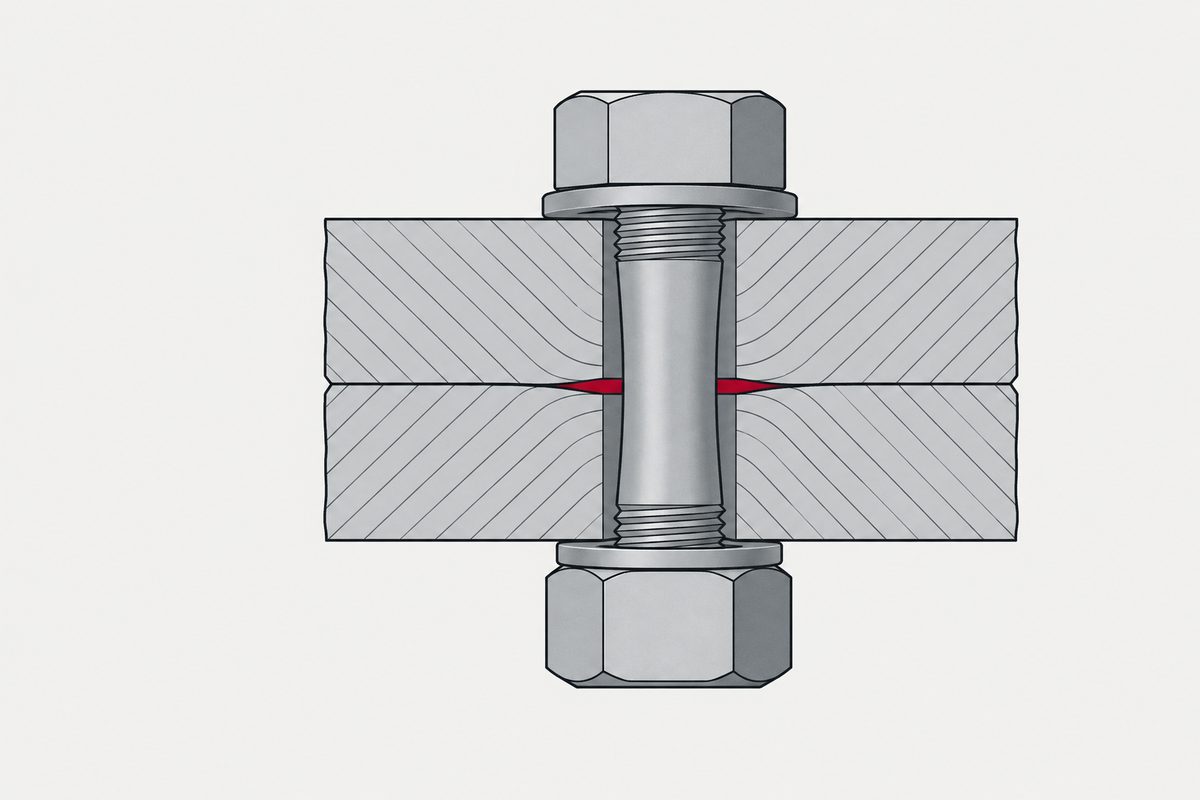
A tightened bolt stretches and the clamped parts compress. Both are springs, and an external load is shared between them in proportion to how stiff each one is. That single idea explains most of what is counter-intuitive about bolted joints — including one thing about preload and fatigue that almost everyone, us included, states incorrectly.
The quantity, and how to name it correctly
VDI 2230 Blatt 1 calls it the Kraftverhältnis, load factor, symbol Φ. It is the share of an axial working load that reaches the bolt:
Φ = FSA / FA
The clamped parts unload by the remainder, FPA = (1 − Φ) FA. For the simplest case — coaxial clamping with the load introduced at the head and nut bearing faces — it comes straight from the two compliances:
ΦK = δP / (δS + δP) = kS / (kS + kP)
NASA-STD-5020B writes the same thing as φ = kb / (kb + kc).
n is a separate quantity, and mixing it into Φ causes confusion. VDI's load-introduction factor n = δVA / δP describes where the working load enters the clamped parts, and it typically runs between 0 and 1. The product is written Φn = n ΦK. So the “nΦ” you meet in the literature is the base stiffness ratio corrected for load introduction, not a third independent parameter. For coaxial clamping with eccentric loading VDI uses Φen, and eccentric clamping adds a star.
One citation to avoid: ISO 16224 is not the ISO equivalent. The withdrawn ISO/TR 16224:2012 and the current ISO 16224:2026 both cover nut load capacity and thread stripping, and neither defines the joint spring diagram or Φ.
The correction: preload does not shrink the stress amplitude
We drafted the usual claim: tighten harder and the bolt's cyclic stress amplitude falls, so it lasts longer. Below separation that is not what happens.
While the joint stays closed and both springs behave linearly, the bolt's load range under a cyclic external load ΔP is
ΔFbolt = nΦ · ΔP
The preload value does not appear. Tightening harder raises the mean stress in the bolt and moves nothing about the amplitude. But that preload is absent from the applied amplitude does not make it irrelevant to fatigue: VDI makes the allowable amplitude a function of mean bolt force. See the fatigue limit is a test convention.
What preload actually buys is distance to separation. Once the joint opens, the load-sharing model stops applying and the bolt takes essentially the whole additional separating load — the slope in the diagram goes from nΦ to 1. NASA states plainly that separation under cyclic loading increases bolt fatigue damage. VDI puts the full-opening point at
FAab = FV / (1 − Φn)
So the honest version of the advice: preload enough that the joint never opens, because the penalty for opening is large and abrupt. Beyond that point, more preload is mostly more mean stress.
So is “do not overtighten” wrong
We were going to say yes. That overreaches.
VDI does say that when tightening within the elastic range, a utilisation of ν = 0.9 should be the target even where the function needs a lower FM max. But the same clause requires you to establish the permissible preload FM zul from surface pressure limits, thermal loading, compliance and strength.
The standard supports using the allowable preload fully. It does not support ignoring the ceiling, and there are real ceilings: yielding, bearing-face crushing, and thermal load. “Do not overtighten” is poor advice when it means “stay well below the allowable”, and correct when it means “do not exceed it”.
Why a soft gasket makes the bolt's life worse
This one holds up. A soft gasket lowers the clamped-part stiffness kP, which raises the compliance δP, which pushes Φ toward 1. More of every external load turns into bolt load.
| Joint | C |
|---|---|
| Soft gasket with a stud | 1.00 |
| Soft gasket with a through bolt | 0.75 |
| Asbestos gasket | 0.60 |
| Soft copper gasket | 0.50 |
| Hard copper gasket | 0.25 |
| Ideal rigid metal joint | 0.00 |
At the top of that table the bolt receives the entire external load. Gaskets also bring nonlinearity, hysteresis and creep, which lose preload over time on top of the stiffness effect.
These are simplified guideline values, not VDI's Φ including n. And there is no general typical range for metal-to-metal joints that we could verify: Bickford gives a “typical” non-gasketed joint as KJ ≈ 5KB, implying Φ ≈ 0.17, and a NASA worked example comes out at 0.314. Both are individual cases.
The preload you lose before anything is even applied
Surfaces bed in. VDI treats the plastic embedding that happens after assembly as a length fZ, and the preload it costs comes from the same two compliances:
FZ = fZ / (δS + δP)
NASA-STD-5020B allows 5% of the initial minimum preload as a short-term embedding loss for all-metal joints. Where the joint contains non-metallic parts or coatings, it requires test values instead — the 5% cannot be carried over.
How precisely you can deliver the preload in the first place is a separate number, and VDI tabulates it: how badly your tightening method controls preload.
What separation actually costs, and the minimum clamp load
VDI's requirement is stated as a minimum clamp load with several jobs to do at once:
FK erf ≥ max(FKQ, FKP + FKA)
FKQ covers transmitting transverse load by friction, FKP covers sealing, and FKA is the minimum clamp load at the opening limit. The joint has to satisfy whichever is largest.
One qualification worth carrying: an eccentric joint can open locally at an edge and begin bearing on one side before anything like full-section separation happens, so “open or closed” is a simplification. VDI handles partial opening separately.
And if the load in your joint runs across the bolt rather than along it, none of the sharing model above applies, and tightening has an upper end that reverses: does tightening harder make a joint last longer?
What this model changes about the rest
- Why joints lose preload without anything unscrewing is in why screws come loose, and the elastic interaction that does it during assembly is in tightening sequence.
- What the torque you apply actually buys, and the friction it assumed, is in torque and clamp force and the friction the torque assumed.
- Why small screws lose a larger share of their preload to the same embedding length follows directly from FZ above.
- What happens when the clamped member is an instrument, so that Φ becomes a calibration error rather than a stress question, is in taring a preloaded load cell leaves a gain error.
Those two compliances are also the denominator when a joint is assembled by angle — torque plus angle.
And the model runs the other way too. If the joint is too stiff to tolerate the length changes it will actually see, the fix is to put a softer spring in series on purpose, which is what the spring on a cooler screw is doing: that spring turns a torque problem into a length problem.
References
- VDI 2230 Blatt 1:2015 — §5.2.2 (load-introduction factor n), §5.3 and Eq. (77) (Φ), §5.3.1.1 Eq. (81)–(83) (ΦK, Φn), Eq. (87) (FAab), Eq. (90)–(92) (Φen), §5.4.1 and R2/4 (FK erf, FKA), §5.4.2 Eq. (113) (FZ), §5.5.1 Eq. (147) and Tables A1–A4 (ν = 0.9, FM zul), Annex D (partial opening)
- NASA-STD-5020B — §4.4.5 Eq. (8)–(9) (φ, Ptb), Appendix A.2 (separation and fatigue), A.3 and Table 1 (5% embedding), A.4 (n), A.6 (separation), A.12 (worked example φ = 0.314)
- Bickford, Introduction to the Design and Behavior of Bolted Joints, 4th ed., §5.3.3 and §5.4 — KJ ≈ 5KB; gasket stiffness dominating the joint
- Josephs and Huston, Blake's Design of Mechanical Joints, 2nd ed. (2019), §5.5 Table 5.2 — guideline values for C
- ISO/TR 16224:2012 (withdrawn) and ISO 16224:2026 — cited only to note that neither covers the joint diagram
Acceptance for any particular joint is governed by your drawing and the standards it invokes.
This page covers step 2, the thread. The whole order is substrate, thread, head, drive, finish, documentation, and why doing it out of order is rework rather than a tweak is in specifying a screw.
Common questions
What is the load factor in a bolted joint?
It is the share of an axial working load that reaches the bolt. VDI 2230 Blatt 1 calls it the Kraftverhältnis, symbol phi, defined as the bolt’s additional axial force divided by the working load, with the clamped parts unloading by the remainder. For the simplest coaxial case it equals the clamped-part compliance divided by the sum of both compliances, which NASA-STD-5020B writes as bolt stiffness over the sum of bolt and clamped-part stiffness.
Does tightening a bolt harder improve its fatigue life?
Not by reducing the stress amplitude. While the joint stays closed and both springs are linear, the bolt’s load range under a cyclic external load is n times phi times that load range, and the preload value does not appear in it. Tightening harder raises mean stress and leaves the amplitude alone. What preload buys is distance to separation, because once the joint opens the bolt takes essentially the whole additional load and NASA notes that separation under cyclic loading increases fatigue damage.
Is the advice to avoid overtightening wrong?
It depends what it means. VDI says that when tightening in the elastic range a utilisation of 0.9 should be the target even where the function needs less, so staying well below the allowable preload wastes capacity. But the same clause requires the permissible preload to be established from surface pressure limits, thermal loading, compliance and strength, and those ceilings are real. The advice is wrong if it means stay far below the allowable and right if it means do not exceed it.
Why does a soft gasket shorten bolt life?
A soft gasket lowers the stiffness of the clamped parts, which raises their compliance and pushes the load factor toward one, so more of every external load becomes bolt load. Published guideline values for the ratio run from 0.00 for an ideal rigid metal joint through 0.25 for a hard copper gasket and 0.50 for soft copper up to 1.00 for a soft gasket with a stud, where the bolt receives the entire external load. Gaskets also add nonlinearity, hysteresis and creep, which lose preload over time.
How much preload is lost to embedding?
VDI treats it as a length, with the preload lost equal to that length divided by the sum of the bolt and clamped-part compliances. NASA-STD-5020B allows five per cent of the initial minimum preload as a short-term embedding loss for all-metal joints, and requires test values instead where the joint contains non-metallic parts or coatings. Because the same embedding length divides by a smaller compliance sum in a short joint, small screws lose a larger share.
Enquiries
If a joint is failing in fatigue and the answer so far has been to tighten it more, send the stack-up and the load. Whether the joint is separating is a different question from whether the bolt is tight enough, and only one of them is fixed by torque.
Request a quotation
Tell us the part and the quantity. We will come back on feasibility, lead time and price.
Or email us directly sales@tigerfasteners.com