 TIGERFASTENERS
Why tightening order matters
Cross pattern, star sequence, three stepped passes, one more time around at the end — most people were taught these rather than told why.
There is really only one thing underneath them, and once it is stated none of the rules need memorising:
Tightening one screw changes the preload in the others. Most often it reduces them, which is the case worth designing around — but the direction is not a law, and that matters for how confidently you can reason about it.
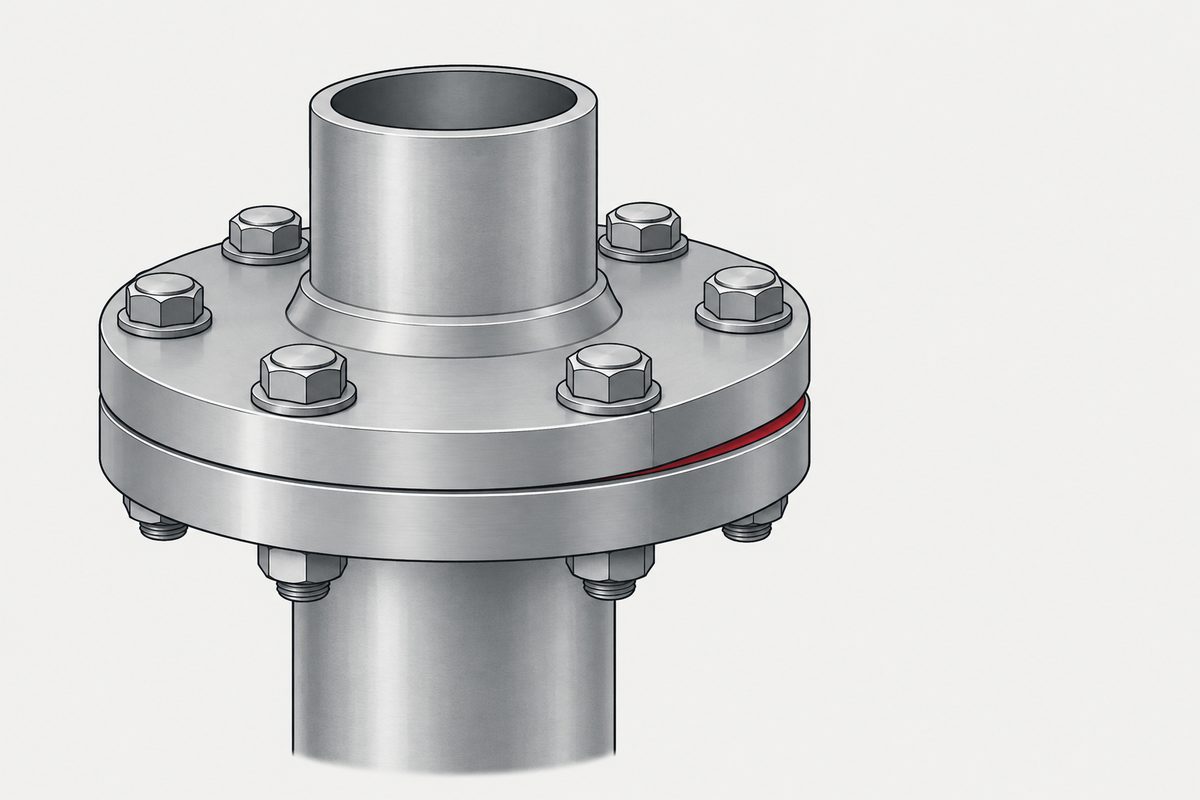
Going round evenly is the habit everyone is taught
Star pattern, cross pattern, work outward from the middle. Every trade passes some version of this on, and on a gasketed flange it is genuinely better than tightening them in whatever order they are reached.
The habit is right. What is usually missing is what it corrects for, which is why it gets applied to joints that have no elastic interaction to speak of and skipped on the ones that do.
Elastic interaction
Tightening a screw builds tension in the shank and, at the same time, compresses the clamped parts a little. The amount is small. It is also real.
Now tighten the one next to it. That deforms the shared clamped parts, and through deformation compatibility it changes how much the first screw is stretched — and therefore its preload. In the common case the first screw's effective grip shortens, it gives back part of its stretch, and its preload falls.
This is elastic interaction, and it is not an operator error.
One correction to how this is usually told, including in our first version of this page. The effect is not always a loss. Published work on multi-bolt joints describes interaction that can be negative, close to zero, or positive, depending on spacing, plate bending, boundary conditions and bolt compliance — in two-bolt models there are even positions where the interaction is approximately nil. So "tightening the second loosens the first" is the usual case and a good default assumption, not something that holds by necessity.
Softer and more compressible clamped material tends to increase it, though thickness, bolt spacing, the bending stiffness of the flange or shell, contact conditions and bolt compliance all bear on the result. Gasketed flanges are the best-studied case with the most experimental data behind it, which is why the published guidance comes from there. Among small screws the analogous roles are played by plastic housings, soft metals, and stacks of washers and coatings.
Elastic interaction is this model applied to neighbours: the bolt is a spring, and so is the joint.
So tighten them evenly — and the first ones come loose as you go
Cross or star sequence: letting the part seat evenly
Working along from one side pulls that side down first, the part starts to tilt, and every screw after it is being driven into an already distorted surface. Jumping across spreads where the load is applied so the part can settle flat.
Stepped passes: not making the first screws absorb the whole difference
Going straight to target means the ones tightened first get partly unloaded during the rest of the sequence — by an amount you do not know. Stepping brings every position up together: all of them to a lower level, confirm the part is seated, then raise them.
The last pass round: recovering what is left
By then the job is no longer squaring the part but checking whether anything was loosened by its neighbours, one fastener at a time. Going round the joint suits that job, which is why the guidance for flanges switches to it at the end.
There is a standard that writes this down. ASME PCC-1–2022, Pressure Boundary Bolted Flange Joint Assembly. Its traditional star pattern runs all bolts to 20–30% of target torque, then 50–70%, then 100%, followed by a check pass in circular order at 100% of the verified target torque, repeated until no further nut rotation occurs.
Four things worth stating rather than glossing, because our first version of this page got each of them slightly wrong:
- Those are ranges, not set points. The intermediate percentages are permissible bands; 30/60/100 is a second-hand simplification.
- That is one pattern of several. The 2022 edition also sets out modified star, quadrant and circular procedures.
- The check pass is circular order — "clockwise" comes from the older edition's wording and is not a requirement in 2022.
- The mechanistic explanation of elastic interaction is not in the current edition. The 2022 text still requires the pattern to counter its effects, but the appendix explaining how it works was removed; the explanation lives in the 2019 and earlier editions.
And mind the scope. It addresses ring-type gasket pressure-boundary flange joints, where the gasket lies wholly within the bolt circle. The standard permits an engineer to apply its principles elsewhere, case by case — which is exactly what this page is doing with the reasoning rather than the numbers. How many passes your joint needs, and to what, is a decision about your joint.
Why some joints get re-tightened after a delay
Preload keeps falling after assembly, and this part has nothing to do with sequence. It has to do with time.
- Embedding. Microscopic high points on the bearing face and in the thread contact flatten out. That is not instantaneous.
- Creep. If the clamped part is plastic, or the bearing pressure is high, the material keeps deforming — which is the subject of the head type page.
How much preload that costs depends on the compliance of the screw and the clamped parts — VDI 2230 expresses the loss as the settling divided by the sum of those compliances, so at comparable conditions a stiffer, shorter-gripping arrangement loses more per micrometre. Which is part of why some designs deliberately increase the effective grip length, or use a more compliant bolt section, to make the joint less sensitive to exactly this. Note that is grip length, not simply a longer screw driven deeper — buying a longer part and threading more of it in does not necessarily add effective compliance.
A re-torque is the usual remedy, and it is not a guaranteed restoration. Re-applying the original torque does not reliably return the original preload, particularly once friction has changed, and it can overload plastic, threads or a gasket. Whether to do one, and after how long, is a design decision for that joint. PCC-1 treats start-up retorque as conditional on temperature and timing with friction correction and a risk assessment, and notes it is generally not recommended for some gasket types.
And if your product attracts loosening complaints after shipping, relaxation is one candidate rather than the first: self-loosening under transverse movement, a wrong torque or friction assumption, damaged threads, a crushed bearing face, differential thermal expansion and simply insufficient design clamp load can all rank as high or higher. (Those routes are on why screws loosen.)
Small screws into plastic: the argument gets stronger, not weaker
It is easy to think a few M3 screws hardly warrant a sequence. The risks point the other way:
- Plastic is far softer than metal, so the same preload deforms it more. Whether that translates into larger bolt-to-bolt interaction still depends on the structure, so treat it as a reason for care rather than a rule.
- Plastic parts are often thin shells, so tightening one side can pull the panel out of shape and the rest go into a distorted surface.
- Plastic creeps, so the time-dependent loss is larger too.
A reasonable working method is to run everything down to light contact first, confirm the part is seated, then step up to target in two or three passes, crosswise or from the centre outward depending on the shape. We could not find a standard prescribing that for plastic parts, so treat it as engineering practice to validate on the actual part rather than as a specified procedure. (The trade-offs of plastic itself are on another page.)
What belongs in the work instruction
- The sequence itself — as a numbered diagram, not the words "tighten crosswise". Above four fasteners, "crosswise" is more than one route.
- How many passes and to what — percentages or actual torques, not "nip up first".
- Whether there is a final rotational pass, and how it ends. "Until nothing moves" only means something with the torque attached — in PCC-1 the check pass runs at 100% of the verified target torque. Written without that, it is not a criterion.
- Whether to re-torque, and after how long — if yes, it is a process step, not a technician's habit.
- What friction condition the torque was validated at — change the finish and it needs revalidating, for the reasons on torque and clamp force.
All of which is the same theme as writing the assumption down. Sequence, passes and timing are assumptions — written down they get followed, and they can be checked when something goes wrong.
Common questions
Why tighten in a sequence?
Because tightening the second screw loosens the first — elastic interaction. The sequence lets the part seat evenly rather than being pulled down at one edge and tightened while distorted.
Why stepped passes?
Going straight to target unloads the first screws by an unknown amount. ASME PCC-1–2022 gives ranges — 20–30%, then 50–70%, then 100% of target. ⚠ The familiar “30/60/100” is a second-hand simplification taking the midpoints, not the standard’s setting. Its scope is gasketed flanges either way, so the percentages are not for copying.
Why is the last pass rotational?
At that stage the job is checking each fastener for having been loosened by its neighbours, which suits going round. PCC-1 continues until no nut movement is detected.
Why re-torque?
Embedding and creep keep costing preload after assembly, by an amount that depends on the compliance of the screw and the parts. Whether to do it is a design decision.
Does this matter for small screws in plastic?
More, not less: plastic is softer, often a thin shell, and creeps. Run everything to light contact first, then step up.
Related
- Torque and clamp force — where the torque figure comes from
- Choosing a head type — embedding and bearing pressure
- Why screws loosen — the other routes preload is lost by
- Screws into plastic — the softest case, and the one that needs sequence most
- Can you reuse a screw — what changes on the second tightening
- The order in which to specify a screw — writing the assumption down
Enquiries
If your part is several screws into a plastic or sheet metal housing, send the drawing with the screw positions — sequence and pass strategy affect which head and finish you should be choosing, and are worth discussing together.
Request a quotation
Tell us the part and the quantity. We will come back on feasibility, lead time and price.
Or email us directly sales@tigerfasteners.com