 TIGERFASTENERS
Can you reuse a screw?
This usually gets a fast answer: "sure" or "no, use a new one". Both can be right, and neither answers the question.
Because "can I reuse it" is three questions stacked together:
- Has the screw itself changed permanently?
- Has the thread it goes back into changed?
- Has the friction changed?
If none of the three has, it is usually fine. If any has, that one needs deciding on its own — and for tapping and thread-forming screws the second is the unusual one, because that thread was made by the screw.
One: has the screw changed?
The easiest to check, because most of it is visible.
- Thread crests deformed, flattened or nicked. A thread carries load on its flanks, so a flattened crest means the contact has already changed.
- A rounded drive recess. This does not affect the strength of a joint already made, but it decides whether you can get it out next time — and rounding is usually not a first-use event.
- Tightened past yield. Some tightening strategies deliberately take the screw into the plastic range, and those screws are single-use by design. Note that angle control does not by itself mean this — elastic angle-controlled methods exist too, so it is the specified strategy that tells you, not the word "angle".
But "looks fine" is weaker evidence than it feels. Yield elongation, fatigue damage, hydrogen embrittlement and material degradation are not reliably visible, so a clean-looking screw out of a joint with an unknown history is not cleared by inspection alone. The other two questions are where it usually gets decided.
Two: is it the same thread?
This is the heart of it, and where tapping and thread-forming screws differ most from machine screws.
A machine screw goes into a thread that already existed — a nut, or a tapped hole. Remove it and put it back and the thread it is looking for is still there, the same shape as before.
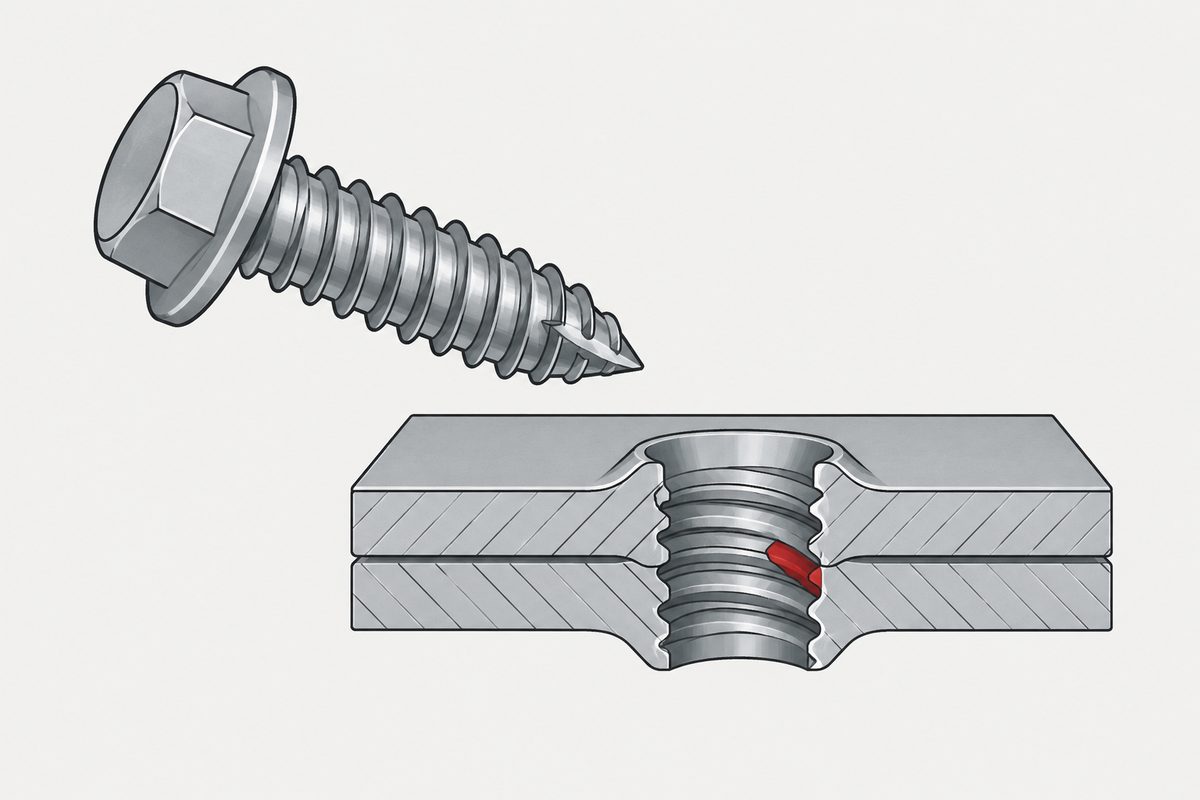
A tapping screw goes back into a thread it created itself. Which raises a question a machine screw does not have: will it find that thread again? And the answer depends on which kind of tapping screw it is, which is the distinction worth getting right.
| Type | How the thread was made | On re-driving |
|---|---|---|
| Thread-cutting | Material removed by a cutting edge | Can start a second set of threads if it does not pick up the original |
| Thread-forming (trilobular) | Material displaced, no chips | The tapered lead tends to follow the least-resistance path back into the formed thread |
The published guidance splits along that line. A design guide for engineering thermoplastics warns that a thread-cutting screw reinstalled into its own hole can cut a second set of threads, reducing strip torque and pull-out strength. The same guidance notes that properly designed thread-forming flights locate into the thread already formed, which is what prevents a second set. The manufacturer of one widely used trilobular thread-rolling screw makes the same point directly: the tapered lead follows the path of least resistance back into the existing thread, and their powered driving trials did not produce cross-threading.
So do not carry this as a general warning about "self-tapping screws". The failure belongs mainly to the cutting type. Where it does happen, the reported consequence is a significant reduction in strip torque and pull-out strength — which is serious, and is not the same as the hole being destroyed outright. Our first version of this page said neither thread would be complete and there would be no clamp load; that was stronger than the evidence.
The practical habit is still worth having, especially with cutting-type screws: turn the screw backwards first, with light pressure, until you feel it drop into the start of the existing thread, then tighten from there. It is a documented working method rather than something a standard prescribes, and it reduces the risk rather than removing it — alignment, and checking the result, still matter.
One correction to a common assumption, including one we made here: modern powered drivers are not blind to this. Equipment can be programmed to reverse and pick up the existing thread, and to detect a bad start from torque, angle and displacement signatures. Worth checking what your station actually does rather than assuming either way. (How the two ways of making a thread differ is on another page; what to do once a thread is damaged is on the stripped threads page.)
Three: has the friction changed?
This one is invisible, and the most often skipped.
How much of your torque becomes clamp force is mainly set by friction — which is the subject of torque and clamp force, whose central point is that the friction coefficient is not a property of the screw but of that pair in its current state.
And first tightening changes that state. How it changes depends on the coating and the conditions, which is exactly why it is hard to predict:
- A lubricant or passivate layer may be partly sheared or displaced
- Contact surfaces may be burnished smoother, or roughened, and a coating can flake
- There can be some adhesive transfer between the two surfaces
So a second use at the same torque may produce more preload than the first, or less. The direction is not the point. The point is that it is no longer the condition you validated. If the clamp force in this joint matters, the second tightening is an unvalidated condition.
Locking features are a separate question
Nylon insert and deformed thread designs work by interference created at first assembly, and that interference decays with each cycle. This is known at design time rather than a surprise.
ISO 2320 covers the functional properties of prevailing torque steel nuts. Two things to state before leaning on it:
Its scope is nuts, M5 to M39 coarse pitch and M8×1 to M39×3 fine — it does not reach smaller sizes, and it is not about screws. And it says in its own scope that the prevailing torque values it specifies are based on laboratory test conditions, noting that actual prevailing torques in practical application can vary.
It does give a cycle figure, which our first version of this page wrongly said it did not. Delivery inspection generally uses a first installation and removal, but initial type testing — and disputes, unless otherwise agreed — call for a fifth removal test: the first procedure followed by four more, with the maximum prevailing-off torque measured on the fifth removal, which must not fall below the minimum in the standard's tables. After complete removal the threads of the nut and the test bolt must be undamaged.
Read that carefully, because it is a type test rather than a licence. Passing a fifth-removal test is not ISO saying five reuses are safe in your application. So the operative question is still what your product specification permits — now with the knowledge that a standard cycle criterion exists to point at. The two prevailing torque figures on that specification are limits in opposite directions rather than values to add.
Deciding in practice
- Visible deformation, nicks or a rounded recess: replace. No thought required.
- Tapping screw going back into its own hole: know which type it is. The second-thread risk belongs mainly to cutting types; trilobular forming screws are designed to relocate. Reverse first to pick up the existing thread either way, and check what your driving equipment is programmed to do.
- If clamp force matters, treat the second tightening as a new condition rather than assuming the torque you validated once still applies.
- Locking parts: go by the cycles the specification allows, not by appearance.
- If nobody knows what it was tightened to, replace it — and check the other half too. A new screw does not repair a damaged internal thread, bearing face or clamped part, so replacing the fastener is the cheap step, not the whole remedy.
That last one deserves a sentence. This series keeps returning to writing the assumption down — reuse is hard to judge not usually because the mechanics are subtle, but because nobody recorded what happened last time.
Common questions
Can a removed screw be reused?
Three questions: has the screw changed, has the thread it returns to changed, has the friction changed. None changed is usually fine; any one changed needs deciding separately.
What goes wrong with a thread-forming screw?
It may form a second thread crossing the first, leaving neither complete and nothing visible. Reversing until it drops into the existing thread avoids it.
Why does the same torque give different clamp force?
Friction changed: lubricant partly sheared, surfaces burnished, possible adhesive transfer. The direction varies; what matters is that it is no longer the validated condition.
Can prevailing torque parts be reused?
Go by the specification's permitted cycles. ISO 2320 covers M5 to M39 nuts and states its values are laboratory-based and can vary in application.
When should I just replace it?
Deformed threads, rounded recess, tightened past yield, locking cycles used up, or most commonly — nobody knows what it was tightened to.
Related
- Torque and clamp force — why changed friction makes the same torque a different thing
- Thread rolling versus cutting — how the thread got made
- Stripped threads — judging a thread that has already failed
- Why cross recesses round out — drive damage accumulates
- Why screws loosen — where uncertain preload ends up
- The order in which to specify a screw — writing the assumption down
Enquiries
If your product gets opened for service, say so at the enquiry — it changes the thread form, the head and the finish you should be choosing, rather than being discovered at the first repair. Below M6 we run wire, forming, rolling and inspection in house, so those trade-offs can be discussed together.
Request a quotation
Tell us the part and the quantity. We will come back on feasibility, lead time and price.
Or email us directly sales@tigerfasteners.com