 TIGERFASTENERS
The Prevailing Torque on the Data Sheet Is a Limit, Not a Number to Add
A manufacturing engineer in his first weeks posted a spec sheet on r/MechanicalEngineering. Prevailing torque 300 in·lbs, breakaway 37, and a drawing telling him to tighten 5 to 40 above prevailing torque. He worked out 305 to 340. The supplier said 42 to 77. He asked which was right, and the answer is that the two numbers on his sheet are doing completely different jobs, one of which is not addition.
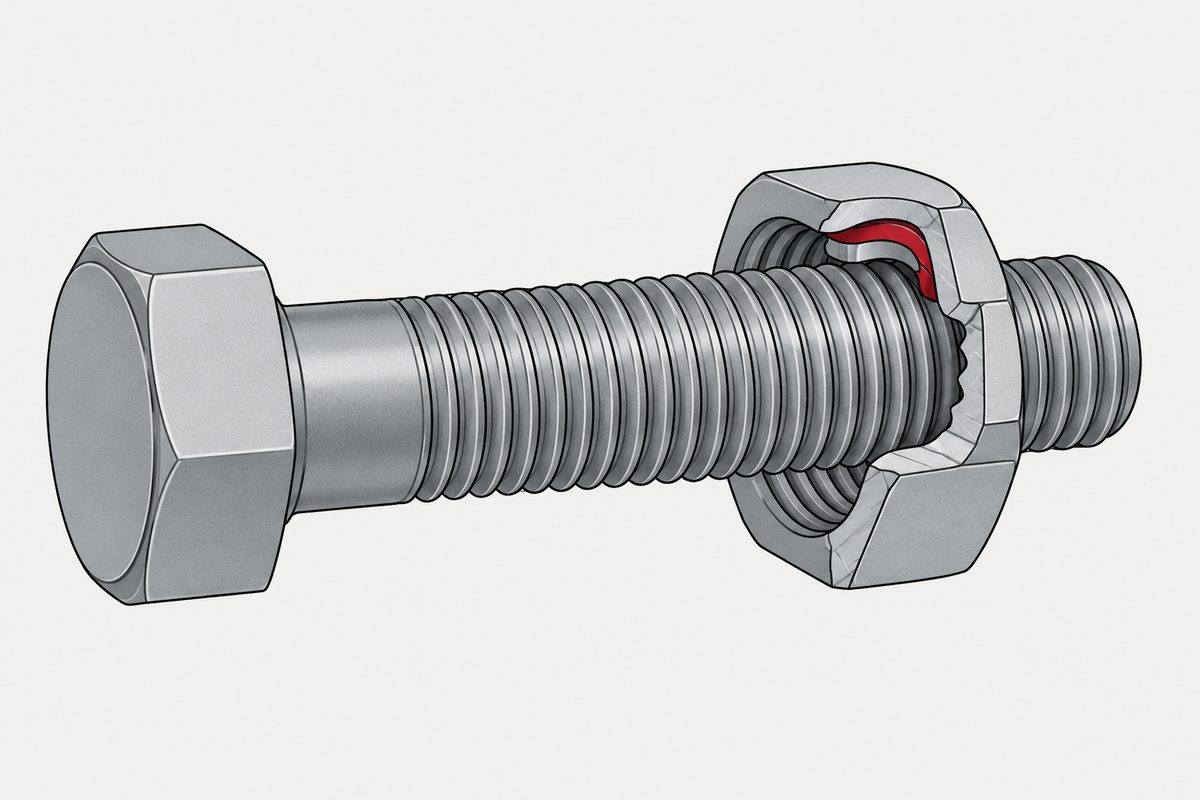
The arithmetic on the thread, and where it goes
Take his numbers as posted. The supplier’s answer is 37 + 5 = 42 and 37 + 40 = 77. So the figure being added is the 37, and the 300 is not in the sum at all. The best reply on the thread put the structural reason in one line: the fastener specification is telling somebody how to make a nut, not telling you how to design the joint.
His aerospace specification is not one we have read, so what follows uses the ISO document that covers the same ground for metric nuts, ISO 2320. Its structure explains why a data sheet can carry two prevailing torque figures that behave nothing alike.
Two limits, pointing in opposite directions
ISO 2320 clause 8, in its own words: the prevailing-on torque shall not exceed the tabulated value, and the prevailing-off torque shall exceed it. One is a ceiling. The other is a floor.
The ceiling exists so the nut can be run down. A prevailing torque feature that fights too hard on the way in wastes tool capacity, heats the insert and makes it impossible to tell seating from friction. The floor is the locking claim: after the joint is slackened, that much resistance must still be there. A nut can fail this standard for being too tight just as it can for being too loose, which is not how most people picture a locknut.
Property class 04, coarse pitch, in newton metres:
| Thread | First installation, maximum | First removal, minimum | Fifth removal, minimum |
|---|---|---|---|
| M5 | 1,6 | 0,29 | 0,2 |
| M6 | 3 | 0,45 | 0,3 |
| M8 | 6 | 0,85 | 0,6 |
| M10 | 10,5 | 1,5 | 1 |
| M12 | 15,5 | 2,3 | 1,6 |
| M16 | 32 | 4,5 | 3 |
| M20 | 54 | 7,5 | 5,3 |
Notice the gap between the columns. At M10 the nut may resist up to 10,5 N·m going in and must still deliver 1,5 coming out. Those are not two estimates of one quantity. They are the two ends of what the part is allowed to be, and the number you would put in a tightening calculation is neither of them: it is what the nut in front of you actually measures.
A footnote under the same table catches people. The first-assembly maxima apply to all-metal nuts only. For non-metallic insert nuts the maximum is half those values, so a nylon insert nut that feels stiff going on is out of specification a good deal sooner than an all-metal one that feels the same.
Worth pinning the part numbers to this, because a purchase order carries a number rather than the words “nylon nut”. ISO 2320 governs how this class of part performs; the part itself is dimensioned elsewhere:
| Commonly called | DIN | ISO | Difference |
|---|---|---|---|
| Nyloc, low profile | DIN 985 | ISO 10511 | lower overall height |
| Nyloc, regular height | DIN 982 | ISO 7040 | taller, more thread engagement |
The locking mechanism is the same in both; the height is not. A drawing that says only “nylon insert nut” describes both of them, and they do not give you the same thread engagement. The prevailing torque table above governs performance, not which height turns up.
These four numbers were paired from supplier technical pages, not from the standards themselves. This page gives no dimensions for them — look those up in the document or ask the supplier for a dimensioned drawing. The prevailing torque table above is read from ISO 2320.
Why the two Reddit answers about the definition both sounded right
A second thread asked what separates locking torque from prevailing torque. One reply offered static versus dynamic friction; another quoted an SAE document saying they are the same thing. ISO 2320 sidesteps that argument by defining the quantity rather than naming it. A prevailing torque nut is one that resists rotation independently of clamping or compression forces, prevailing-on torque is measured while the nut is in motion and without clamp force, and prevailing-off torque is what it takes to keep turning through the 360 degrees after the clamp force has gone.
So it is not the joint’s friction and it is not measured against preload at all. The standard even names the moment the two stop being separable: the seating point, where clamp force first appears. Everything before that is the locking feature; everything after it is torque against clamp force, which the same friction problem governs.
The reuse question, and what the standard does instead of answering it
The fifth-removal column above is where people get their “you can use it five times” rule, and the standard says something different. For delivery inspection the first installation and removal test applies. The fifth removal is an initial type test, and a test in case of dispute. It qualifies the design; it does not authorise five uses of one nut.
The clause then hands the decision over explicitly: prevailing torque performance decreases as a function of the number of reuses, and the consumer shall take into consideration the consequences of the decreased performance before any reuse of the nut.
That is a standard declining to give the number everybody wants, and the refusal is the useful part. It tells you the decision is yours and that it has to be made against consequences rather than a count. What the five-cycle row does give you is the shape of the decay: the minimum after five removals runs at roughly two-thirds of the minimum after one, right across the size range. Whether two-thirds is enough is a question about your joint, and the rest of that judgement is in can this screw go back in, which also sets out how the fifth-removal test is actually run.
One document does give a number, and it is worth knowing which kind of number it is. An aircraft maintenance circular says not to reuse a fibre or nylon locknut if it cannot meet a minimum prevailing torque listed by thread size. That is not a count either. It is the same decision this standard hands back to you, converted into something you can put a torque wrench on.
Three lines that change how you read a locknut
| Clause | What it says | Why it matters |
|---|---|---|
| Thread | A non-metallic insert nut’s GO gauge must run free by hand until it seats against the locking feature. An all-metal nut’s need only run free for one pitch | The difference in feel is specified, not accidental. An all-metal nut is allowed to grip almost immediately; a nylon one is not |
| Lubrication | At the manufacturer’s option, a lubricant may be applied to the lot to fulfil the functional requirements | The prevailing torque you feel may be a lubricated value, and degreasing parts before assembly can move it |
| Note under the tables | Evaluating prevailing torque results by statistical process control has no statistical relevance | A supplier chart of prevailing torque with control limits on it is not evidence in the way it looks like evidence |
Two more worth carrying. The service ranges differ by type: −50 to +150 °C for all-metal nuts, −50 to +120 °C for non-metallic insert nuts, and the temperature-influence test for insert nuts is run only at the customer’s request. And the tabulated range starts at M5. Sizes M3 and M4 appear in an informative annex, which is a different status from the body of the standard, and the general form of that problem is where fastener standards stop.
Where prevailing torque sits among the other things people reach for is the table in why screws loosen: it addresses rotation and does not restore lost clamp force. The countermeasure that was written into a standard and later taken out is the double nut.
This is not one of the six steps. It shows up across them, or after assembly. Where the decisions that lead here were made is in specifying a screw, which sets out the order and why doing it out of order is rework.
Common questions
Do I add the prevailing torque from the data sheet to my tightening torque?
Not the specification limit, no. ISO 2320 tabulates a maximum for the first installation and a minimum for removal, and both are bounds on what the part is allowed to be rather than the value of the part in your hand. A drawing that says to tighten a stated amount above prevailing torque means the prevailing torque actually present, which is measured. Adding a maximum limit is how the engineer in the source thread arrived at a figure roughly ten times the supplier’s answer.
What is the difference between prevailing torque and locking torque?
The terminology is genuinely inconsistent between documents, which is why two answers on the source thread contradicted each other. ISO 2320 avoids the argument by defining the quantity: a prevailing torque nut resists rotation independently of clamping or compression forces, prevailing-on torque is measured while the nut is in motion and without clamp force, and prevailing-off torque is measured while backing off, through the rotation after clamp force has gone. If a document is ambiguous, ask which of those it means.
How many times can a nylon insert nut be reused?
It specifies a test at five removals and it does not specify a permitted number of reuses, which are different things. Delivery inspection uses the first installation and removal. The fifth removal is an initial type test and a test in case of dispute, which qualifies a design rather than licensing five uses of one nut. The clause then states that performance decreases with the number of reuses and that the consumer shall consider the consequences before any reuse. The tables do show the shape of the decay: the fifth-removal minimum is about two-thirds of the first-removal minimum.
Why is my all-metal locknut tight from the first turn and my nylon one is not?
Because the standard asks for different things. For a non-metallic insert nut the GO gauge has to run free by hand until it seats against the locking feature. For an all-metal nut it need only run free for one pitch. The all-metal design is permitted to start gripping almost immediately. Separately, the maximum prevailing torque on first assembly for a nylon insert nut is half the tabulated value that applies to all-metal nuts.
Does ISO 2320 cover small nuts?
Its tables run from M5 to M39 coarse and M8 x 1 to M39 x 3 fine. M3 and M4 in property classes 8 and 10 appear in an annex the contents page marks as informative, which is a weaker status than the body of the standard. If a drawing depends on prevailing torque values below M5, that difference in status is worth settling with the supplier rather than assuming.
References
- ISO 2320:2015 — fasteners, prevailing torque steel nuts, functional properties; clause 1 scope and temperature notes, clause 3 definitions, clause 5 thread, clause 6 lubrication, clause 8 functional requirements, Tables 1 to 4
- ISO 16047 — fasteners, torque/clamp force testing; the source of the terms and definitions ISO 2320 builds on
- r/MechanicalEngineering — the thread this began in, with the 300 and 37 figures and the drawing note
- r/MechanicalEngineering — locking torque against prevailing torque, where two answers disagreed
ISO 2320:2015 was read from the publicly available preview PDF, which carries the contents page, clauses 1 to 8 and Tables 1 to 4 in full. Every value and every quoted requirement above comes from those clauses and from Table 1, property class 04, coarse pitch. The preview stops before clause 9, the test method, and before all three annexes, so this page does not describe how the test is performed and quotes no value from Annex C; the statement that M3 and M4 sit in an informative annex comes from the contents page, which the preview does carry. The 300 and 37 figures are what the engineer in the source thread said his own specification carries. That specification is in the NASM and SAE aerospace family and we have not read it, so nothing here is attributed to it and the only claim made about those numbers is the arithmetic anyone can repeat: 37 plus 5 is 42, and 37 plus 40 is 77. The ISO catalogue number was taken from the preview URL path and then confirmed against a second source, which is the routine this site adopted after publishing a wrong one.
Enquiries
If prevailing torque nuts are part of an enquiry, say which type and which class, and say whether the joint will be taken apart in service. All-metal and non-metallic insert are held to different limits on the way in and to different service temperatures, and the reuse decision is one the standard hands back to the user rather than settling.
Request a quotation
Tell us the part and the quantity. We will come back on feasibility, lead time and price.
Or email us directly sales@tigerfasteners.com