 TIGERFASTENERS
Which nut goes first was in the standard, and then it was taken out
Thin nut against the joint, or thin nut on top? The argument runs through fifty years of engineering forums, with authorities cited on both sides. It has an answer — thin nut first, against the joint — and that answer was written into ISO 898-2:2012. The 2022 edition kept the requirement that the two nuts be paired, and deleted the procedure. Which is a better clue about how much this method is trusted than either side of the argument.
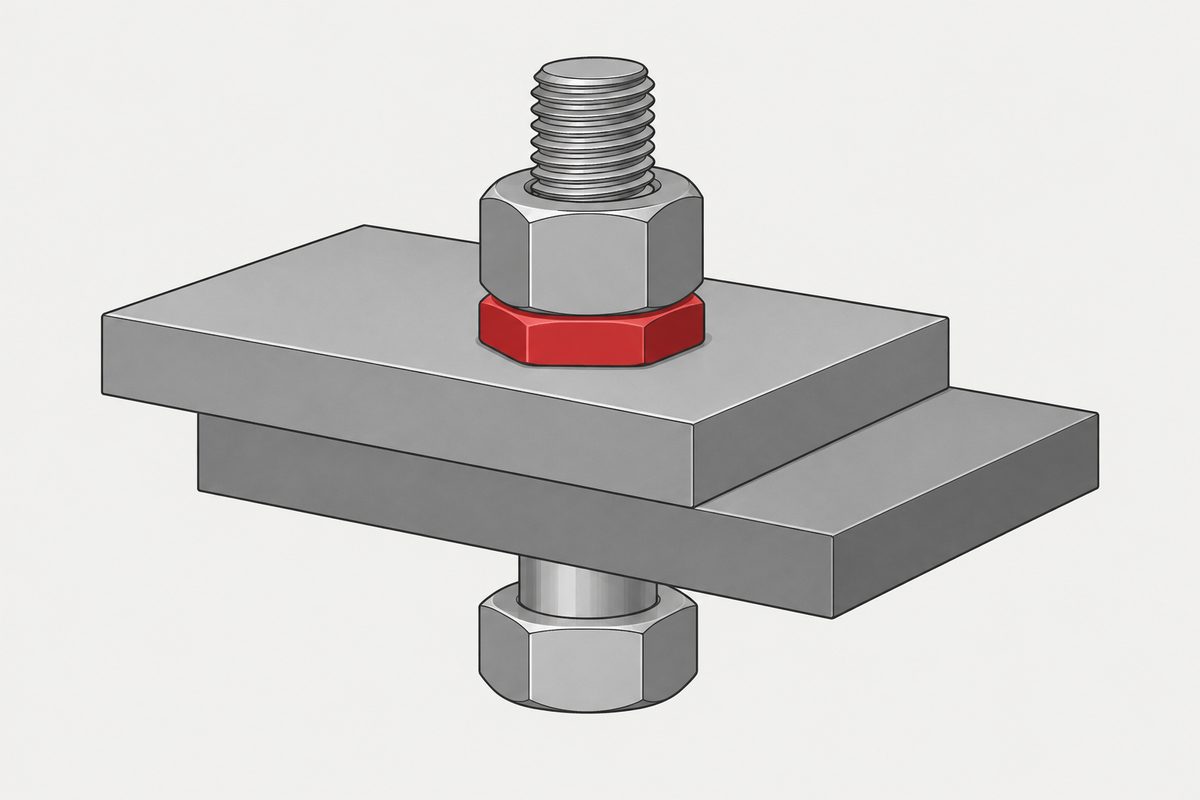
The answer, and where it used to be written
For an ordinary preloaded joint using one thin nut and one regular-height nut, the arrangement is: thin nut against the joint, tightened first; regular nut outside it, tightened to full torque while the thin nut is held against rotation.
ISO 898-2:2012 §5 specified this in words — tighten the thin nut against the joint first, then tighten the regular or high nut onto it.
ISO 898-2:2022 §6 kept the pairing and strength-matching requirements and removed the procedure. So the current ISO text no longer tells you the order. Anyone quoting ISO for the order today is quoting an edition that has been superseded.
It is not only ISO. The arrangement also appears in Bickford (4th edition §14.6.4, p.319), which calls thin-nut-against-joint the conventional arrangement, and in the US Navy NSTM Chapter 075 (§075-5.3.4.1–.2), which requires the thin nut between the joint face and the thick nut, held with a wrench while the thick nut is tightened.
Why that order: the working load changes hands
This is the part worth understanding rather than memorising, and the Navy manual states the reason in one line: the outer nut must be as thick as it would have to be if it were the only nut, because the main nut carries all the working load.
That is the sequence, mechanically:
- The inner thin nut is run down and tightened. The bolt and the thin nut contact on the normal load-bearing thread flank.
- Tightening the outer nut elongates the bolt further, which progressively unloads the inner thin nut.
- With the two nuts jammed against each other, they end up bearing on opposite flanks of the bolt thread, taking out the axial clearance and establishing a local, opposed preload.
- Bickford notes a benefit that follows: the jam nut preloads the threads in the direction opposite the final load, which improves thread load distribution.
So the reason the thin nut goes underneath is that after final tightening it is not the part carrying the working load. The outer, full-height nut is. A thin nut put in the position that carries the load would be the wrong part for the job — which is the next section.
Two things we would have overstated, and they matter:
- “The thin nut carries nothing” is too strong. It describes the external working-load path only. The thin nut still carries the mutual axial force of the two nuts pressing together, thread contact and bending stress, and — if assembly went wrong — potentially a large stripping load.
- The bolt between the two nuts is in tension, not compression. What is in compression is the interface where the two nuts press on each other. Describing that bolt section as “squeezed” gets the stress state backwards.
What a thin nut actually is
A thin nut is style 0 in ISO 898-2, covered by ISO 4035:2023 (fifth edition, published August 2023), in property classes 04 and 05. The leading zero is the standard's own notation for reduced loadability.
| Nut | Class | Proof load, M10×1.5 |
|---|---|---|
| Thin (style 0) | 04 | 22.0 kN |
| Thin (style 0) | 05 | 29.0 kN |
| Regular (style 1) | 8 | 50.5 kN |
| Regular (style 1) | 10 | 60.3 kN |
| Regular or high | 12 | 67.3 kN |
A class 04 thin nut proof-loads at 44% of a class 8 regular nut in the same size. ISO 898-2:2022 is explicit that a thin nut is not designed to avoid thread stripping under overload — whereas the matched regular-nut-and-bolt design aims for the bolt to fail ductilely in its free threaded length instead.
We were going to claim the standard does not sanction jam-nut use at all. That is wrong. ISO 4035:2023 §1 explicitly addresses it: thin nuts used as jam nuts shall be paired with a regular or high nut. The same clause warns that their loadability is lower and that they cannot be relied on to avoid stripping under overload. So the standard permits the use and attaches a caution to it — which is not the same as endorsing it as a locking method.
What a thin nut is not is a prevailing-torque nut. That distinction, and the substitution rule that goes with it, is in the nut has one number.
Now the part the argument never gets to
Both camps in the ordering debate share an assumption: that double-nutting is a locking method whose reliability turns on getting the order right. The engineering literature is considerably less confident than that.
| Source | Position |
|---|---|
| NASA-STD-5020B §4.6.1 / TFSR 16 | Every threaded joint in spaceflight hardware needs at least one locking feature not dependent on preload. Appendix B Figure 29 states a jam nut may not qualify where it depends on preload, or where a change in preload would destroy the locking performance |
| NAVSEA NSTM §075-5.3.4 | Calls jam nuts an old prevailing-torque method and says they are generally not recommended for new installations — because the thickness is easily chosen wrong and the relative position easily reversed |
| Bickford 4th ed., Table 14.4 | In a Junker vibration comparison (M10, class 4.8, 70% of yield) the double nut is rated poor resistance |
| VDI 2230 Part 1:2003, Table A14 | Lists locking options — slotted nut with pin, safety wire, tab washers, all-metal and plastic-insert self-locking nuts, serrated flanges, adhesive. A plain double nut is not among them |
Read that table precisely, because it is easy to over-read. NASA does not ban double nuts; it refuses to accept one as the sole required locking feature. NAVSEA does not forbid them; it discourages them for new design and still publishes the procedure. And VDI 2230 Table A14 omits the plain double nut — omission is not prohibition, and we could not find a clause in the current 2015 edition that prohibits it.
The honest summary is not “the standards ban it”. It is that where locking has to be verified, this method keeps failing to qualify.
The reason it does not qualify: you cannot inspect it afterwards
NASA-STD-5020B §4.6.4 / TFSR 19 requires that the presence of a locking feature and its locking moment be verified. Hold a finished double-nut joint up against that requirement:
- Nothing about the assembled joint shows how much torque the first nut received
- Nothing shows whether the thin nut was actually held while the outer nut was tightened — and if it turned with it, the opposed contact that does the locking was never established
- Nothing shows whether the threads have already yielded locally
- Bolt Science notes that the permissible axial clearance in a thread can vary by roughly ten times, so the initial preload in the thin nut is hard to control even by a careful fitter
So its performance is set entirely at assembly, and assembly leaves no evidence. Two joints that look identical can behave completely differently. For a quality system that is a bad property in a fastener — not because the mechanism is wrong, but because you cannot demonstrate you got it.
We should flag that no standard states this in exactly these words. It follows from NASA’s verification requirement and from the mechanics, and we think it is the strongest practical argument in the whole subject — but it is our conclusion, not a quotation.
The pre-torque figure, and why two sources disagree
The widely quoted instruction is to tighten the thin nut to 25–50% of the final torque. That is not from a standard. It traces to Bolt Science, as engineering advice, and the reasoning is that thread clearance and grip length make the exact initial load hard to determine, so a simplified fraction is used.
NAVSEA gives a different rule, scaled to the parts: tighten the thin nut in proportion to the thickness ratio — its example being that where the thin nut is two-thirds the thickness of the main nut, it goes to about one-half to two-thirds of the main nut torque, is then held with a wrench, and the main nut is tightened to the specified preload torque.
Two credible sources, two different numbers, neither of them a standard. That is worth knowing before you write a number on a work instruction.
Where thin-on-bottom stops being the answer
On a long bolt with a lot of elongation, the lower thin nut can strip first. Bolt Science raises this specifically. And note what the fix is not: the answer is not to flip the thin nut to the top. It is to use two regular-height nuts, or a different locking method entirely.
This is also why we are not going to tell you a thin nut in a load-carrying position is always wrong. For a joint required to develop the bolt’s full strength, a thin nut must not be the nut doing that alone. But thin nuts have legitimate uses well below proof load — adjusters, rod ends, turnbuckles, positioning, and tight spaces.
The historical dissent
The thin-nut-on-top position is usually traced to Tubal Cain — T. D. Walshaw — writing in Model Engineer (vol. 140, no. 3500, 1 November 1974, p. 1069). The article is real and catalogued.
We could not obtain a publicly verifiable full text, and the forum retellings of his argument contradict each other, so we are not going to characterise his reasoning. What can be said is that the conclusion runs against ISO 898-2:2012, Bickford, the NAVSEA manual, and a Bolt Science transverse-vibration demonstration in which thin-nut-on-top let both nuts back off together while thin-nut-on-bottom, correctly tightened, showed only initial relaxation. That demonstration is one test at one size, not a general proof.
So: a documented historical dissent, not a refuted one and not a current standard position.
What to do with all this
- Work out which kind of loosening you have first. A double nut can only address a nut that rotates. If the bolt never turned and the clamp force left anyway, this method addresses nothing — two different failures share the word.
- If locking has to be verified, choose something verifiable. Prevailing torque to ISO 2320, mechanical locking, or a qualified adhesive process all leave evidence that a double nut does not.
- If you are using one anyway — maintenance, high temperature, a legacy assembly, somewhere a standard locking nut does not fit — then thin nut underneath, held while the outer nut is tightened, and check that the outer nut is as thick as a single-nut design would require.
- Know what you bought. A thin nut is class 04 or 05. If your supplier quoted “M10 nut” and shipped thin nuts, you have a 22.0 kN part where a 50.5 kN part was assumed.
- Do not cite ISO for the order. That sentence is in the 2012 edition, and the 2022 edition removed it.
The alternatives with defined acceptance tests are in which kind of loosening threadlocker actually fixes.
References
- ISO 898-2:2012 §5 — the tightening sequence for a thin nut used with a regular or high nut. ISO 898-2:2022 §6 — retains the pairing and strength-matching requirements, without the procedure; §5.2.2 and Annex B on reduced loadability; Table 5 proof loads
- ISO 4035:2023, hexagon thin nuts, style 0, fifth edition, August 2023 — §1 on jam-nut use paired with a regular or high nut and the loadability caution; Table 3, property classes 04 and 05. Companion editions: ISO 4032:2023 (regular nuts, 5th ed.), ISO 4033:2023 (high nuts, 4th ed.)
- NASA-STD-5020B (2021, revalidated 5 January 2026) — §4.6.1 / TFSR 16 (a locking feature not dependent on preload); §4.6.2 (mechanical locking for bolts used as rotating shafts); §4.6.4 / TFSR 19 and Table 4 (verification of locking feature and locking moment); Appendix B Figure 29 (jam nuts dependent on preload)
- NAVSEA NSTM Chapter 075, Rev. 2, §075-5.3.4.1–.2, p. 75-96 — thin nut between joint face and thick nut; the main nut carries all the working load; thickness-proportional pre-torque; not recommended for new installations
- J. H. Bickford, An Introduction to the Design and Behavior of Bolted Joints, 4th ed. §14.6.4 p. 319 (conventional arrangement; the Sawa et al. procedure) and Table 14.4 (Junker comparison, double nut rated poor); 2nd ed. ch. 17 (jam nut preloading threads opposite the final load)
- VDI 2230 Part 1:2003 §6.2 and Table A14 — recommended locking elements; the plain double nut is not listed
- Bolt Science — the 25–50% simplification, thread axial clearance variation, the long-bolt stripping caution, and a transverse-vibration comparison of the two arrangements
- T. D. Walshaw (Tubal Cain), ‘Bolts, Nuts & Screws’, Model Engineer, vol. 140, no. 3500, 1 November 1974, p. 1069 — the thin-nut-on-top position; full text not publicly verifiable
Acceptance for any particular application is governed by your drawing and your own testing.
This page covers step 2, the thread. The whole order is substrate, thread, head, drive, finish, documentation, and why doing it out of order is rework rather than a tweak is in specifying a screw.
Common questions
Does the thin nut go on first or last?
For an ordinary preloaded joint it goes on first, against the joint face, with the regular-height nut tightened onto it while the thin nut is held against rotation. ISO 898-2:2012 section 5 specified this sequence in words, and the arrangement also appears in Bickford and in NAVSEA NSTM Chapter 075. Note that ISO 898-2:2022 section 6 keeps the requirement that the two nuts be paired but no longer states the procedure, so the current ISO text does not give the order.
Why does the thin nut go underneath?
Because after final tightening it is not the part carrying the working load. Tightening the outer nut elongates the bolt further and progressively unloads the inner thin nut, and the two nuts end up bearing on opposite flanks of the bolt thread. The NAVSEA manual states that the main nut carries all the working load and must therefore be as thick as it would need to be if it were the only nut. The thin nut still carries the mutual force between the nuts and thread contact stress, so it is not unloaded entirely.
Is a thin nut weaker than a regular nut?
Substantially. A thin nut is style 0 in ISO 898-2, covered by ISO 4035:2023 in property classes 04 and 05, where the leading zero is the standard notation for reduced loadability. In M10 by 1.5 the proof load is 22.0 kN for class 04 and 29.0 kN for class 05, against 50.5 kN for a class 8 regular nut. ISO 898-2 is explicit that a thin nut is not designed to avoid thread stripping under overload.
Do standards recommend double nuts for locking?
Not where locking has to be verified. NASA-STD-5020B requires a locking feature that does not depend on preload and states that a jam nut may not qualify. NAVSEA calls it an old method generally not recommended for new installations. Bickford rates the double nut as poor in a Junker vibration comparison. VDI 2230 Part 1 Table A14 does not list a plain double nut among its locking options, although omission is not the same as prohibition and no outright ban was found.
Should the thin nut be tightened to 25 to 50 percent of final torque?
That figure is engineering advice rather than a standard requirement, traceable to Bolt Science, where a simplified fraction is used because thread clearance and grip length make the exact initial load hard to determine. NAVSEA gives a different rule scaled to the parts, with a thin nut two thirds the thickness of the main nut tightened to about one half to two thirds of the main nut torque. Two credible sources give different numbers and neither is a standard.
Can a double nut be inspected after assembly?
Not meaningfully, which is the practical problem with it. The finished joint does not show how much torque the first nut received, whether the thin nut was held while the outer nut was tightened, or whether the threads have already yielded locally. Since performance is established entirely during assembly and assembly leaves no evidence, two joints that look identical can behave differently. This is our conclusion from the verification requirements and the mechanics rather than a quotation from a standard.
Enquiries
If a drawing calls for a thin nut, tell us whether it is doing a jam-nut job or carrying load. Those need different property classes, and a class 04 thin nut is proof-loaded at well under half a class 8 regular nut in the same size.
Request a quotation
Tell us the part and the quantity. We will come back on feasibility, lead time and price.
Or email us directly sales@tigerfasteners.com