 TIGERFASTENERS
Which kind of loosening threadlocker actually fixes
A screw comes loose, and the usual reaction is "use threadlocker next time".
Sometimes that is exactly right. Sometimes it does not touch the problem at all — and telling them apart is not about the colour or the strength grade. It starts with one question:
Did the screw actually rotate?
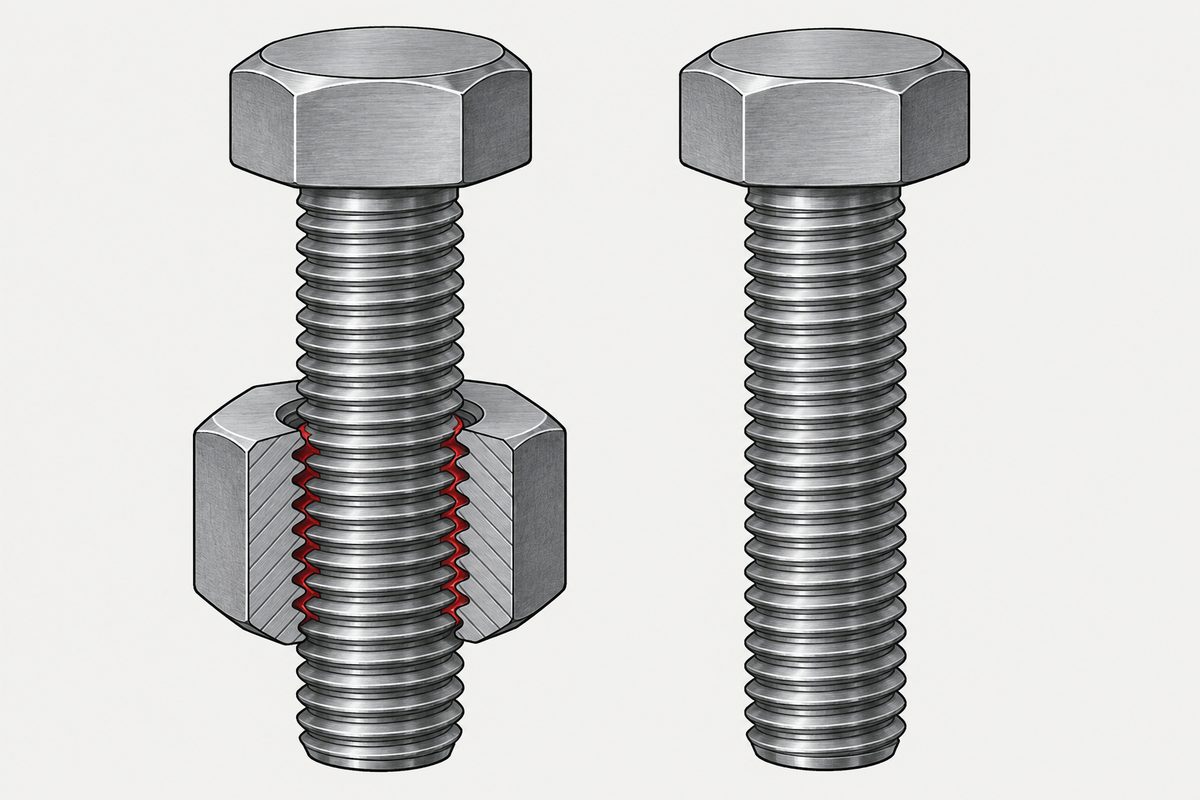
Two entirely different routes
Why screws loosen separates these properly; here only its conclusion is needed:
| Route | What happened | Does threadlocker help |
|---|---|---|
| Self-loosening (rotation) | The screw actually turned relative to the mating thread, classically under transverse cyclic movement | This is its job |
| Preload loss (no rotation) | Embedding and creep consumed the preload — the screw never turned | Almost none |
The reasoning is direct: threadlocker works by resisting relative rotation. If nothing rotates, that resistance is never called upon.
And the second route is a serious risk for small screws — particularly into plastic or soft material, where bearing pressure is high, the material creeps, and preload drains away without the screw moving at all. Treat that as a hypothesis to check rather than an established fact: we found no failure statistics showing it is the most common mode, and diameter alone is not the criterion — grip length, joint stiffness, material, temperature and the applied load matter more. (Why that happens is on the head type page; why it continues after assembly is on the tightening sequence page.)
Applying threadlocker to that case does very little for the underlying problem: it cannot give back clamp displacement already lost to creep or a settled bearing face. Cured adhesive does fill the thread clearance and restrain micro-slip, so a small indirect effect is not impossible — but it is not the remedy, and treating it as one mostly buys the feeling that something was done.
And one thing it is not rated for at all: filling a thread that has already stripped.
How it cures, and why that matters unusually much here
Common threadlockers are anaerobic. Curing needs two conditions together:
- Absence of air — which is why it stays liquid in the bottle and reacts once in the thread
- Contact with active metal ions — the reaction is catalysed by the metal surface
The second condition carries a limit many people never hear about. Some surfaces are described as less active, and commonly cited examples include zinc and zinc-plated steel, stainless, anodised aluminium and titanium, along with cadmium, chromate finishes, gold, silver, magnesium and some black oxides. On those, strength can develop considerably more slowly — manufacturer data for one long-standing grade shows zinc-chromate and stainless well behind steel at 24 hours.
Two things not to over-read, both of which our first version did.
It is not "plated versus unplated". Activity depends on the outermost layer and its post-treatment, not on whether the part was plated — the same manufacturer tables that list zinc as slow list nickel as active.
And it is not a blanket verdict on ordinary screws. Slower is not never, and a lower final strength relative to a steel baseline is not an incomplete cure. Current formulations are explicitly sold for plated and stainless surfaces, several of them primerless. So the honest statement is that the product, the plating chemistry, the passivation, the gap and the temperature all bear on it — read the datasheet for the grade you are actually using.
Where a primer or activator is called for, its job is broader than "adding metal ions": it supplies and accelerates the redox system that initiates polymerisation. One well-known activator contains a copper salt alongside aliphatic amines, and compositions differ between brands.
With adhesive on the thread, your torque figure is no longer your torque figure
This one is easy to skip, and unlike the others it takes effect immediately rather than months later.
The central point of torque and clamp force is that most of the applied torque is spent on friction, and that with the geometry and tightening method fixed, friction is the dominant variable in how much becomes clamp force — a property of that pair in its current state. Putting a substance on the threads changes that state. (Pitch, effective diameter, bearing geometry and the tightening method matter too; they are simply not what changes when adhesive is added.)
This page does not state a direction. Sources disagree on whether uncured adhesive raises or lowers thread friction, and we did not find a basis solid enough to settle it.
What is certain, and what to act on: a torque validated on dry threads is not a validated condition once adhesive is applied. If you are going to use it, revalidate on the actual pair with the actual product.
Into plastic: probably not
Three reasons stack up:
- Compatibility has to be checked. Some anaerobic formulations can cause stress cracking in certain thermoplastics. Datasheet question, not an assumption.
- Plastic does not supply the metal ions the cure needs. With plastic on both sides of the thread, the reaction is short of a condition.
- And it is often the wrong remedy anyway. Creep and stress relaxation are a recognised design problem in plastic joints — enough that compression limiters exist for it — though thread stripping, boss cracking, over-torque and thermal cycling are live alternatives, so treat creep as the leading candidate rather than the assumed cause.
So on plastic parts, reviewing bearing area and the preload design is generally far more useful. (See screws into plastic and choosing a head type.)
So when should it be used
When the failure genuinely is rotation. The classic case is a joint under transverse cyclic movement — the textbook cause of self-loosening, and the problem threadlocker is actually solving.
The other method aimed at the same failure is double-nutting, and it is worth knowing why the literature trusts it so much less: its performance is set entirely during assembly and the finished joint carries no evidence of how it was assembled.
Four things to confirm before reaching for it:
- Substrate. Is it an inactive surface? Is a primer needed?
- Cleanliness. Oil affects both cure and strength.
- Fixture time versus full cure — different numbers. Adhesive generally keeps curing in transit while the anaerobic contact holds, so shipping early is not automatically a failure. The risk is the joint meeting vibration, heat, pressure or chemicals before it has the strength it needs.
- Whether it comes apart again. The wrong strength grade means a service engineer cannot remove it, or removes the thread with it — and if removal needs heat, check what that does to nearby materials.
- Strength grade, service temperature range, thread size and the gap the product fills. Datasheet basics, and where mismatches usually start.
- Where it goes and how much. Application point and coverage — and in a blind hole, the risk of misapplication or of hydraulic pressure splitting the boss.
- The actual service loads and media, and compatibility with any plastic or coating in contact.
The use to avoid is as insurance. "A drop won't hurt" costs you something specific: it masks the real cause — insufficient preload, a crushed bearing face, or tightening conditions that were never controlled. Those do not go away because adhesive was applied. They surface later, and are harder to trace.
Common questions
Does threadlocker stop screws coming loose?
It depends which kind. It resists rotation. Against preload lost to embedding and creep without rotation it does almost nothing, because it cannot restore clamp displacement already lost — a serious risk for small screws, though we found no statistics establishing it as the single most common mode.
Why does it sometimes not cure?
Anaerobic cure needs absence of air and active metal ions. Zinc, stainless, anodised aluminium and titanium are among the less active surfaces, where strength develops more slowly. But it is not plated versus unplated — nickel is listed as active — and current grades are sold for plated and stainless surfaces, several without primer. Read the datasheet for your grade.
Does it change the torque value?
It needs revalidating. This page does not give a direction because sources disagree, but a torque validated dry is not validated with adhesive on the threads.
Can it be used on plastic?
Check the datasheet. Some formulations cause stress cracking in thermoplastics, plastic supplies no metal ions, and creep is the leading loosening candidate in plastic joints — though not the only one.
When should it be used?
When the failure is genuinely rotation, typically under transverse cyclic movement, and after confirming substrate, cleanliness, strength grade, service temperature, gap, application coverage, fixture time against full cure, and removability.
Related
- Why screws loosen — the two routes in full
- Torque and clamp force — why adding anything means revalidating
- Choosing a head type — bearing pressure and creep
- Why tightening order matters — preload lost after assembly
- Screws into plastic — where adhesive is least likely to be the answer
- The order in which to specify a screw — identify the problem before choosing the fix
Enquiries
If you are considering threadlocker, tell us whether the loose screws come out already slack, or are still tight but holding nothing — that one sentence decides whether adhesive is the right answer. Below M6 we make the parts ourselves, so the preload and bearing design can be looked at together.
Request a quotation
Tell us the part and the quantity. We will come back on feasibility, lead time and price.
Or email us directly sales@tigerfasteners.com