 TIGERFASTENERS
What can you put in a hole where the bolt spins free?
The short version: three of the four things people reach for are rated for something real — just not for this. Threadlocker is rated to stop rotation. Tape is rated to seal fluid. Metal putty is rated to be machinable. None of those is a load rating. There is one product class that does publish a number for exactly this job, and noticing which is which is the entire skill.
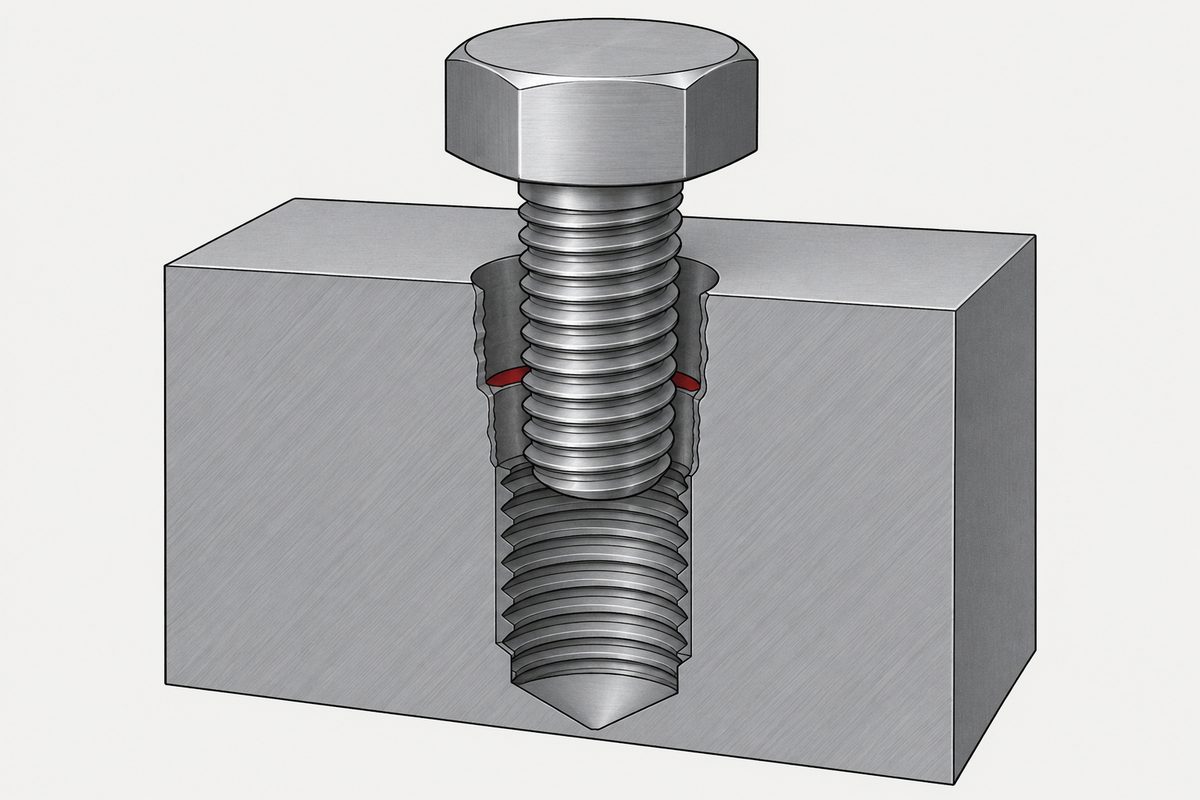
The question, asked eighty-three thousand times
“What can I use as a thread tightener compound for a free-running bolt?” has been read over 83,000 times on DIY Stack Exchange. The instinct is sound: the bolt turns and turns and never pulls up, so the gap needs filling. Something must fill it.
Three of the four usual candidates will not, and each fails for a different reason worth knowing.
Threadlocker: the numbers measure unscrewing
An anaerobic threadlocker cures into an adhesive solid, so it is doing more than adding friction. But look at what its data sheet actually reports. LOCTITE 243 on an M10 steel pair gives breakaway torque 22 N·m and prevailing torque 9 N·m. Those come from ISO 10964, which positions the test as comparing the securing or locking effect: breakaway is the torque to break the bond and first turn the nut; prevailing torque is the continued resistance while unscrewing.
Both measure resistance to rotation. Neither is an axial load. And the specimens in that test are not seated against a clamped joint at all, so there is no preload in the number to begin with. ASTM D5363, which classifies anaerobics, states outright that it is not for engineering design use.
On gap filling, and a distinction that gets lost. Ordinary threadlockers are formulated for normal thread clearance — manufacturer curves are run at controlled gaps in the region of 0.05–0.25 mm, and US Navy fastener guidance uses 0.127 mm of radial thread clearance as the point at which you move to a high-viscosity grade. Those are cure-performance test points and selection thresholds, not a repairable wear allowance. Separately, retaining compounds are a different product class for cylindrical fits — worn shafts, bearing seats, keys — and they genuinely do carry published shear strength (LOCTITE 277 lists at least 9 N/mm² in pin-and-collar compressive shear). Do not carry that number across to a stripped thread.
PTFE tape: the number is fluid pressure
Tape and pipe sealant are specified to seal tapered pipe threads and to act as an anti-galling lubricant during assembly. A tapered thread seals by flank interference, and the tape fills the small helical paths left at crest and root so fluid cannot travel along them.
When a sealant data sheet says 5000 psi, that is the fluid system pressure it will seal against. It is not a tensile or shear strength, and it is not a thread pullout rating. We found no axial load figure published for these products at all.
And here is where the intuition comes from. Wrapping tape on a pipe thread really does make it feel tighter, so people carry the experience across. But that firmness is tapered-thread interference plus the tape being squeezed into the clearance — on a parallel machine thread there is no taper to interfere. Fitting manufacturers do not recommend tape or sealant as the sealing method on straight threads either; those seal with a gasket, an O-ring or a metal face.
That last point has a primary source, which we did not have when this page was written. The scope of ISO 228-1 states that its parallel pipe threads are not suitable as jointing threads, and that a pressure-tight result should be obtained by compressing two tightening surfaces outside the threads with a seal between them. We read it, next to the standard whose title is the same sentence without the word not, in the seal goes outside the thread.
Metal-filled epoxy: machinable is not load-rated
General metal-filled putties often state that once cured they can be drilled, tapped and machined. That is a statement about machinability. It says the material will hold a thread form under a tap. It does not say what that thread will hold under a bolt.
We found no general standard certifying an arbitrary epoxy putty, tapped after curing, as restoring the original thread grade or the original proof load. If the data sheet has no repaired-thread torque or pullout figure, then no such figure exists for it.
The exception, which is the useful part
Now the part that stopped us writing “nothing works”.
Dedicated stripped-thread repair products exist and they publish a number. LOCTITE PC 3967 is sold explicitly as a stripped thread repair kit and tabulates a maximum recommended torque for the repaired thread, by size:
| Size | M6 | M8 | M10 | M12 | M25 |
|---|---|---|---|---|---|
| N·m | 2.6 | 5.1 | 9.3 | 21.8 | 173.8 |
A comparable Permatex kit adds a service temperature range of −54 to 149 °C. Note also that PC 3967 is a dimethacrylate ester rather than the two-part epoxy people usually picture.
So the difference between the products that work here and the ones that do not is not chemistry. It is whether anyone published a figure for this use. That is a test you can apply in a shop, in front of a shelf, without knowing any chemistry at all: does the data sheet give a number for repaired threads, in the size you have?
What that number is not
Read the figures above for what they are: the product's own maximum recommended installation torque. They are not the parent thread's proof load, and they do not restore the joint to what the drawing assumed. The typical applications the manufacturers list are oil pans, valve covers and gearbox housings — sealing and retention duties, not primary structure.
The reason is in how thread capacity is calculated in the first place. NASA's fastener design manual computes pullout from the parent material's shear strength, the mean thread diameter and the effective length of engagement. Every term in that is metal. A repair that does not put metal back does not put those terms back either — which is why the proper repairs work by removing the damaged parent thread and establishing a new complete one, and why the load ends up wherever the first intact thread now sits.
What threadlocker is actually for is in threadlocker. Where thread choices sit in the wider order is in specifying a screw.
References
- ISO 10964 — anaerobic adhesives: determination of torque strength (securing or locking effect)
- ASTM D5363 — classification of anaerobic adhesives; states it is not for engineering design use
- LOCTITE 243 and 277 technical data sheets — breakaway and prevailing torque; controlled bond gaps; pin-and-collar shear for retaining compounds
- LOCTITE PC 3967 stripped thread repair kit — maximum recommended torque by size
- Permatex stripped thread repair kit and PTFE thread sealant data
- Swagelok — tapered versus parallel threads; sealing methods
- NASA RP-1228 — Fastener Design Manual, thread pullout calculation
- “What can I use as a thread tightener compound for a free-running bolt?”, DIY Stack Exchange
This page explains what published product figures do and do not cover. For any actual repair, the governing document is that product's data sheet for your size, material, temperature and load.
This page covers step 2, the thread. The whole order is substrate, thread, head, drive, finish, documentation, and why doing it out of order is rework rather than a tweak is in specifying a screw.
Common questions
Can threadlocker fix a stripped thread?
Not according to what its data sheet rates. Threadlocker figures such as breakaway torque of 22 newton metres and prevailing torque of 9 newton metres for LOCTITE 243 on M10 come from ISO 10964, which measures resistance to unscrewing rather than axial load, on specimens that are not clamped in a joint. ASTM D5363, which classifies anaerobics, states that it is not for engineering design use. No proof load or pullout figure is published for a repaired thread.
Does PTFE tape make a loose bolt hold?
No. Tape and pipe sealant are specified to seal tapered pipe threads and to prevent galling during assembly. When a sealant lists a figure such as 5000 psi, that is the fluid pressure it seals against, not a tensile or shear strength. The reason tape feels like it tightens a pipe thread is tapered flank interference, which a parallel machine thread does not have.
Can I fill the hole with metal epoxy and tap it?
General metal-filled putties often state that they can be drilled and tapped once cured, which is a statement about machinability rather than load capacity. We found no general standard certifying an arbitrary epoxy putty, tapped after curing, as restoring the original thread grade or proof load. If the data sheet gives no repaired-thread torque figure, none exists for that product.
So is there anything that does work?
Yes. Dedicated stripped thread repair kits publish a maximum recommended torque for the repaired thread by size: LOCTITE PC 3967 lists 2.6 newton metres at M6, 5.1 at M8, 9.3 at M10, 21.8 at M12 and 173.8 at M25 against class 8.8 bolts. A comparable Permatex kit adds a service range of minus 54 to 149 degrees Celsius. The difference from the products that do not work is not chemistry; it is that somebody published a figure for this use.
Does a repair kit restore the original strength?
No, and the figures do not claim to. They are the product own maximum recommended installation torque, not the parent thread proof load. Typical listed applications are oil pans, valve covers and gearbox housings. Thread pullout is calculated from the parent material shear strength, the mean thread diameter and the effective length of engagement, all of which are properties of metal, so a repair that does not put metal back does not restore them.
Enquiries
If a threaded hole in a production part keeps stripping, the useful thing is not which compound to try but why the engagement is short. Send the parent material, hole depth and what the joint carries, and we will tell you what we would change.
Request a quotation
Tell us the part and the quantity. We will come back on feasibility, lead time and price.
Or email us directly sales@tigerfasteners.com