 TIGERFASTENERS
The first threads carry most of the load, and nobody can tell you how much
The short version: threads do not share the load evenly, the entry thread takes the largest share, and the size of that share is not a constant. Careful published models put it between roughly 18% and 42%. More importantly, the moment the entry threads are damaged the whole distribution moves — which is why you cannot answer “how much strength did I lose?” by subtracting numbers from a chart.
The question, and the instinct that gets it wrong
“How do I fix a blind bolt hole when the first two or three threads are ruined?” has been read over 11,500 times on Engineering Stack Exchange. The instinct behind it is reasonable: there are another ten threads down there, so surely most of the strength is intact.
The instinct is wrong, but not for the reason usually given — and the correct reason is more useful.
Threads do not share evenly
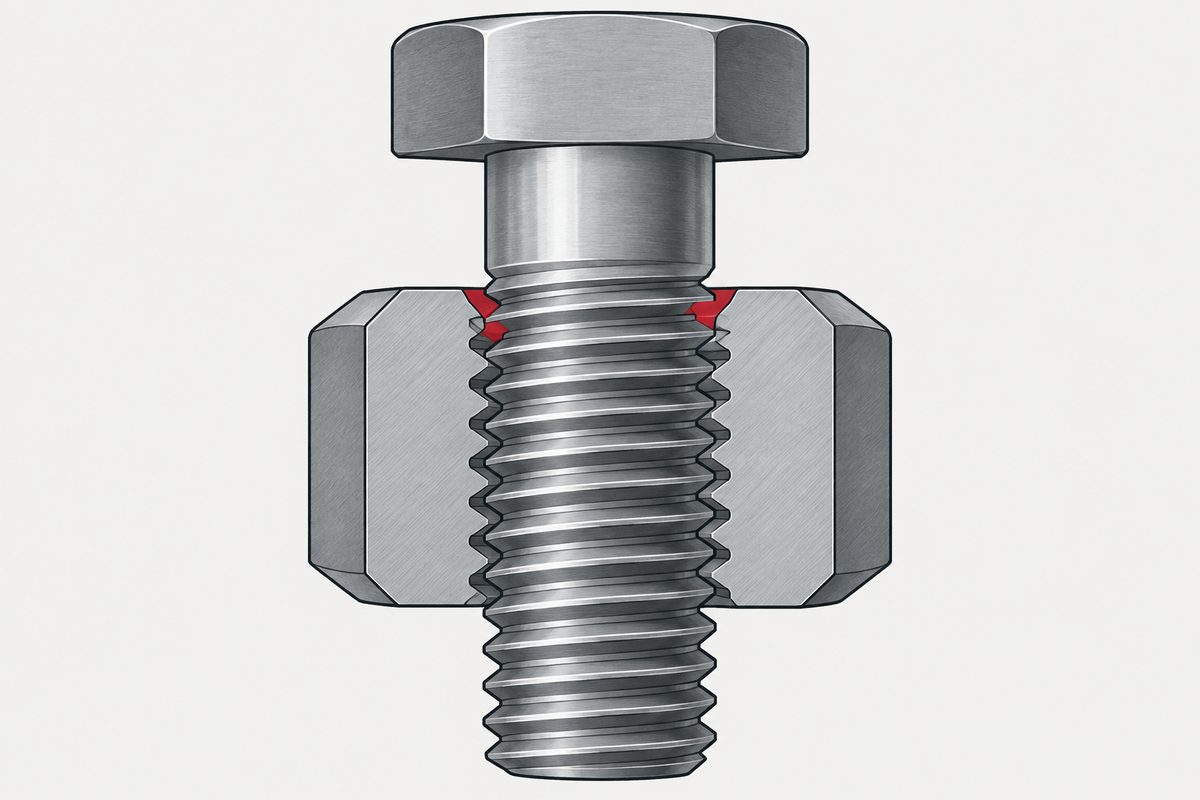
A bolt in tension stretches. A nut in compression shortens. Under load the two no longer present the same thread spacing to each other, and the mismatch is worst where the axial force and the local strain difference are greatest — at the bearing face. So the thread nearest the bearing face takes the largest share, and the share falls off going inwards.
The sequence you will see quoted for this is 34%, 23%, 16%, 11%, 9%, 7% across six threads. It is worth knowing exactly what that is: one photoelastic model of one six-thread joint. It is not a standard, and it is not a constant.
| Source | First thread | Conditions |
|---|---|---|
| Photoelastic six-thread model | 34% | The commonly quoted sequence |
| Hollenbeck, COMSOL 2023 | 21.1–23.9% | 2D axisymmetric, with and without washer |
| Hollenbeck, aluminium nut | 17.7% | Low-modulus internal thread |
| 3D ISO-profile study, 2022 | 33.8–41.9% | Varies with size |
Sopwith, whose 1948 paper is the origin of most of this work, said the peak load intensity can run at two to four times the average or higher, and that it depends on thread form, the proportions of the members, and lubrication. He was describing a range on purpose.
So the honest headline is the spread, not a number. Anything from about a fifth to about two fifths, depending on what the nut is made of, how the parts are proportioned, whether there is a washer, and how it was modelled. A design rule quoting a single percentage is quoting one study.
Why that chart still does not answer the question
Here is the part we got wrong before checking, and it is the part that matters for anyone standing over a damaged hole.
That distribution describes a joint where every thread is intact and in contact. Strip the first two, and they are not carrying 34% and 23% any more. They are carrying nothing. The load entry simply moves inwards: the first still-intact thread becomes the new first thread, and it picks up the concentration that used to sit above it.
So you cannot subtract. There is no sense in which losing the first three threads means losing 73% of the strength. What you have actually lost is effective engagement length, shear area, and the integrity of the entry region — and how much that matters depends on how much length was there to begin with.
Is damage at the entry worse than the same damage deeper down? Likely but unquantified — those threads were doing more in the intact case, and we found no published test that compares the two. But “probably” is as far as the published work lets you go — quantifying it would need the damaged geometry re-analysed or a pull-out test, and we did not find that comparison in the literature.
What yielding does, and why it is not a safety margin
The uneven distribution is an elastic result. Once the highest-loaded threads yield locally, further load shifts to the ones behind them and the distribution evens out. Sopwith noted that the peak is almost insensitive to nut length unless yielding occurs.
That sounds like free margin. It is not. The yielding is local — at the flank or root, not through the bolt — it leaves permanent deformation, and it is unhelpful for fatigue, for repeated disassembly, and for holding preload. It is not a basis for leaving damaged threads in service.
Which is why the repairs work the way they do
Read the three common repairs against the above and each one becomes legible:
- Drill and tap deeper, use a longer bolt. Buys back usable engagement length below the damage. It does not repair the entry threads and it does not remove the concentration — that just relocates to whichever thread is now first.
- A wire insert or solid bushing. Removes the damaged parent threads and establishes a fresh, complete internal thread. This is what the FAA's airframe maintenance guidance lists for repairing damaged internal threads. Its job is restoring thread form and engagement, not evening out the load.
- A thread chaser. Cleans debris, burrs and light deformation. We found no support for the idea that it restores material that has been torn out, or the original strength of a badly damaged thread. If material is gone, chasing it will not bring it back.
The common thread, so to speak: these restore enough intact engagement with a correct thread form. None of them makes the threads share equally, because nothing does.
Two things this does not license
“More engagement is proportionally stronger.” No. Lengthening an ordinary nut does little to the first-thread peak — Bickford makes this point directly. Extra length still buys total stripping area, tolerance for incomplete entry threads and local damage, and it matters more in softer parent material. But there is no universal “beyond N diameters it does nothing”. Bickford's roughly 0.8d guidance for steel fasteners is a starting point, not a cliff, and other materials need an actual stripping calculation.
“A standard nut is 0.8d tall because of load distribution.” Not primarily. The modern standard heights follow from nut proof load, thread stripping, and being strength-compatible with the bolt they are sold to match.
One more boundary: a tapped hole is not a nut. The surrounding material's diameter, thickness and stiffness change how load enters, so the percentages above should not be carried across to a threaded hole in a casting or a plate. Blind versus through matters less than what sits around the first load-bearing thread.
The pattern worth taking away
When careful studies of the same quantity land between 17.7% and 41.9%, the spread is the finding. Picking one number and calling it the answer is the error — and it is the same error behind engagement-length rules that disagree with each other.
For repair decisions, see stripped threads; for how much engagement to specify in the first place, see thread engagement; and for where these choices sit in order, see specifying a screw.
References
- D. G. Sopwith, “The Distribution of Load in Screw Threads”, Proc. IMechE 159 (1948), pp. 373–383
- C. Hollenbeck, COMSOL Conference Munich 2023 — 2D axisymmetric thread load distribution
- Numerical study of bolt thread geometry, Journal of Engineering Research 10(2B), 2022
- J. Bickford, Introduction to the Design and Behavior of Bolted Joints, ch. 2 — engagement length and thread strength
- FAA AC 65-9A, “Repair of Damaged Internal Threads” — bushings and wire inserts
- “Fixing a blind bolt hole when the first 2-3 threads are ruined?”, Engineering Stack Exchange
This page explains a mechanism and the spread in the published values for it. Acceptance for any particular joint is governed by your drawing, the standards it invokes, and where required an actual calculation or test.
This page covers step 2, the thread. The whole order is substrate, thread, head, drive, finish, documentation, and why doing it out of order is rework rather than a tweak is in specifying a screw.
Common questions
How much load does the first thread carry?
There is no single figure. Published models put the first engaged thread anywhere from about 17.7% for a low-modulus aluminium nut to 41.9% in a three-dimensional ISO-profile study. The commonly quoted 34/23/16/11/9/7 sequence is one photoelastic model of one six-thread joint. Sopwith, whose 1948 paper underlies most of this, said peak intensity can be two to four times the average depending on thread form, proportions and lubrication.
If the first three threads are stripped, have I lost 73% of the strength?
No, and the arithmetic does not work that way. Once those threads are damaged they are not carrying their original share; the load entry moves inwards and the first still-intact thread picks up the concentration. What you have lost is effective engagement length, shear area and the integrity of the entry region, not a percentage off a chart.
Is damage at the entry worse than damage deeper in the hole?
Probably, because those threads were carrying more when everything was intact. But the intact-joint distribution does not prove it, and we found no published test quantifying the difference. Treating it as likely rather than proven is the accurate position.
Does adding engagement length make the joint proportionally stronger?
No. Lengthening an ordinary nut does little to reduce the first-thread peak. Extra length does buy total stripping area, tolerance for incomplete or damaged entry threads, and it matters more in softer parent material. There is no universal point beyond which it does nothing; the roughly 0.8 diameters often quoted for steel is a starting guideline, not a cliff.
Will a thread chaser fix a damaged tapped hole?
It cleans debris, burrs and light deformation. We found no support for the idea that it restores material that has been torn out or recovers the original strength of a badly damaged thread. Where material is gone, a wire insert or solid bushing removes the damaged parent thread and establishes a new complete one; the FAA lists both for repairing damaged internal threads.
Enquiries
If you are deciding between a longer screw into deeper thread and an insert, the thing that usually settles it is how much intact engagement is left below the damage. Send the hole depth, the material and what the joint is holding, and we will tell you which way we would go.
Request a quotation
Tell us the part and the quantity. We will come back on feasibility, lead time and price.
Or email us directly sales@tigerfasteners.com