 TIGERFASTENERS
Thread engagement: make the screw fail, not the hole
The short version: the design target is not “as much as possible”. It is that the screw gives way before the female thread does — a broken screw is visible, predictable and replaceable, while a stripped thread usually condemns the parent part. The 1×D figure people quote comes from steel into steel; softer material needs more. And at small sizes there is a second effect that gets missed: pitch does not scale with diameter, so the same 1×D buys fewer whole engaged threads than it does further up the range.
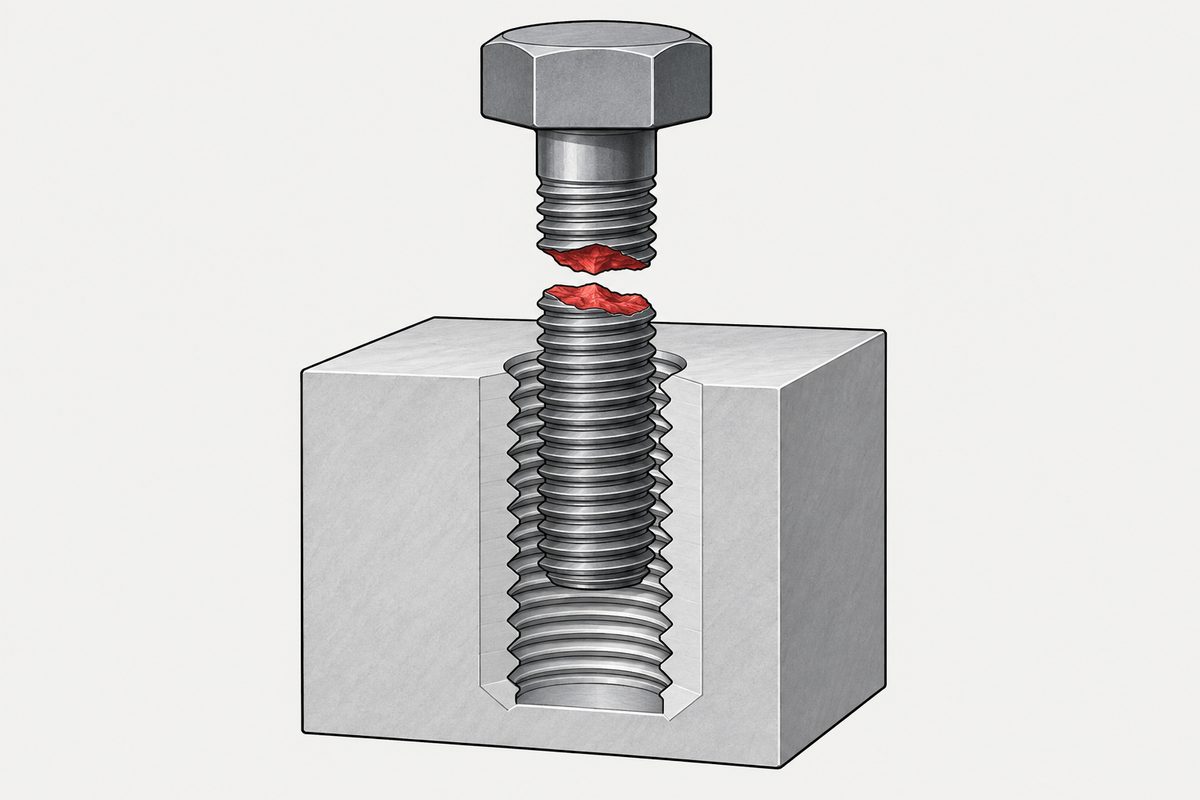
The design target: put the weak link on the screw
Pull a threaded joint apart and there are only two outcomes: the screw breaks, or the female thread strips. They do not cost the same:
| Failure | Is it visible | Recovery |
|---|---|---|
| Screw breaks | An obvious fracture; found on removal | Fit another one |
| Thread strips | Often just “it will not tighten” | Re-tap, fit an insert, or scrap the part |
Where the multiples themselves come from, and why one forum thread can produce eight of them, is worked through separately in why every source gives a different minimum.
So engagement is sized until the screw is the first thing to go. That is not conservatism — it is putting the failure on the cheap, visible side.
When the mating part is a nut rather than a tapped hole, the standard names the intended failure mode outright: the nut has one number.
So one diameter of engagement — and diameter is not what sets it
What the female thread can carry is the sheared thread area times the shear strength of the parent material. What the screw can carry follows from its section and its own material. To make the screw lose, the product on the female side has to be large enough — and the softer the parent material, the more length is needed to make up the area.
- Steel into steel: around 1×D is the figure usually quoted
- Aluminium, cast iron and similar: generally noticeably more
- Plastics: separate practice per resin; metal figures do not transfer
⚠️ These are rules of thumb, not design values from a standard. They assume a parent strength, a thread form and a level of manufacturing quality. The number you use should be established on the real material and the real screw — which is the same measurement as driving and stripping torque.
Hole depth is not engagement
Several parts of a measured hole depth carry nothing:
- The chamfer at the mouth has no full thread
- Incomplete threads where tapping begins
- Clearance at the bottom of a blind hole, for swarf and for tolerance
- Incomplete threads and the run-out on the screw itself
Treating hole depth as engagement overstates the loaded turns. At large sizes the error is diluted; at small sizes it can account for more than half.
The small-size trap: 1×D buys fewer whole threads, not less area
Pitch does not shrink in proportion to diameter. The same phrase, one diameter of engagement, describes quite different amounts of thread:
| Size | Coarse pitch | 1×D ≈ turns |
|---|---|---|
| M1.0 | 0.25 | 4.0 |
| M1.4 | 0.3 | 4.7 |
| M1.6 | 0.35 | 4.6 |
| M2.0 | 0.4 | 5.0 |
| M3.0 | 0.5 | 6.0 |
| M5.0 | 0.8 | 6.3 |
“One diameter is fine”, carried down from M3 and above, is about 4.7 turns at M1.4. The rule kept its name and lost a fifth of its whole threads — which matters for a different reason than the one usually given.
Fewer turns is not less shear area. The section above gave the quantity that matters without working this part through: what the female thread carries is sheared area times the parent's shear strength — and that area is 0.875 π·d·Le, with the pitch cancelling, because more turns each carry proportionally less width. At 1×D the ratio of that area to the screw's own stress area comes out at 5.97 at M1 against 4.85 at M5. On that geometry, one diameter is if anything more conservative at the small end — for the same material pairing. What sets stripping is that area times the parent's shear strength against the screw's stress area times its tensile strength, so this says M1 is not worse than M5, not that one diameter is enough in a soft parent. The section above already said it is not.
What the turns column really measures is how much one whole thread is worth. An incomplete entry thread, a chamfer taking a turn, or one badly knocked thread costs a quarter of the engagement at M1 and a sixth at M5. That is the small-size trap, together with plating and form error, which do not scale down either — not a loss of shear area that the geometry says is not there.
Three changes that quietly spend engagement
- Shortening the screw. The standard move for a stack-up problem — and it takes turns of thread straight off
- Switching to a countersunk head. The head sinks into the hole, so at the same overall length there is less shank available (and the angle has to be paired too)
- Adding a washer or thickening the clamped parts. More grip length means less thread in the parent material
Individually all three look trivial. Together they are a common source of the lot that “will not tighten”. Recomputing engagement after a change costs less than chasing the failures later.
Where this sits in the sequence
Engagement length is part of the thread decision, and the thread is step two of six. What comes before it decides what kind of thread can exist at all, and what comes after is constrained by it — the order the decisions happen in lays out the whole path for someone specifying a screw for the first time.
One thing engagement length does not buy is an even share across the threads — the entry thread always takes the most, and how much is not a constant.
Request a quotation
Tell us the part and the quantity. We will come back on feasibility, lead time and price.
Or email us directly sales@tigerfasteners.com
Enquiries
Setting engagement, or already stripping threads? Send the parent material, the thickness and the screw specification in use. We will tell you which side this combination fails on, and what would have to be measured to confirm it.