 TIGERFASTENERS
Pilot hole size: the screw diameter does not decide it
The short version: there is no single correct pilot hole, there is a window. Too large and there is not enough thread engagement, so it strips before it is tight. Too small and driving torque climbs until something gives — a snapped head, a split boss, a cracked casting. The useful exercise is not looking up a diameter. It is measuring driving torque and stripping torque and seeing how far apart they are — that gap is your process margin. This page covers what moves the window, and what to ask the screw supplier for.
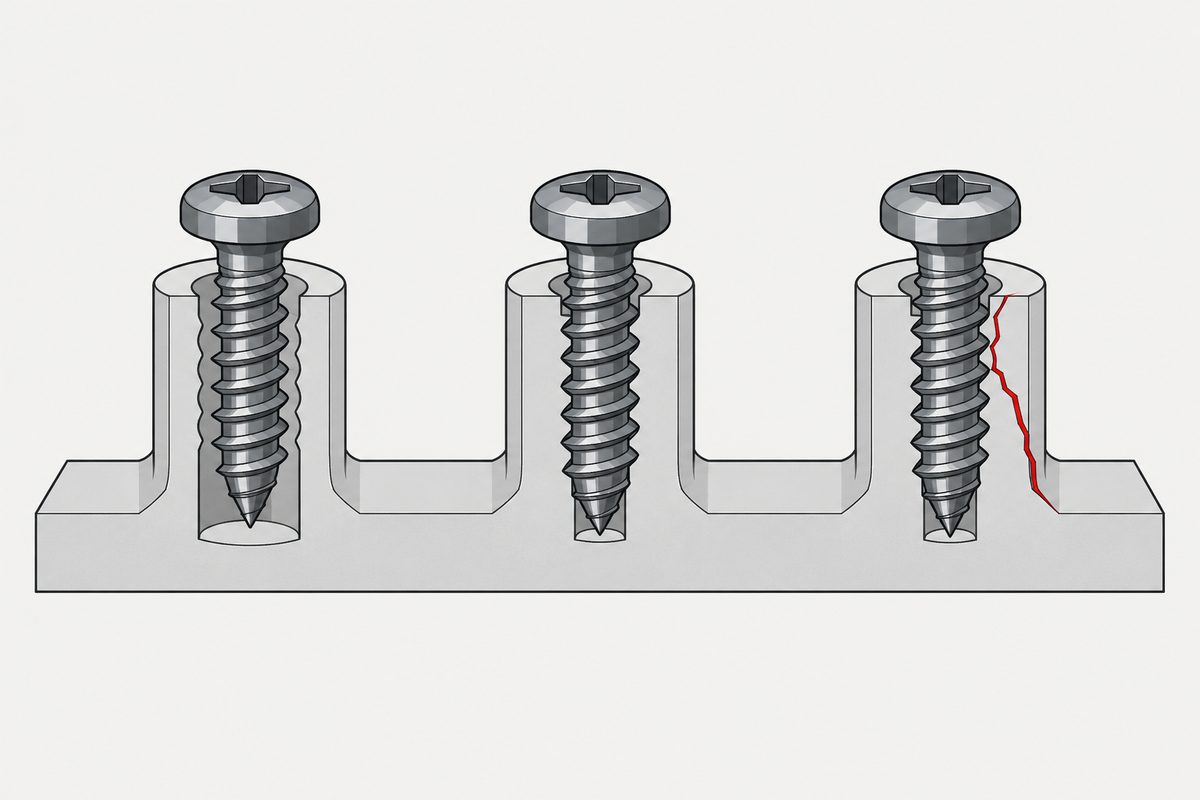
Everyone expects a number, and that is reasonable
Every other dimension on the drawing is a number with a tolerance. Ask what size hole a screw needs and you expect the same thing back: a value, maybe plus or minus something.
Charts encourage it. Open any tapping-drill table and there is one figure per size, printed with no more hesitation than a thread pitch. So when a supplier answers "it depends", it sounds like they are avoiding the question.
So look up the hole size — and there is no single right one
Both ends fail, and they fail differently:
| Direction | Immediate effect | What the line sees |
|---|---|---|
| Hole too large | Not enough engagement, so axial capacity drops | Spins part way in; torque never builds |
| Hole too small | Driving torque climbs toward the torsional limit of the screw | Snapped heads; split bosses; longer cycle time |
Both get logged as “bad screws”. Spinning looks like a badly formed thread and snapping looks like the wrong material — and both can be purely a hole problem, in which case changing supplier changes nothing.
What moves the window
- How the thread is made. Cutting and forming want different holes, and the forming window is distinctly narrower
- Parent material. Steel, aluminium, castings and each plastic yield and flow differently; numbers do not transfer between them
- Thickness (or boss wall). The same hole gives a different number of engaged threads in thin and thick material
- How the hole is made. Punched, drilled and cast holes differ in wall condition and in the spread of actual diameters
- Plating. Coating inside the hole reduces the effective diameter; coating on the screw changes friction (the allowance problem at small sizes)
Timber is the one parent where a published rule does name the material, and it is worth reading closely because it is keyed to a diameter most charts do not use. The Wood Handbook puts the lead hole at about 70 per cent of the root diameter in softwoods and about 90 per cent in hardwoods, and gives a different set of percentages, taken from the shank, for lag screws. Which diameter the percentage belongs to moves the hole further than the percentage does.
Measure torque, not diameter
The hole is only the means. Two torques are the thing actually being controlled:
- Driving torque — what it takes to seat the screw
- Stripping torque — where the female thread fails
The gap between them is the process window. A wide gap means the torque setting on the line tolerates drift; a narrow one means a small shift in hole size or driver accuracy puts you through the floor or the ceiling.
So the question for a supplier is not “what hole should I drill”. It is “in my material, at my thickness, what are the driving and stripping torques”. A supplier who can produce those two numbers has actually run it under your conditions.
Why small sizes are harder to hold
As parts shrink, the absolute tolerance on the hole does not shrink with them — punching and drilling deviations stay in the same range while the usable window narrows. At the same time the torsional strength of the screw falls steeply with diameter, so the ceiling sits closer to the driving torque.
Which is the same reason that, in this size range, there is progressively less standard text to copy: fixturing, method and acceptance usually have to be agreed between the parties.
This page covers step 2, the thread. The whole order — substrate, thread, head, drive, finish, documentation — and why doing it out of order is rework rather than a tweak, is in specifying a screw.
Four things to settle before release
- The recommended hole and its tolerance, and which material it was established in
- Driving and stripping torque for that material at that thickness
- How the hole is produced, and the real distribution of diameters — not the nominal on the drawing
- Whether plating is in the hole or on the screw, and how thick
Enquiries
Setting a pilot hole, or already seeing spin-outs and snapped heads? Send the parent material, the thickness and the hole you are using now. We will tell you whether this is the hole or the screw, and what would have to be tested to be sure.
Request a quotation
Tell us the part and the quantity. We will come back on feasibility, lead time and price.
Or email us directly sales@tigerfasteners.com