 TIGERFASTENERS
Whether That Locknut Goes Back On Is a Measurement, Not a Count
Somebody noticed that a nylon lock nut on their engine mount had been put back on and was not sitting flush, and was told that those nuts do not always seat fully. Four hundred and nineteen upvotes, seventy six replies. There is a free document that has three separate things to say about that situation, and the most useful of them is not about the nut at all: it is that whether a self-locking nut may be reused is settled by measuring what it still does, not by counting how many times it has been on.
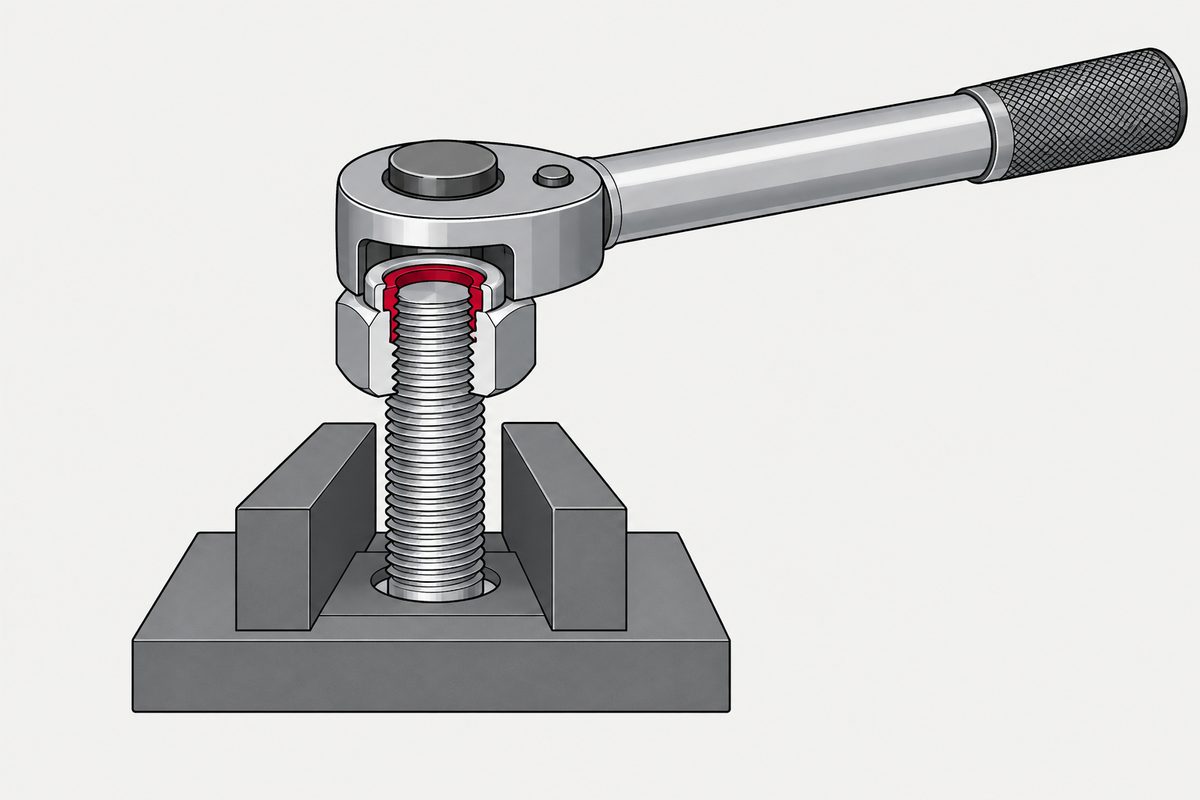
“DO NOT reuse a fiber or nylon locknut, if the nut cannot meet the minimum prevailing torque values.” That sentence, and the table it points at, are the whole idea. The criterion is not a number of installations. It is a torque you measure on the nut in your hand, compared against a minimum for its thread size.
The document is an aircraft maintenance document. It is FAA advisory circular AC 43.13-1B, Acceptable Methods, Techniques, and Practices, Aircraft Inspection and Repair, dated 8 September 1998, six hundred and forty six pages, free to download in full. It is not a rule for cars, machinery or buildings, and nothing here should be applied to one. We quote it because it is free, complete, and because on this particular question it does something almost nothing else does: it gives a measurable criterion instead of a policy.
We also do not diagnose the engine mount in the forum post, which we have not seen, and we do not evaluate what that mechanic said about that nut. No vehicle is named.
The same requirement, three times, in three chapters
Before the reuse question there is a simpler one about how far the nut should go on, and this document answers it three separate times. That repetition is our observation, but the three sentences are its.
7-37: “All bolt installations which involve self-locking or plain nuts should have at least one thread of the bolt protruding through the nut.”
7-64 f: “After the nut has been tightened, make sure the bolt or stud has at least one thread showing past the nut.”
8-9 c: self-locking nuts may be used on aircraft engines “when there is at least one full thread protruding beyond the nut”.
A general bolt installation clause, a clause specifically about fibre and nylon locknuts, and a clause about self-locking nuts on engines. Three chapters, one requirement, repeated in slightly different words. A document that says the same thing three times is telling you which thing people get wrong.
Notice what it is a rule about, though. It is about the bolt reaching through, not about the nut sitting flat against anything. Those are different questions, and this document only answers the first.
The table that answers the reuse question
Table 7-2 is titled Minimum prevailing torque values for re-used self-locking nuts. It has a fine thread series and a coarse thread series, nine sizes each, in inch-pounds.
| Fine | Minimum | Coarse | Minimum |
|---|---|---|---|
| 7/16 to 20 | 8 | 7/16 to 14 | 8 |
| 1/2 to 20 | 10 | 1/2 to 13 | 10 |
| 9/16 to 18 | 13 | 9/16 to 12 | 14 |
| 5/8 to 18 | 18 | 5/8 to 11 | 20 |
| 3/4 to 16 | 27 | 3/4 to 10 | 27 |
| 7/8 to 14 | 40 | 7/8 to 9 | 40 |
| 1 to 14 | 55 | 1 to 8 | 51 |
| 1 1/8 to 12 | 73 | 1 1/8 to 8 | 68 |
| 1 1/4 to 12 | 94 | 1 1/4 to 8 | 88 |
Values in inch-pounds. This is a reuse criterion, not a tightening torque.
That distinction deserves a sentence of its own, because the two get confused. This is not what to tighten the nut to. It is the drag the nut must still be able to produce on a clean thread before it is allowed back into service. The tightening torques in this document are elsewhere and are not reproduced here.
Put the two columns side by side and something falls out, and the subtraction is ours. At four sizes the two series ask for exactly the same figure: 7/16, 1/2, 3/4 and 7/8. At two sizes coarse asks for more, by one and by two inch-pounds. At the three largest sizes fine asks for more, by four, five and six. The two series cross over somewhere around three quarters of an inch, and the document offers no explanation for the shape.
The number you add is one you measured
This site has written before about the prevailing torque figure on a data sheet being a limit rather than a number to add. AC 43.13-1B appears at first glance to say the opposite. Its tightening procedure says this:
c. “Run the nut down to near contact with the washer or bearing surface and check the friction drag torque required to turn the nut. Whenever possible, apply the torque to the nut and not the bolt.”
d. “Add the friction drag torque to the desired torque. This is referred to as final torque, which should register on the indicator or setting for a snap-over type torque wrench.”
The two documents do not disagree, and the difference between them is the point. The catalogue figure is a specification limit for a population of nuts and adding it to a torque is arithmetic on the wrong number. The friction drag in step c is measured on the nut being installed, a minute before it is installed. One is a number you looked up; the other is a number you took. Only the second one belongs in the sum.
The rest of that procedure is worth having for the same reason. Threads clean and dry unless the manufacturer says otherwise. Torque applied to the nut rather than the bolt where possible, to reduce rotation of the bolt in the hole. A smooth even pull, and if chattering or a jerking motion occurs, back off the nut and retorque. A note warns that the torque is for the size of the bolt shank, not the wrench size. And the torque wrench is to be calibrated at least once a year, or immediately after it has been abused or dropped.
One more note in that clause is a whole subject in three lines. “Many applications of bolts in aircraft engines require stretch checks prior to reuse. This requirement is due primarily to bolt stretching caused by overtorquing.” The bolt is measured before it goes back, for the same reason the nut is. Reuse is a measurement in both directions.
Where a self-locking nut is not allowed at all
Clause 7-64 spends most of its length on prohibitions, and they are specific enough to be useful outside their own domain as a way of thinking.
- Not on parts subject to rotation. The clause opens with it, in capitals
- Not where a loose nut could be drawn into a turbine engine air intake. The failure being guarded against is not the joint coming apart, it is where the pieces go
- Not to attach access panels or doors, or to assemble any parts that are routinely disassembled before or after each flight
- Permitted with anti-friction bearings and control pulleys, but only if the inner race of the bearing is secured to the supporting structure by the nut and bolt
- Fibre and nylon types not installed where temperatures exceed 250 degrees Fahrenheit
The third one is the interesting one for anybody who has ever put a nyloc on something they were going to take off again next week. The objection is not that it will fail. It is that a locking feature which works by being deformed once is the wrong choice for a joint whose job is to come apart.
The clause also explains how the fibre type works in one line: the insert is unthreaded and has a smaller diameter than the nut, so the thread cuts into it on the way through. That is the whole mechanism, and it is why the criterion for reuse is a drag torque rather than a visual check.
The two things that are never reused
Set the locknut against its neighbours in the same sentence. Clause 7-38: “Lock or safety all bolts and/or nuts, except self-locking nuts. Do not reuse cotter pins or safety wire.”
Three safetying devices appear there and they are treated in two ways. Cotter pins and safety wire are single use, full stop, and clause 8-8 repeats it: “Do not use cotter pins and safety wire a second time.” The self-locking nut is the exception, and even its exception carries the condition in Table 7-2. It is the only one of the three whose reuse is a question at all.
What the wire itself is for, and where it is deliberately made weak enough to shear, is a subject of its own in the same chapter.
Clause 8-8 has one more item that catches people out: lock washers must be replaced at overhaul unless the manufacturer’s recommendations permit their reuse, alongside flat steel wrist pin retainers.
And for the castellated nut, the alignment rule is a bracket rather than a value. Start alignment with the cotter pin hole at the minimum recommended torque plus friction drag. “Do not exceed the maximum torque plus the friction drag. If the hole and nut castellation do not align, change washer or nut and try again.” When the slot does not line up, the answer is a different washer, not another few degrees.
What to take from it
- Reuse of a self-locking nut is decided by measurement. Do not reuse a fibre or nylon locknut if it cannot meet the minimum prevailing torque for its thread size
- That table is a reuse criterion, not a tightening torque. The two are different numbers doing different jobs
- The two thread series cross over. Equal at four sizes, coarse higher at two, fine higher at the three largest, with no explanation offered
- At least one thread through the nut, said three times in three chapters
- The drag you add to a torque is one you measured on that nut, not one from a data sheet, which is a limit for a population
- Cotter pins and safety wire are never reused, and lock washers are replaced at overhaul unless the manufacturer permits otherwise
- A castellated nut that will not align wants a different washer, not more torque past the maximum
- Self-locking nuts are wrong for anything routinely taken apart, and for parts subject to rotation
- This is an aircraft document. It is quoted for how it reasons, not as a rule for anything else
The forum question was whether to be concerned. This page cannot answer that about a car it has not seen. What it can say is that in at least one field, the argument about whether a used locking nut is still a locking nut was settled a long time ago by putting a torque wrench on it.
The same document treats identification the same way. It never uses a grade word, and requires traceability to an approved source instead.
This is not one of the six steps. It shows up across them, or after assembly. Where the decisions that lead here were made is in specifying a screw, which sets out the order and why doing it out of order is rework.
Common questions
Can a nylon lock nut be reused?
AC 43.13-1B does not answer with a count. It says do not reuse a fibre or nylon locknut if the nut cannot meet the minimum prevailing torque values, and gives those values by thread size in its Table 7-2. So in that document reuse is a measurement on the nut in front of you, not a number of previous installations.
What are the minimum prevailing torque values?
Table 7-2 lists nine sizes in each of two thread series, in inch-pounds: for the fine series 8 at 7/16, rising to 94 at 1 1/4, and for the coarse series 8 at 7/16, rising to 88 at 1 1/4. It is a reuse criterion, not a tightening torque.
Do the fine and coarse series ask for the same thing?
Not quite, and by our subtraction they cross over. The two are equal at 7/16, 1/2, 3/4 and 7/8. Coarse asks for more at 9/16 and 5/8, by one and two inch-pounds. Fine asks for more at 1 inch, 1 1/8 and 1 1/4, by four, five and six. The document offers no explanation.
How far should a nut go onto the bolt?
This document says at least one thread of the bolt should protrude through the nut, and it says it three times: in the general bolt installation clause, in the clause on fibre and nylon locknuts, and in the clause on self-locking nuts for aircraft engines. It is a rule about the bolt reaching through, not about how the nut sits against the surface.
Should prevailing torque be added to the tightening torque?
Those are two different numbers. The value printed on a product data sheet is a specification limit for a population of nuts, and this site has covered why adding it is arithmetic on the wrong figure. What AC 43.13-1B says to add is the friction drag torque measured on the nut being installed, moments before it is installed. The sum is what it calls final torque.
Can cotter pins or safety wire be reused?
Not in this document. Clause 7-38 says do not reuse cotter pins or safety wire, and clause 8-8 repeats that they are not to be used a second time. It adds that lock washers must be replaced at overhaul unless the manufacturer permits their reuse.
What if a castellated nut will not line up with the cotter pin hole?
The clause gives a bracket rather than a value. Start alignment at the minimum recommended torque plus friction drag, and do not exceed the maximum torque plus the friction drag. If the hole and the castellation do not align, change the washer or the nut and try again.
Where should a self-locking nut not be used?
The clause lists several cases: not on parts subject to rotation, not where a loose nut could be drawn into a turbine engine air intake, and not to attach access panels or doors or to assemble parts that are routinely disassembled before or after each flight. Fibre and nylon types are not installed where temperatures exceed 250 degrees Fahrenheit.
Does this apply to my car?
No, and this page does not claim it does. AC 43.13-1B is an FAA advisory circular for aircraft inspection and repair. It is quoted here because it is free to read in full and because it settles a common argument with a measurement rather than an opinion. It is not a rule for any vehicle, machine or building.
References
- FAA AC 43.13-1B, Acceptable Methods, Techniques, and Practices, Aircraft Inspection and Repair, with Change 1. Complete, free, 646 pages. Paragraphs 7-37, 7-38, 7-40, 7-64, 8-8, 8-9 and Table 7-2
- r/MechanicAdvice, where a nylon lock nut that was not sitting flush produced the question
AC 43.13-1B was downloaded in full from the FAA and read for the paragraphs cited. It is an aircraft inspection and repair document. It is not a rule for cars, machinery, buildings or anything else, and nothing on this page should be applied to one. It is quoted because it is free and complete, and because on the reuse question it gives a measurable criterion rather than a policy. We do not diagnose the engine mount in the forum post, which we have not seen, we do not evaluate what the mechanic said about that particular nut, and no vehicle make or model is named. The tightening torque tables in this document are not reproduced here. Table 7-2 is quoted in full because it is a reuse criterion rather than a tightening torque, and the difference is stated in the text. The following are our own counting and arithmetic, not statements by the document: that the requirement for one thread to protrude appears three times in three chapters, and the comparison of the fine and coarse columns of Table 7-2 showing four equal sizes, two where coarse is higher and three where fine is higher. The document offers no explanation for that pattern and we do not offer one. The AN, MS and NAS part specifications this circular cites have not been read. We read the forum post and not its replies. Why the figure on a product data sheet is a limit rather than a number to add, and how the fifth removal test is run, are covered on an earlier page and in the article on putting a screw back, and are not repeated here.
Enquiries
If a locking nut on your drawing is going to come off and go back on in service, say so, because that changes which locking method belongs there. A feature that works by being deformed once is a different proposition from one designed for repeated assembly, and the decision is easier before the first build than after the third service.
Request a quotation
Tell us the part and the quantity. We will come back on feasibility, lead time and price.
Or email us directly sales@tigerfasteners.com