 TIGERFASTENERS
Rolled or cut: the blank is thinner than the finished screw
The short version: a rolled thread is not cut into the material, it is pushed out of it. The blank starts at roughly the pitch diameter — below the finished major diameter — and the dies displace metal outward to form the crest. Nothing is removed, so there is no swarf and no severed grain. That one geometric fact explains the fatigue difference, the cost difference, and a failure mode that leaves the parts looking perfect.
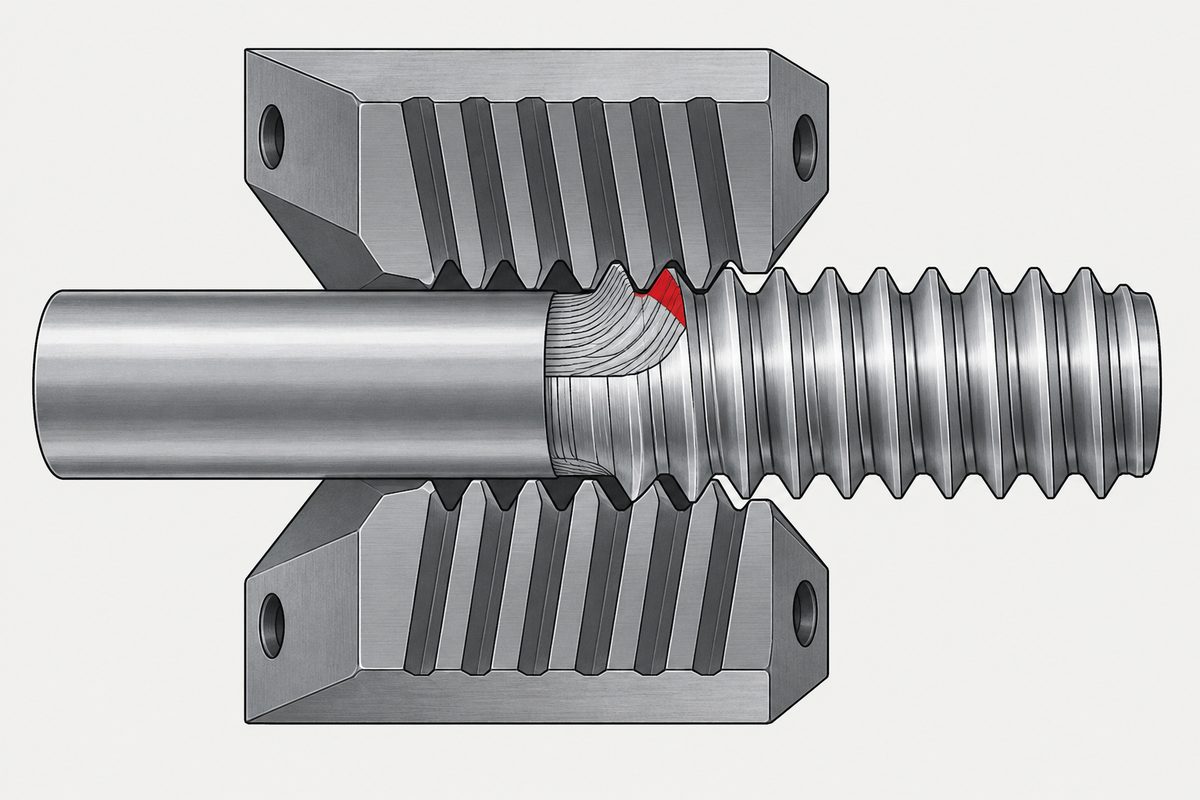
The two processes, side by side
| Rolled (cold formed) | Cut (single point, die, tap) | |
|---|---|---|
| Starting blank | Smaller than the finished thread, near pitch diameter | Equal to the finished major diameter |
| Material | Displaced — no swarf | Removed — swarf, and the swarf has to go somewhere |
| Grain at the root | Follows the thread contour, uninterrupted | Severed — grain runs straight past the root |
| Residual stress at the root | Compressive — delays crack initiation | Neutral at best, tensile at worst |
| Surface at the flank | Burnished and work-hardened | As-cut, with tool marks running across the thread |
Read the first row again, because it is the one people get wrong. A rolled M3 screw does not start life as a 3 mm bar with material taken off. It starts smaller and grows. If you measure the wire and the finished screw and the wire is thinner, nothing is wrong — that is the process working.
Why the root is the whole argument
Fatigue cracks in a threaded fastener start at the thread root, because that is where the section is smallest and the stress concentration highest. Everything that separates the two processes converges on that one location:
- Cutting severs the grain exactly there, leaving grain ends exposed at the highest-stress point in the part
- Rolling bends the grain around the root instead, so it runs continuously through the contour
- Rolling also leaves the root in compression. An applied tensile load has to cancel that compression before it can begin to open a crack
Published comparisons commonly put rolled threads well ahead of cut threads in fatigue life, with figures varying by material, heat treatment and test method. Treat the mechanism as the reliable part and the numbers as indicative — the direction is consistent across sources, the magnitude is not.
Below M6 there is barely a decision to make
- The benefit is largest where the root is smallest. On a fine pitch at M2 the root radius is a fraction of a millimetre, and a severed grain there is a much larger proportion of the load path
- Cutting a thread on a small blank is slow and fragile. Holding an M1.6 blank rigidly enough to cut a clean thread is a fixturing problem that rolling does not have
- Volume settles it. Rolling is a forming operation measured in parts per minute; cutting is measured in seconds per part
So “is it rolled or cut” is rarely the right question to ask a small-screw supplier — below M6 the answer is almost always rolled. The question that separates suppliers is the next one down: how the dies are monitored.
The failure mode nobody sees
Rolling dies wear. They do not chip or break in a way that shows up on the part — they wear gradually, and the effect is that the pitch diameter drifts.
- The parts look perfect. Crest, flank and finish all appear normal to visual inspection and to a projector silhouette
- They start failing a go/no-go ring gauge — or worse, they pass at the supplier and bind on the customer’s line after coating adds its share
- The onset is gradual, so a fixed final-inspection sample catches it late. What catches it early is gauging frequency during the run, not tighter limits at the end
This is why the coating conversation and the die conversation are the same conversation. A pitch diameter drifting toward the top of tolerance plus a coating that the tolerance never set anything aside for produces parts that gauge correctly bare and bind after plating — with nobody having made a mistake at any single step.
What rolling cannot fix
- Bad wire. Inclusions, seams and decarburised surface get rolled into the thread along with everything else, and the root is exactly where you do not want them — this is what the mill certificate is for
- Material that will not flow. Rolling needs ductility; a material or a hardness that resists cold forming will crack at the crest rather than form it, which is the same constraint that limits head forming
- Hydrogen introduced later. A rolled thread is stronger in fatigue and still breaks by delayed fracture if plating charges hydrogen into a hardened part
When cutting is the right answer
- Very short runs, where die cost cannot be amortised
- Threads on features that cannot be rolled — internal threads in a housing, interrupted threads, threads adjacent to a shoulder with no run-out
- Material already hardened past the point where it will cold form
- Non-standard forms where no die exists and one order does not justify making one
Notice that none of these are about quality. They are about geometry, hardness and quantity. Choosing cut over rolled for a high-volume external thread is choosing the weaker root for no compensating benefit — which is worth checking if a quotation comes back unexpectedly cheap.
Three questions worth asking
And once rolling is settled, there is a second question with a much less flattering answer: whether rolling after heat treatment is worth paying for at your preload.
- How often is thread gauging done during a run, not at the end of it?
- Is the pitch diameter recorded, or only pass/fail? A recorded value shows the drift; a pass/fail only shows the moment it stopped passing
- Is the gauging done before or after coating? Before only means the fit was never checked in the condition it ships in
This page covers step 2, the thread. The whole order is substrate, thread, head, drive, finish, documentation, and why doing it out of order is rework rather than a tweak is in specifying a screw.
Common questions
Is a rolled thread stronger than a cut thread?
In fatigue, yes, and the reason is located at the thread root. Cutting severs the grain exactly where the section is smallest and the stress concentration highest, leaving grain ends exposed at the point where fatigue cracks start. Rolling bends the grain around the root so it runs continuously through the contour, and it leaves the root in compression, so an applied tensile load must first cancel that compression before a crack can open. Published fatigue comparisons vary in magnitude by material and test method, but consistently favour rolled threads.
Why is the blank smaller than the finished screw diameter?
Because a rolled thread is displaced rather than removed. The blank starts at roughly the pitch diameter, below the finished major diameter, and the dies push metal outward to form the crest. No material is cut away, so there is no swarf. If you measure the incoming wire and the finished screw and find the wire is thinner, that is the process working correctly, not an error.
Are small screws rolled or cut?
Below about M6, almost always rolled. The fatigue benefit is largest where the root is smallest, holding a very small blank rigidly enough to cut a clean thread is a fixturing problem that rolling avoids, and rolling is a forming operation measured in parts per minute rather than seconds per part. Because the answer is nearly always the same, the more useful question to a small-screw supplier is how the rolling dies are monitored.
How does thread rolling die wear show up on the parts?
As pitch diameter drift, not as a visible defect. Dies wear gradually rather than chipping, so crest, flank and finish all look normal under visual inspection and on a projector silhouette while the pitch diameter moves. Parts begin failing a go/no-go ring gauge, or pass at the supplier and bind on the customer line once coating adds its share. Because the onset is gradual, gauging frequency during the run catches it and a fixed final-inspection sample catches it late.
When should a thread be cut rather than rolled?
For very short runs where die cost cannot be amortised, for internal threads and other features that cannot be rolled, for material already hardened past the point where it will cold form, and for non-standard forms where no die exists. None of those reasons are about quality — they are about geometry, hardness and quantity. Choosing cut over rolled on a high-volume external thread accepts the weaker root with no compensating benefit.
References
- Thread rolling — Wikipedia
- ISO 965-1 — ISO general purpose metric screw threads — Tolerances — Part 1
- ISO 898-1 — Mechanical properties of fasteners made of carbon steel and alloy steel
- ASTM F2281 — Standard Specification for Stainless Steel and Nickel Alloy Bolts, Hex Cap Screws, and Studs, for Heat Resistance and High Temperature Applications (thread forming after heat treatment)
Enquiries
Comparing quotations and one is unexpectedly cheap? Ask whether the thread is rolled or cut, how often it is gauged during the run, and whether gauging happens before or after coating. Those three answers separate suppliers far more reliably than the unit price does — and they are questions a supplier with the process under control can answer immediately.
Request a quotation
Tell us the part and the quantity. We will come back on feasibility, lead time and price.
Or email us directly sales@tigerfasteners.com