 TIGERFASTENERS
Rolled after heat treatment: one of those numbers is negative
Rolling the thread after heat treatment costs more, and it is sold on a fatigue number. The number is real: up to +158% fatigue strength at ten million cycles. What the number does not say is that it was measured at 1% preload — essentially an untightened bolt. Run the same comparison on coarse threads at the preloads a real joint uses, and the measured benefits were +8%, −9% and 0%.
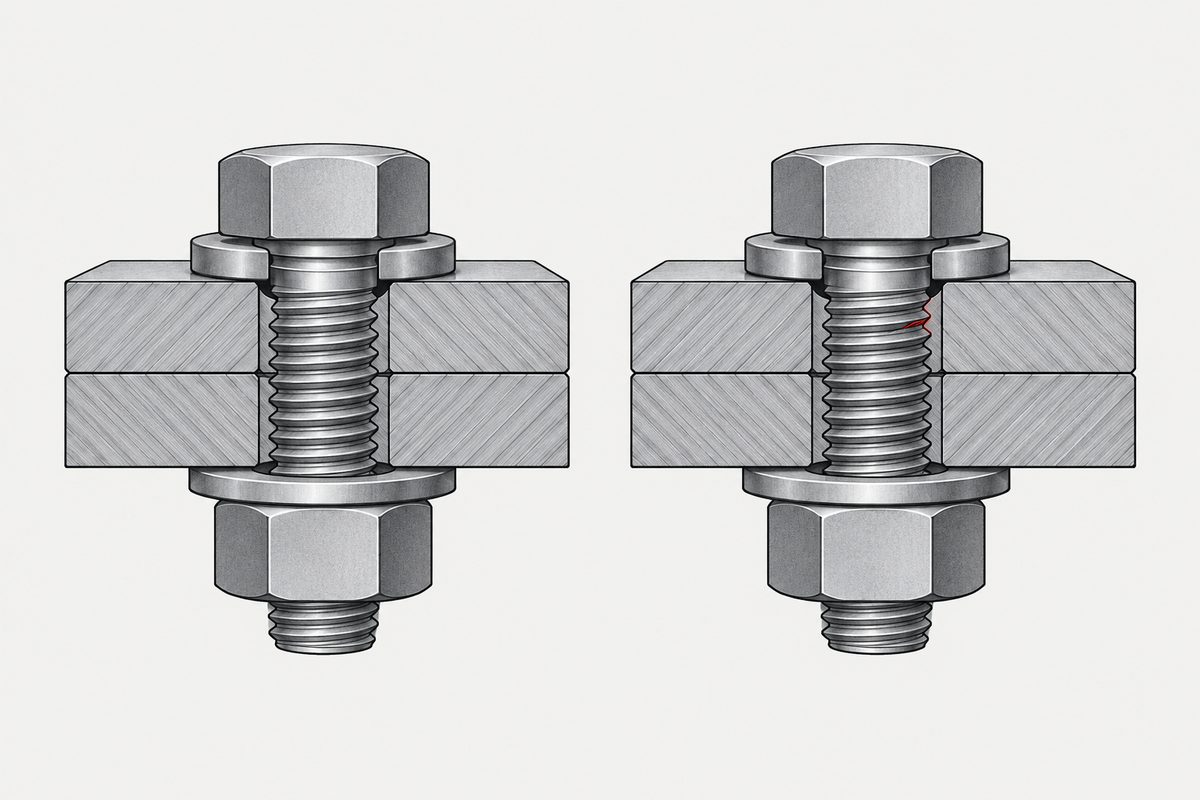
The experiment, and what “preload” meant in it
Stephens and co-authors compared bolts rolled before heat treatment (RBHT) against rolled after (RAHT) at five preload levels, building S–N curves at each. That design is why this study is worth reading: most fatigue comparisons pick one mean stress and stop.
“Preload” here is the fixed minimum applied axial stress, with maximum stress varied to build the curve. The percentages are referenced to about 1100 MPa — the average proof stress of the RBHT specimens, not of each group.
That matters, because RAHT proof stress was about 10% lower. So the nominal levels correspond to roughly these fractions of the RAHT bolts' own proof stress:
| Nominal | Of RAHT's own proof stress | What it represents |
|---|---|---|
| 1% | 1.1% | Essentially no assembly preload, R < 0.05 |
| 50% | 55% | Moderate mean stress |
| 75% | 83% | Like a real installed joint |
| 90% | 100% | At about RAHT proof stress |
| 100% | 110% | Above it; plasticity becomes relevant |
The authors themselves described the 75% and 90% conditions as representative of real-life preload, based on Caterpillar and author experience. So the practical evidence is there — it is just not the number in the headline.
The table the sales figure comes from
| Nominal preload | Fine thread (3/8-24 UNRF) | Coarse thread (3/8-16 UNRC) |
|---|---|---|
| 1% | +158% | +147% |
| 50% | +67% (STP table); +69% in the SAE abstract | +8% |
| 75% | +50% | −9% |
| 90% | +40% | 0% |
| 100% | about +30% | no high-preload increase reported |
Read the right-hand column at 75%. Minus nine percent. At the preload the authors call representative of real life, the coarse-thread RAHT bolts did not beat the cheaper process — they came out slightly behind it.
We are not going to claim RAHT makes coarse threads worse. A single −9% among +8% and 0% reads as no reproducible benefit, not as harm. The honest summary is that the coarse-thread group showed no reliable high-preload advantage at all.
Before you act on that, the caveats are real
This is the part that decides whether you can use the table, so it is not buried at the bottom.
- The coarse group was confounded. Different rolling dies, root radii differing by 5–15%, anomalous residual stresses, and thread laps in the coarse RAHT specimens. Some of the coarse result may be manufacture, not process sequence
- The fine/coarse contrast at 1% is not shown to be significant. +158% against +147% was never subjected to a hypothesis test
- Magnitudes are not universal. A later study on M8 class 10.9 bolts found only about 9% RAHT improvement at R ≈ 0.8
- Published values differ by version. The SAE and JAI abstracts give “69 to 30%”; the later ASTM STP table gives 67%, 50% and 40% at nominal 50, 75 and 90%. Treat that as rounding or analysis revision, not false precision
What survives all of that is the shape rather than the numbers: the RAHT advantage is largest with almost no preload and falls as preload rises, and the authors state that as a result rather than leaving it to be inferred.
The residual stress figures are misquoted more than they are wrong
RAHT works by cold-working the thread root after the material has been hardened, leaving compressive residual stress where fatigue cracks would otherwise start. The numbers that circulate are real measurements — of things people then describe loosely.
| Figure | What it actually is |
|---|---|
| −500 to −1000 MPa | Maximum near-surface compressive components by XRD, at the surface and at 0.051 and 0.127 mm depth. Not the axial surface stress of every RAHT thread |
| Fine RAHT axial surface | About −255 MPa |
| Coarse RAHT axial surface | Slightly tensile — which is consistent with that group showing no benefit |
| −225 MPa | By neutron diffraction, not surface XRD; unloaded, hot-dip galvanised grade 10.9 M36 |
And “preload uses up the compressive stress” is a simplification we are not going to repeat. Applied elastic tension offsets the residual compression within the local total-stress history; genuine relaxation requires local plasticity or cyclic redistribution. The 2005 work inferred relaxation from fatigue behaviour and unloaded XRD profiles — it did not track the stress field continuously while the bolt was tightened.
The bake, not the plating
There is a study often summarised as “surface treatment cancels the RAHT benefit”. That summary is wrong in a way worth correcting, because it points at the wrong thing on your drawing.
What was investigated was post-rolling temperature exposure — the kind associated with organometallic coating cure and with the hydrogen-relief bake after electroplating. The mechanism at issue is thermal relaxation of cold-work residual stress. It is not a claim that plating chemistry universally cancels RAHT.
And it is not hydrogen embrittlement, which is a distinct mechanism covered separately in the rust-proofing that breaks the screw. The connection is only that the same bake is relevant to both — the bake that protects you from one problem is the heat that may relax the residual stress you paid for.
What the standards do and do not give you
- ISO 898-1 does not require RAHT, and more usefully, it explicitly does not specify fatigue resistance at all. A high property class does not buy fatigue performance — that is a separate requirement you have to state
- It does recognise that thread rolling after heat treatment can raise surface hardness, but it does not prescribe the manufacturing sequence
- Aerospace is not a blanket rule either. Thread-form standards such as AS8879 define geometry; it is the procurement or product specification that imposes the process
- There is no universal size or hardness ceiling. Ordinary rolling practice sits around 32 HRC; specialised aerospace dies and processes roll roughly 38–40 HRC and above. Diameter, pitch, ductility, die material, rolling force and acceptable tool life all bear on it
- The 20–40% cost premium is an industry estimate stated in the ASTM paper and repeated since. We could not find a supplier-neutral cost dataset behind it
So when is it worth specifying
- When the joint is fatigue-critical and lightly preloaded. That is where the measured benefit is largest, and it is a real design case — not every joint is tightened hard.
- Not as a general upgrade on a well-preloaded joint, and especially not on coarse threads, where this study found no reliable advantage at working preload.
- Ask what happens after rolling. If the parts are plated and baked, or a coating is thermally cured, the residual stress you are buying sees that heat. Get the sequence and the temperatures, not just the process name.
- State fatigue as a requirement if you need it, because the property class will not carry it. ISO 898-1 says so itself.
- Fix the preload question first. Fatigue behaviour here is dominated by mean stress, so the joint diagram and how well your method controls preload matter more than the rolling sequence for most joints.
The prior question — rolled or cut at all — is in rolled or cut.
References
- R. I. Stephens, N. J. Bradley, N. J. Horn, J. J. Gradman, J. M. Arkema and C. S. Borgwardt, ‘Fatigue of High Strength Bolts Rolled Before or After Heat Treatment with Five Different Preload Levels’, SAE Technical Paper 2005-01-1321, 2005, DOI 10.4271/2005-01-1321
- N. J. Bradley and co-authors, ‘Influence of Cold Rolling Threads Before or After Heat Treatment on the Fatigue Resistance of High Strength Fine Thread Bolts for Multiple Preload Conditions’, Journal of ASTM International 3(4), 2006, JAI13069, DOI 10.1520/JAI13069
- R. I. Stephens and co-authors, ‘Influence of Cold Rolling Threads Before or After Heat Treatment on the Fatigue Resistance of High Strength Coarse Thread Bolts for Multiple Preload Conditions’, Journal of ASTM International 3(3), 2006, JAI13075, DOI 10.1520/JAI13075
- N. J. Horn and R. I. Stephens, ‘Influence of Cold Rolling Threads Before or After Heat Treatment on High Strength Bolts for Different Fatigue Preload Conditions’, Journal of ASTM International 3(1), 2006, JAI12551, DOI 10.1520/JAI12551
- Marcelo and co-authors, 2011 — M8 class 10.9, approximately 9% RAHT improvement at R ≈ 0.8
- ISO 898-1 — mechanical properties of fasteners; specifies property classes and explicitly does not specify fatigue resistance. AS8879 — thread form geometry, not a process requirement
Acceptance for any particular joint is governed by your drawing and your own testing.
This page covers step 2, the thread. The whole order is substrate, thread, head, drive, finish, documentation, and why doing it out of order is rework rather than a tweak is in specifying a screw.
Common questions
Is rolling threads after heat treatment worth the money?
It depends almost entirely on how hard the joint is preloaded. In the five-preload study by Stephens and co-authors the fine-thread RAHT bolts gained 158% in ten-million-cycle fatigue strength at 1% preload, but only about 40% at nominal 90% preload. The coarse-thread specimens gained 8% at nominal 50%, minus 9% at 75% and 0% at 90%, which is no reliable benefit at the preloads the authors describe as representative of real life.
What does 1% preload mean in those tests?
It is the fixed minimum applied axial stress, set at 1% of about 1100 MPa, the average proof stress of the bolts rolled before heat treatment. The stress ratio was below 0.05, so the bolt still saw cyclic tension but had essentially no assembly preload. Quoting the 158% figure without that context would misrepresent it for anyone designing a tightened joint.
Why are the percentages referenced to the other group?
Because the study used the RBHT average proof stress as the common reference for all specimens. The RAHT bolts had roughly 10% lower proof stress, so the nominal levels of 1, 50, 75, 90 and 100% correspond to approximately 1.1, 55, 83, 100 and 110% of the RAHT bolts own proof stress. At nominal 90% the RAHT bolts were already at about their own proof stress.
Does plating cancel the benefit of rolling after heat treatment?
That is a misreading. The study usually cited investigated post-rolling temperature exposure, of the kind associated with organometallic coating cure and with the hydrogen-relief bake after electroplating, and the mechanism at issue is thermal relaxation of cold-work residual stress. It is not evidence that plating chemistry itself cancels the benefit, and it is a different mechanism from hydrogen embrittlement, although the same bake is relevant to both.
Does a high property class mean good fatigue performance?
No. ISO 898-1 specifies mechanical and physical property classes and explicitly does not specify fatigue resistance. If fatigue matters for your joint it has to be stated as a separate requirement, and the manufacturing sequence, thread root condition and preload will drive it rather than the property class number.
Enquiries
If a drawing calls for threads rolled after heat treatment, tell us the preload the joint will actually see, and what happens to the parts after rolling. Both change whether that requirement is buying you anything.
Request a quotation
Tell us the part and the quantity. We will come back on feasibility, lead time and price.
Or email us directly sales@tigerfasteners.com