 TIGERFASTENERS
The Fatigue Limit Is a Test Convention, Not a Promise
Two things get taught together: steel has a stress below which it survives forever, and aluminium does not. Both are useful first approximations. Neither is a law, and the exceptions are not obscure.
What the number actually is
A fatigue limit quoted without conditions is incomplete. In practice the figure is the stress amplitude at which a stated proportion of specimens survived a predetermined number of cycles — a run-out — at a stated stress ratio. The test stopped. That is not the same as the specimen being immortal.
The run-out is not even a single convention. ISO 1099 cites around 107 cycles for structural steels and 108 for others, while warning that metals generally have no limit that guarantees infinite cycles. For threaded fasteners specifically, ISO 3800 uses a predetermined run-out usually between 5×10⁶ and 107, and VDI 2230-1 reference endurance amplitudes apply from ND ≥ 2×10⁶. Those are different numbers for the same word.
The exceptions run in both directions
Very-high-cycle testing did find steels failing beyond the traditional 107-cycle limit, typically high-strength quenched-and-tempered, bearing or spring steels, with cracks starting at internal inclusions. But “VHCF proved steel has no fatigue limit” is not what the evidence says.
In a comparison on 42CrMo4 with the same inclusion distribution, the high-tempered condition below about 1400 MPa tensile strength produced no failures at all between 106 and 109 cycles, and its 109 strength matched its 106 strength. Only the higher-strength, low-tempered condition became sensitive to internal defects. Susceptibility depends on strength and microstructure, not on being steel.
The other half of the textbook pairing fails too, and in a way worth remembering: smooth 6061-T6 specimens showed no plateau out to 1010 cycles, while notched specimens of the same alloy showed a clear limit. The notch changed the answer. AA2198-T8 showed a plateau near 109. Copper is the one case with clean evidence in the expected direction — no conventional limit detected out to 1010.
Why none of this transfers straight to a bolt
It is tempting to conclude that bolts must also fail eventually from internal inclusions. That extrapolation is the thing to avoid, and the standards block it explicitly.
- ISO 1099 covers specimens without deliberate stress concentration and excludes component testing. A bolt is a notched component; the thread root is the notch.
- A notch changes the stress gradient, shrinks the highly stressed volume, and adds residual stress from thread rolling. The sharper the notch, the more likely initiation moves back to the surface — to the thread root — rather than to an internal inclusion.
- A recent review of notched VHCF concludes there is still no broadly validated general model for complex notched components.
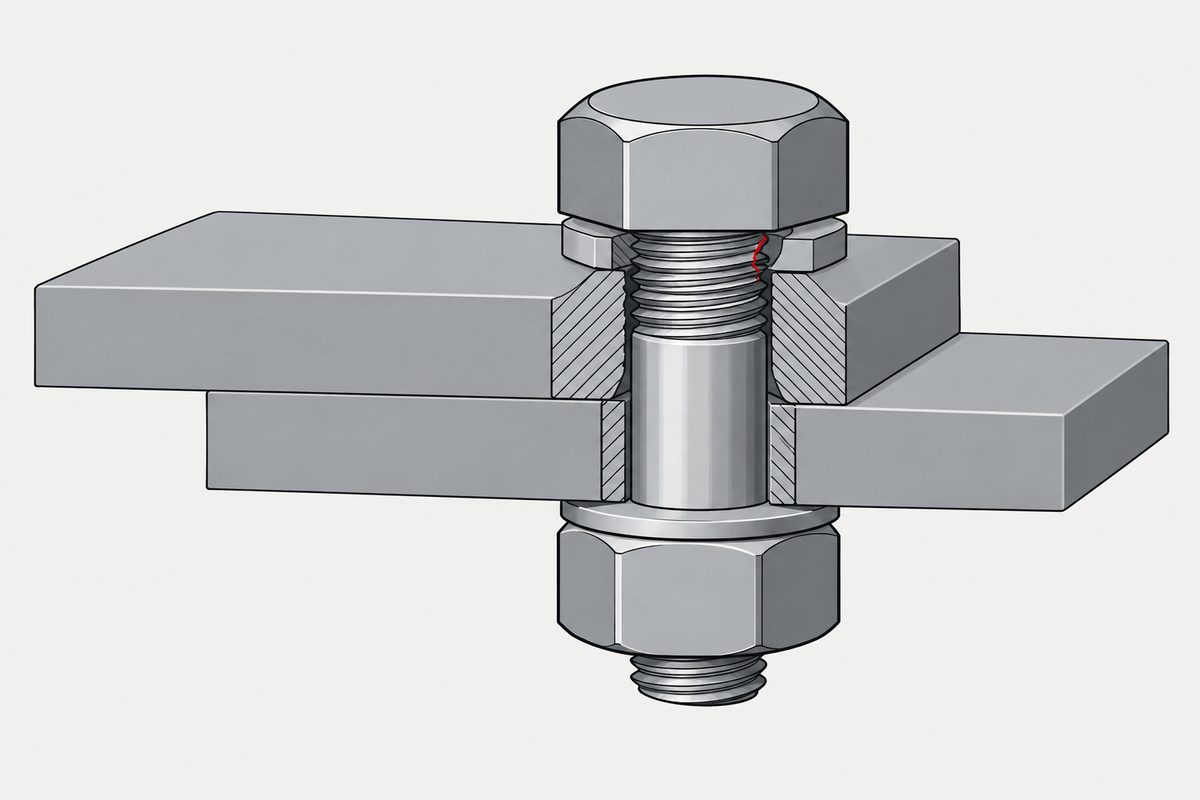
The bolt's own hotspot is well established and is a different story: the root of the first engaged thread, because load is shared unevenly between threads and the root concentrates it. That is the same location the rolling-versus-cutting argument converges on.
A correction to something else on this site
We have written that preload does not appear in the bolt's load amplitude — ΔFb = Φ·FA, with Φ set by stiffness. That is correct, and it is easy to read one step too far: that preload is therefore irrelevant to fatigue.
It is not. For bolts rolled after heat treatment, VDI 2230-1 makes the allowable endurance amplitude itself a function of the mean bolt force: σASG = (2 − FSm/F0.2min) · σASV. Preload is absent from the applied amplitude and present in the permitted one.
So “enough preload and fatigue is not a problem” is wrong as stated. Adequate, retained preload does reduce the cyclic amplitude the bolt sees by keeping the joint closed — that part is real, and it is what the spring model buys you. It does not excuse checking the root amplitude, the mean and maximum stress, preload scatter and loss, eccentric bending, or transverse slip.
What the codes do instead of promising forever
Structural practice does not extend the curve to gigacycles. EN 1993-1-9 runs the direct-stress curve at m = 3 to ND = 5×10⁶, treats that as the constant-amplitude fatigue limit, and — where a variable spectrum contains ranges both above and below it — changes the slope to m = 5 and continues to a cut-off at 108. Tension bolts sit in detail category 50 on the tensile stress area, and prying and bending have to be included.
That structure is an engineering truncation rule, not a claim about nature. It is also a reminder that a constant-amplitude limit is not a licence under a variable spectrum: a few large cycles can make the small ones count.
And the number that is missing from all of this: ISO 898-1 does not specify fatigue performance at all. A bolt being a correct 10.9 says nothing about how long it survives cyclic load. If fatigue matters, it is a joint qualification question, not a property class question.
This is not one of the six steps. It shows up across them, or after assembly. Where the decisions that lead here were made is in specifying a screw, which sets out the order and why doing it out of order is rework.
Common questions
Does steel really last forever below its fatigue limit?
Not as a law. Low and medium strength steels often do show a plateau under non-corrosive constant-amplitude loading, and in one 42CrMo4 comparison the high-tempered condition produced no failures between ten million and a billion cycles, with matching strengths at both. But high-strength quenched-and-tempered, bearing and spring steels have failed beyond the traditional limit from internal inclusions. Whether a plateau exists depends on strength, microstructure, defects, surface, environment and stress ratio.
Is it true that aluminium never has a fatigue limit?
It is the usual behaviour but not universal, and the exception is instructive: smooth 6061-T6 specimens showed no plateau out to ten billion cycles while notched specimens of the same alloy showed a clear limit, and AA2198-T8 showed a plateau near a billion cycles. Copper is the cleaner case, with no conventional limit detected to ten billion cycles.
Do these very-high-cycle results apply to bolts?
Not directly, and the standards say so. ISO 1099 covers specimens without deliberate stress concentration and excludes component testing, while a bolt is a notched component whose notch is the thread root. Notches change the stress gradient and the highly stressed volume, and a sharper notch tends to move initiation back to the surface rather than to an internal inclusion. A recent review of notched very-high-cycle fatigue finds no broadly validated general model for complex notched components.
If preload is not in the amplitude equation, does preload not matter for fatigue?
It matters, in a different place. The applied amplitude is the load factor times the external load, and preload does not appear there. But VDI 2230-1 makes the allowable endurance amplitude a function of the mean bolt force for bolts rolled after heat treatment, so preload enters the permitted amplitude rather than the applied one. Adequate preload also keeps the joint closed, which is what stops the amplitude jumping.
References
- Lang, Korn & Rohm (2016). VHCF behaviour of 42CrMo4 in different heat treatment conditions. Procedia Structural Integrity. DOI 10.1016/j.prostr.2016.06.145
- Pyttel, Schwerdt & Berger (2011). Very high cycle fatigue — is there a fatigue limit? International Journal of Fatigue. DOI 10.1016/j.ijfatigue.2010.05.009
- Akiniwa et al. (2006). Fatigue strength of smooth and notched specimens in the very high cycle regime. International Journal of Fatigue. DOI 10.1016/j.ijfatigue.2005.04.017
- Majzoobi et al. (2005). Experimental evaluation of the effect of thread pitch on fatigue life of bolts. International Journal of Fatigue. DOI 10.1016/j.ijfatigue.2004.06.011
- ISO 3800:1993 — Axial load fatigue testing of threaded fasteners (run-out usually 5×10⁶ to 107; does not account for clamped-part compliance)
- ISO 898-1 — scope explicitly excludes fatigue resistance
The quantified reduction sometimes quoted for gigacycle testing is material and geometry specific: mildly notched 17-4PH showed roughly 5% lower strength at 10^9 than at 10^7 at room temperature and about 10% lower at 350 C. There is no general percentage for steels or for bolts.
Enquiries
If the joint sees cyclic load, a property class is not an answer — ISO 898-1 does not cover fatigue. Tell us the load spectrum and how the load enters the joint, and we will tell you what has to be qualified on the assembly rather than on the fastener.
Request a quotation
Tell us the part and the quantity. We will come back on feasibility, lead time and price.
Or email us directly sales@tigerfasteners.com