 TIGERFASTENERS
That Spring Turns a Torque Problem Into a Length Problem
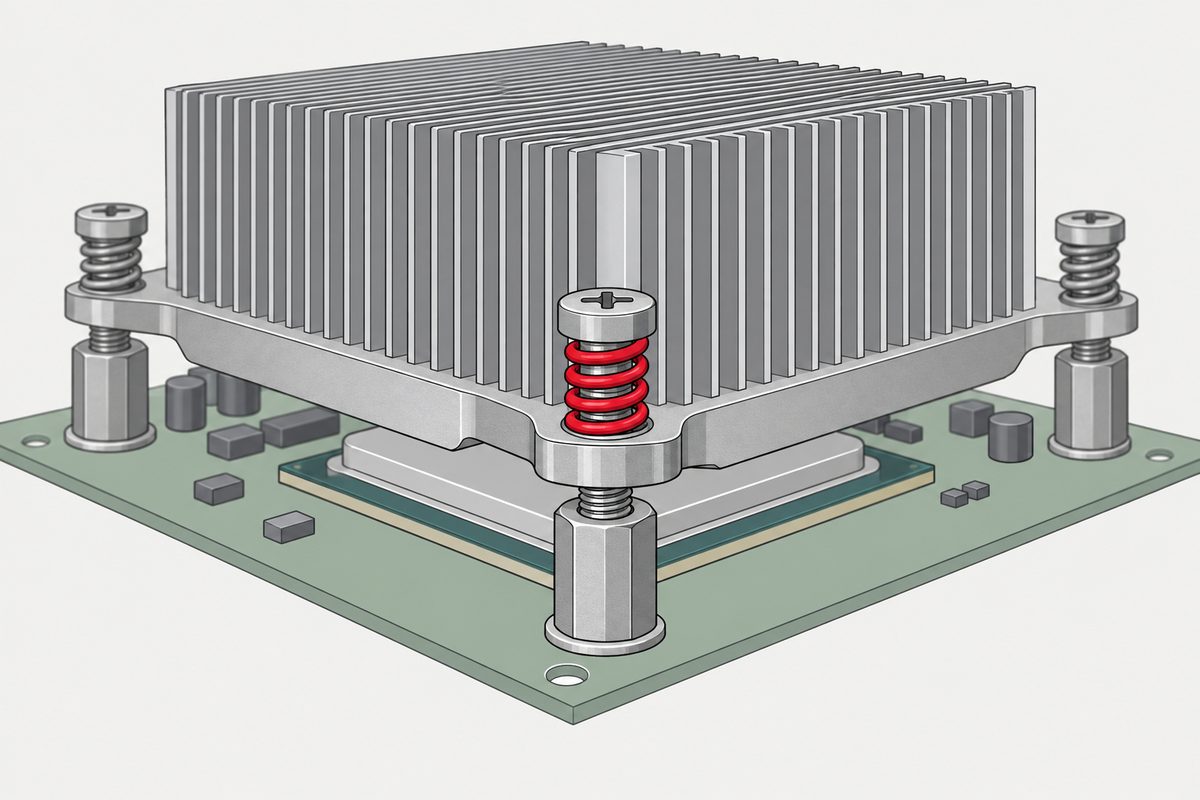
Somebody asked why the screws holding a CPU cooler have springs on them, and the thread produced two good answers and one excellent aside. The good answers were tolerance and thermal expansion, and the fact that those screws are meant to be run down until they stop. The aside was a reply pointing out that screws and bolts already are springs, just very stiff ones, and that you could get the rate you wanted with long enough screws and spacers if you had the room. All three are correct, and together they describe a deliberate swap.
The aside is right, and it is the whole model
A bolt is an elastic member. Tightening stretches it, and the clamp force is that stretch multiplied by its stiffness. What decides how a joint behaves afterwards is not the bolt alone but the ratio between the bolt's stiffness and the clamped parts', which is the bolt is a spring.
The consequence people meet first is that a stiff bolt in a stiff joint is intolerant of small changes in length. Embedding of a few microns, a temperature swing across two materials with different expansion coefficients, a tolerance stack that came out at the wrong end: each of those is a tiny displacement, and in a stiff assembly a tiny displacement is a large change in load. What temperature alone does to it is temperature moves preload.
The usual answer in a bolted joint is to add grip length, because a longer bolt is a softer spring and dilutes the same displacement over more material, which is screw length and grip. A cooler has no length to add. The stack is a few millimetres and the package underneath has a load window it must stay inside. So the compliance gets bought as a separate part instead.
What bottoming out actually buys
The reply that said those screws tighten until they stop was describing the real mechanism, and it is worth stating plainly. Once the screw reaches its hard stop, further torque goes into the stop, not into the spring. The spring has been compressed by a fixed distance set by the geometry, and the force it delivers is that distance multiplied by its rate.
So the load is no longer a function of how hard somebody turned the driver, or of the thread friction, or of whether the threads were oiled or damp. Those are exactly the variables that make a torque figure unreliable, and what a torque spec silently assumes about them is a torque spec assumes a friction condition.
Load control has moved from torque to displacement. That is the same family of decision as angle control and yield control, which replace a force measurement with a rotation measurement, except here the geometry does it and the operator does not have to be trained at all.
The condition doing the work is that the stop sits in the clamp path. Move it outside, as happens when a closed-end nut bottoms on an over-length stud, and the same mechanism gives the opposite result: the wrench still climbs and clicks while nothing has been clamped.
The uncertainty does not vanish, it changes supplier
This is the part worth carrying away, because it is easy to read the spring as free accuracy. It is not. The scatter has moved from one place to another, and the new place has a price list.
Torque control carries the friction condition with it. VDI 2230's figure for torque tightening calibrated on the original joint is ±17 to 23%, and where the more familiar ±25% actually comes from is worked through in how badly your tightening method controls preload. None of that is under the assembler's control and none of it is visible afterwards.
A compression spring carries its manufacturing tolerance instead, and that tolerance is a specified, gradeable thing. EN 15800 sets quality requirements for cold coiled compression springs and defines three quality grades, with permissible variations covering the coil diameter, the free length, squareness and parallelism, and — the one that matters here — the spring force at a given length. Grade 1 is the tightest tolerance band and costs the most; grade 3 is the loosest.
That is the swap in one sentence. A torque-controlled joint inherits an uncertainty from a physical process nobody can see or adjust. A displacement controlled joint inherits one from a component whose tolerance is a line on a purchase order. Neither is free. Only one of them is something you can decide.
The bolted-joint version of the same idea
The cooler screw is the visible case, but the same trade is available in an ordinary bolted joint with much less travel, in the form of a conical spring washer. DIN 6796 covers them for bolted connections, and our own washer page carries them as one line in a type table: they maintain preload through thermal cycling and settling, which addresses preload loss rather than rotation. The rest of that table, and what each of the other washer types actually does, is washers explained.
Two things about them are worth knowing before they are treated as a general fix. A disc spring manufacturer states that these washers are intended exclusively for static loads in bolted joints, and that their maximum force corresponds to 70 to 90% of the clamping force of class 8.8 and 10.9 bolts. That is a named manufacturer with a figure, though it remains a manufacturer describing the standard: we have not read DIN 6796. Read the second one carefully: a spring element that is nearly flat at working load has almost no travel left, so what it is providing is a small elastic reserve rather than the kind of compliance a cooler spring provides.
What it costs
- Height and part count. The compliance has to live somewhere, and in a cooler it is the tallest thing in the fastener stack.
- A spring is a part that relaxes. It has its own behaviour at temperature and over time, and it is now in the load path permanently.
- The verification changes. You can no longer confirm the load with a torque wrench, because torque after bottoming tells you about the stop. The check becomes dimensional, or it becomes trust in the spring's grade.
- The stop has to be a real stop. Everything above assumes the screw reaches a hard shoulder in a controlled place. If it bottoms in a thread, or on a surface that yields, the geometry that was setting the load has moved.
When to reach for this
- When the part underneath has a load window rather than a minimum. Too little and it does not seat, too much and it is damaged. Torque control is a poor way to land inside a window.
- When the grip is too short to be a useful spring. A few millimetres of stack cannot dilute a thermal excursion. Adding a soft element is the only compliance available.
- When the assembler is not the person you specified for. A screw that stops is a screw that a hurried hand cannot over-tighten past the design load.
- Not when the joint has to transmit transverse load by friction. That case wants preload as high as the parts allow, not a controlled and deliberately modest one.
What decides the shape of that spring’s curve is a ratio, and on a disc spring it is the letter in the part number: A, B and C are three curve shapes, not three size grades.
This is not one of the six steps. It shows up across them, or after assembly. Where the decisions that lead here were made is in specifying a screw, which sets out the order and why doing it out of order is rework.
Common questions
Why do heatsink screws have springs on them?
Because the package underneath has to be held within a load window, and the stack is too short for the screws themselves to act as a useful spring. Adding a soft element in series means the assembly can change length a little, through embedding, thermal expansion or tolerance, without the load changing much. The screws are then designed to bottom out, so the load is set by how far the spring has been compressed rather than by how hard anybody turned the driver.
Is a spring more accurate than a torque wrench?
It is not free accuracy, it is a different source of uncertainty. Torque control carries the friction condition in the threads and under the head, which nobody can see or adjust after the fact; VDI 2230 puts torque tightening calibrated on the original joint at plus or minus 17 to 23%. A spring carries its own manufacturing tolerance, and EN 15800 makes that a gradeable quantity by specifying the permissible variation of spring force at a given length across three quality grades. The uncertainty becomes something you buy rather than something you inherit.
Why not just use longer screws to get the same effect?
You can, and one reply in the source thread said exactly that: a bolt is already a spring, just a very stiff one, and long enough screws with spacers would give the rate you want. The obstacle is packaging. A cooler stack is a few millimetres and there is nowhere to put the extra length. Where the room does exist, adding grip length is the normal answer and it is the better one, because it removes a part instead of adding one.
Can I use a conical spring washer to do the same job on a normal bolt?
It is the same idea with far less travel, and it is a smaller intervention. DIN 6796 covers conical spring washers for bolted connections. A disc spring manufacturer states that these washers are intended exclusively for static loads in bolted joints, and that their maximum force corresponds to 70 to 90% of the clamping force of class 8.8 and 10.9 bolts. That is a named manufacturer with a figure rather than the vaguer summary this page carried before, though we still have not read DIN 6796 itself. The practical reading is unchanged: a washer which is nearly flat at working load has very little travel left, so it provides an elastic reserve against settling rather than the tolerance to length that a cooler spring provides.
How do I inspect a joint like this?
Not with a torque wrench. Once the screw is against its stop, the torque you read is about the stop and not about the load in the spring. What is left is dimensional, checking that the screw has actually reached the shoulder and that the spring has been compressed to the intended height, or it is confidence in the spring grade you specified. This is the hidden cost of the swap: the load became repeatable and it also became harder to confirm on the line.
References
- EN 15800:2008 — cylindrical helical springs made of round wire, quality specifications for cold coiled compression springs; the source of the three quality grades and of the permissible variation of spring force at a given length
- DIN 6796 — conical spring washers for bolted connections; catalogue entry, the standard was not read
- Surisa, DIN 6796 standard — a disc spring manufacturer’s description: exclusively static loads, maximum force 70–90% of the clamping force of class 8.8 and 10.9 bolts, C60 hardened to 420–510 HV, tables M3–M36
- VDI 2230 Part 1 — tightening factor, and the stiffness ratio model this page builds on
The source levels on this page are not uniform and it is worth saying which is which. The stiffness ratio model and the tightening factor figures are taken from our own pages linked above, where they were worked through against VDI 2230 and NASA RP-1228 at the time. The EN 15800 content, that it defines three quality grades and that the permissible variations include the spring force at a given length, comes from the standard summary and catalogue listings rather than from clauses we have read; the grades are described qualitatively there and no percentage is quoted here because none was available. The DIN 6796 statements were at that same summary level when this page was written and have since been upgraded: a named disc spring manufacturer states that these washers are intended exclusively for static loads and that their maximum force corresponds to 70 to 90% of the clamping force of class 8.8 and 10.9 bolts. That is a manufacturer describing the standard, not the standard, and DIN 6796 remains unread here. One conflict is left open rather than resolved: that manufacturer gives the tables in the standard as M3 to M36, while a distributor DIN 6796 sheet lists sizes from M2 and M2.5 upwards. We have read neither document and do not know which range is right, which matters for this site because M2 and M2.5 are inside our production range. No load figure for any processor package appears here because we found no citable public specification. EN 15800 is a CEN standard rather than an ISO one, so it is linked to a catalogue listing rather than to iso.org; the site has not cited it before, so there was no existing number here to copy.
Enquiries
If a joint needs a controlled load rather than the highest preload the parts will take, tell us the window and the space available. Which way that decision goes changes the screw, and it usually changes it before anything about the thread does.
Request a quotation
Tell us the part and the quantity. We will come back on feasibility, lead time and price.
Or email us directly sales@tigerfasteners.com