 TIGERFASTENERS
Temperature moves preload, and the direction depends on which side grows
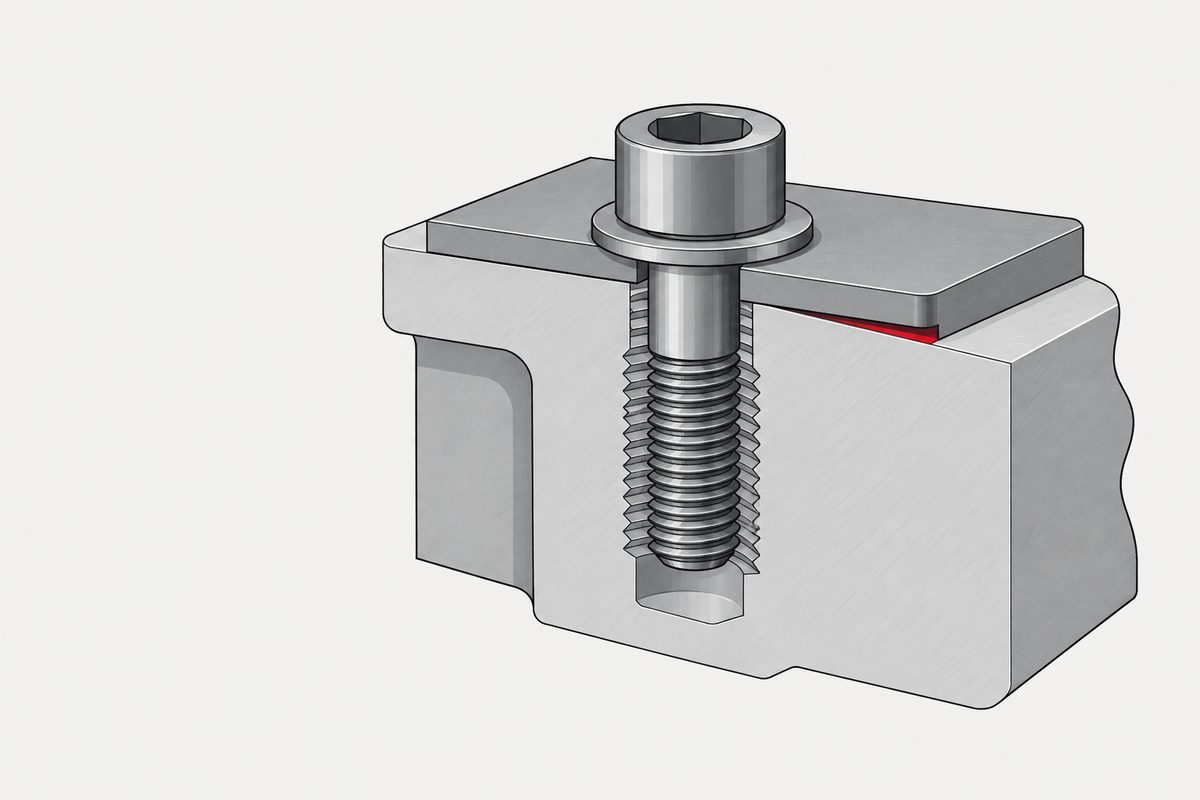
Put a steel screw into an aluminium housing and the two respond to heat differently. The joint you tightened at room temperature is a different joint at 80 °C, and a different one again at −20 °C — in opposite directions, with opposite risks.
The quantity, and a sign convention that catches people out
VDI 2230 Blatt 1 §5.4.2.3 defines the change in preload caused by a temperature different from room temperature. The full quantity is ΔFVth, Equation (116):
ΔFVth = FVRT − FVT
Read the sign carefully. It is room-temperature preload minus working-temperature preload, so ΔFVth greater than zero means the preload has dropped, and a negative value means it has risen. We had this backwards in the draft.
The primed ΔF′Vth that appears in the R5 assembly-preload equation is the simplified form, Equation (118), for use when the modulus change is small enough to ignore.
The term almost everyone forgets
The full expression, Equation (117), has two parts:
ΔFVth = FVRT[1 − (δS + δP) / D] + lK(αSΔTS − αPΔTP) / D
where D = δSESRT/EST + δPEPRT/EPT
The second part is the one people expect: clamp length times the difference in thermal expansion. The first part is a preload-dependent term driven by the change in elastic modulus, and the working-temperature moduli come from VDI Table A10.
VDI states the consequence directly: even if the bolt and the clamped parts expand by exactly the same amount, heating reduces preload on its own, because both moduli fall. In a steel screw in aluminium, that works against the increase the expansion mismatch is producing.
Which way it goes
| What happens | The risk | |
|---|---|---|
| Heating | Aluminium grows more than the screw and forces it to stretch further, so preload rises | Yield, or crushing the bearing face |
| Cooling | Aluminium contracts more, the screw unloads, so preload falls | Loss of clamp load, and in the limit separation |
NASA's fastener design manual makes the same point about the cold side: differential contraction can unload a joint or separate it. Cooling raises a second, separate question — whether the material itself turns brittle: the property class does not cover the cold.
The reverse combination is real, and it is one you may already be using. An A2 or A4 austenitic stainless screw expands at about 16 × 10−6/K against carbon steel clamped parts at about 11 to 13. Heat that joint and the screw grows more than what it clamps, so the preload falls — the opposite of the aluminium case.
The numbers
| Material | α | Source |
|---|---|---|
| Carbon and low-alloy steel | 11.1–12.6 | VDI Table A9, 20–100 °C |
| Austenitic stainless A2 / A4 | about 16 | VDI Table A9 (1.4301, 1.4307, 1.4401) |
| Cast aluminium, general | 21–22 | VDI Table A9, G/GK/GD-AlSi |
| ADC12 die casting | 20.6 | Peer-reviewed thermal-stress data |
| A380 die casting | 21.8 | NADCA A-3-2-09 |
| Wrought aluminium alloys | 23.4–23.7 | VDI Table A9 |
| Zamak 3 zinc alloy | 27.4 | Producer datasheet, converted from 15.2 µin/in·°F |
| PC, unfilled | 65 | Makrolon 2405, ISO 11359, 23–55 °C |
| ABS, unfilled | 80–110 | Terluran GP-22, ISO 11359 |
| PA6, unfilled | 102 | Ultramid B3S, 23–55 °C |
Plastics cannot be given one value per resin name. Fibre content, moulding direction and moisture state move these substantially. The three above are traceable unfilled commercial grades, quoted as examples rather than as design values.
Swapping a carbon steel screw for stainless narrows the mismatch against aluminium from roughly 8.4–12.6 down to roughly 5–7.7, which is a meaningful reduction. It does not change the direction, because aluminium is still the faster-growing side.
How large does it actually get
One measured example is worth more than an assertion. A temperature-cycling test on an 8 mm steel bolt through a steel / aluminium / steel stack went from 25 °C to 160 °C, and the preload rose from about 11 kN to 15 kN — roughly 3.6 kN, or about 33%. The author attributes it to the aluminium's higher expansion and warns explicitly against generalising that ratio.
We wanted to end by saying temperature does not merely nudge preload. Stated as a universal, that goes too far. The magnitude depends on the temperature change, the clamp length, the compliances and temperatures of both sides, how the moduli move, and the initial preload. Where the temperature swing is small or the coefficients are close, the change can be genuinely negligible.
The defensible version: differential thermal expansion can push preload up into yield or down into separation, and whether it does has to be computed case by case with the full expression. VDI asks for the minimum and maximum steady-state temperatures, the transient differences, and any permanent deformation to be checked, and it feeds ΔFVth into the bolt's maximum load.
Where this connects
Why preload matters and how load is shared is in the bolt is a spring, and so is the joint; how precisely you can deliver it in the first place is in how badly your tightening method controls preload. When the clamped part is a casting, its own properties vary with depth — see a die casting is not one material. For plastics, the torque window and the boss are in screws for plastic.
References
- VDI 2230 Blatt 1:2015 — §5.4.2.3 and Equations (114)–(118); ΔFVth at Eq. (116), the full form at Eq. (117), the simplified ΔF′Vth at Eq. (118); Table A9 (expansion coefficients), Table A10 (moduli at working temperature)
- NASA RP-1228, Fastener Design Manual — differential contraction unloading or separating a joint
- NADCA A-3-2-09 Alloy Data — A380 at 21.8 µm/m·K
- Materials Transactions 51(2) — ADC12 at 20.6, SUS304 at 17.1, from thermal-stress model data
- Producer datasheets — Zamak 3; Makrolon 2405 (PC); Terluran GP-22 (ABS); Ultramid B3S (PA6), all to ISO 11359 where stated
- Kieffer, Bolt Preload Temperature Cycling, 2022 — 8 mm bolt, steel/aluminium/steel, 25 to 160 °C, 11 to 15 kN
Acceptance for any particular joint is governed by your drawing and your own calculation.
This page covers step 1, the substrate. The whole order is substrate, thread, head, drive, finish, documentation, and why doing it out of order is rework rather than a tweak is in specifying a screw.
Common questions
Does a steel screw in an aluminium housing gain or lose preload when it gets hot?
It gains. Aluminium expands roughly twice as fast as steel, so on heating the clamped parts grow more than the screw and force it to stretch further, which raises preload. On cooling the reverse happens and preload falls, which is the side where the joint can lose clamp load or separate. The net change also includes the drop in elastic modulus with temperature, which works against the increase.
What is the symbol for the thermal change in preload?
VDI 2230 Blatt 1 clause 5.4.2.3 defines it at Equation 116 as delta F Vth, equal to the room-temperature preload minus the working-temperature preload. Note the sign: a positive value means the preload has dropped. The primed version that appears in the R5 assembly preload equation is the simplified form at Equation 118, for use when the modulus change can be ignored.
Why does heating reduce preload even when both sides expand equally?
Because the elastic modulus of both the bolt and the clamped parts falls as they get hotter, and VDI’s full expression carries that as a preload-dependent term with the room-temperature to working-temperature modulus ratios in the denominator. Working-temperature moduli come from its Table A10. In a steel screw in aluminium this term works against the increase that the expansion mismatch produces.
Does using stainless screws fix the mismatch with aluminium?
It narrows it without changing the direction. Austenitic stainless expands at about 16 against carbon steel at about 11 to 13, so the mismatch against aluminium falls from roughly 8.4 to 12.6 down to roughly 5 to 7.7. Aluminium is still the faster-growing side, so heating still tends to raise preload. Note the opposite case: a stainless screw into carbon steel loses preload on heating, because there the screw is the faster-growing side.
How much preload change should I expect?
It has to be calculated. One published temperature-cycling test on an 8 mm steel bolt through a steel, aluminium and steel stack found preload rising from about 11 to about 15 kN between 25 and 160 degrees, roughly 33 per cent, and the author warns against generalising that ratio. The magnitude depends on the temperature change, clamp length, the compliances and temperatures of both sides, how the moduli move and the initial preload, so with a small swing or close coefficients it can be negligible.
Enquiries
If a joint sees a real temperature range, send the stack materials and the range along with the screw. The clamped material changes the answer more than the screw grade does.
Request a quotation
Tell us the part and the quantity. We will come back on feasibility, lead time and price.
Or email us directly sales@tigerfasteners.com