 TIGERFASTENERS
Does Tightening Harder Make a Joint Last Longer? Two Joints, Two Answers
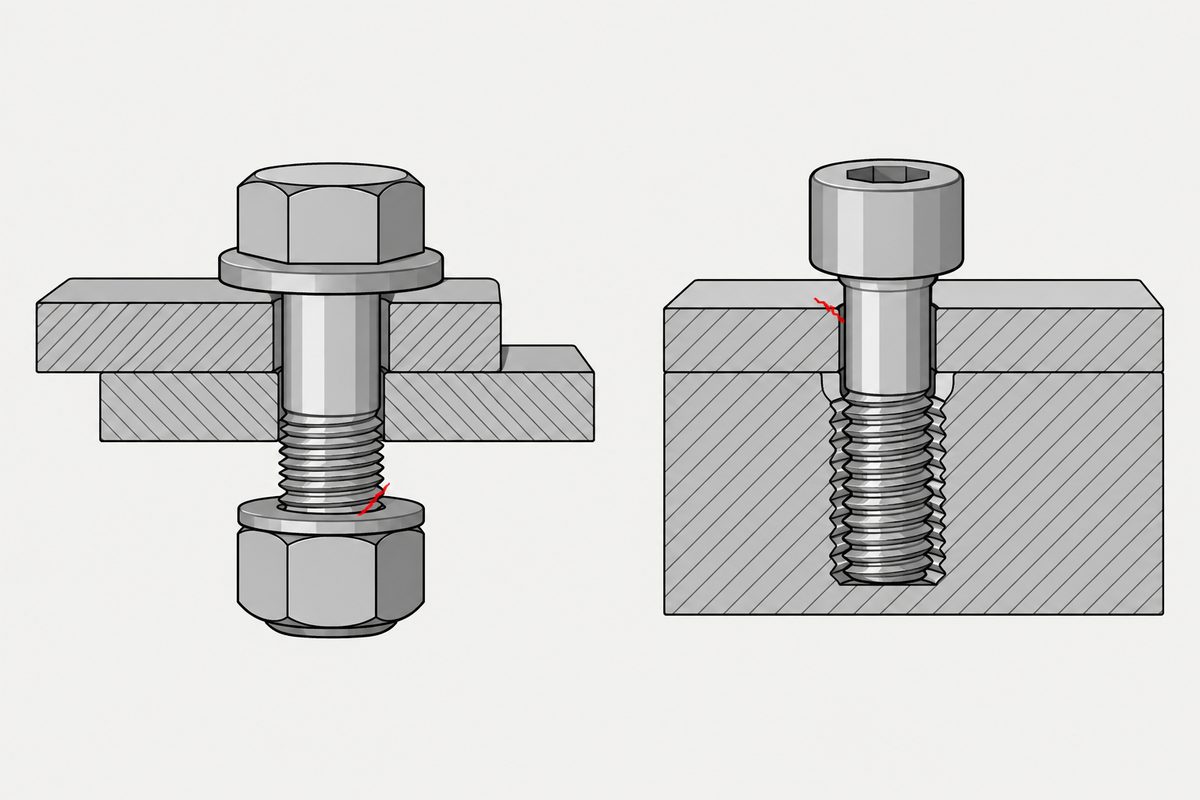
The advice to tighten properly for fatigue life is sound, and the reason usually given for it is wrong. Worse, it is given as one rule when there are two different joints underneath, which fail in different places for different reasons.
The reason usually given is not the reason
The familiar explanation is that a higher preload makes the bolt carry a smaller share of the external load, so its stress amplitude falls, and fatigue is driven by amplitude. The conclusion is right often enough. The mechanism is wrong.
While the joint stays closed and both members behave linearly, the additional bolt load is ΔFb = Φ · FA, where Φ comes from the stiffness of bolt and clamped parts and from where the load is introduced. Preload does not appear in it. Tightening harder raises the bolt's mean stress and leaves the amplitude alone.
What preload actually buys is distance from separation. Once the joint opens, the sharing model stops applying and the bolt takes almost all of the additional load. That is the cliff the preload is holding you back from — covered in the bolt is a spring.
Bickford states the uncomfortable corollary plainly: if the joint was never going to separate at the maximum working load, raising the preload does not reduce the load amplitude, and the higher mean stress can reduce fatigue life.
That was the tension joint. The lap joint is a different machine.
Everything above assumes the load pulls along the bolt axis and that the fatigue hotspot is the thread root. In a lap joint the load runs across the bolt: two plates are clamped face to face and the load is transferred between them.
Here preload does something else entirely. It presses the faying surfaces together so that friction carries the shear, which keeps the plates from sliding and keeps the bolt from bearing against the side of its hole. The fatigue crack starts in the plate, not the bolt, and the thing preload controls is how the plates rub.
And in that joint, more torque stops helping and then hurts
Wagle and Kato tested aluminium A2024-T3 lap specimens — 4 mm plates, a 6.03 mm hole, a 5.95 mm class 12.9 bolt, about 80 µm of clearance, 10 Hz, R = 0.05. At a stress amplitude of 15 MPa the failure mode changed as the torque rose:
| Torque | Where it fails | Life as torque rises |
|---|---|---|
| 1 N·m | mechanical fatigue at the hole edge | rising |
| 3 N·m | gross-slip fretting wear | still rising |
| 8 N·m | fretting fatigue | falling |
The cracks were found at the mating interface between the two plates, roughly 1.8–2.1 mm ahead of the hole. Not at the thread root, and not in the bolt. Higher clamping raises the contact pressure and the transmissible friction, which moves the damage from the hole wall to the stick–slip boundary of the interface, where local micro-slip under high contact pressure starts the crack.
The reversal is at the high-torque end. It is not caused by the external load being small. The related effect that does involve load is that the torque at which the mode changes rises with stress amplitude — so a lightly loaded joint reaches the fretting regime at a lower torque, which is not the same statement.
Independent evidence, and a case where torque did nothing
Juoksukangas and colleagues report the same direction from a different setup: fretting fatigue life falling as both preload and bulk stress rise. So the reversal is not an artefact of one experiment.
The opposite caution comes from Mínguez and Vogwell, who tested single- and double-lap aluminium joints. In the double-lap specimens, raising torque improved life clearly. In the single-lap specimens, going from 1 to 6 N·m produced no significant improvement at all, because eccentric bending dominated the geometry. (The mechanism by which a flexing member amplifies bolt load is prying — see twice the load you applied.) Same material, same family of joint, opposite sensitivity to the thing you are adjusting.
What you can take from this, and what you cannot
These are lap-plate, shear-transfer, clamped-part-failure experiments. They do not transfer to tension joints where the thread root is the hotspot, to flanges and gaskets, to composite or soft clamped parts, or to joints where dowels or an interference fit carry the shear. Surface roughness, lubrication, coating, hole clearance and plate thickness all move the numbers.
Nor is this in the standards as a general rule. ISO 898-1 explicitly does not specify fatigue performance. ISO 3800 is an axial fatigue test method that does not account for clamped-part compliance. VDI 2230-1 tells you to avoid interface micro-slip and fretting corrosion — which is the same concern — but does not state that higher preload generally caps fatigue life through fretting.
The usable version is a question rather than a number: is this joint carrying its load along the bolt or across it? If across, the preload is managing friction at an interface, the crack will start in the plate, and there is an upper end to tightening that a torque table will not show you. Ask for the qualification test, not a rule of thumb.
This is not one of the six steps. It shows up across them, or after assembly. Where the decisions that lead here were made is in specifying a screw, which sets out the order and why doing it out of order is rework.
Common questions
So is “tighten it properly for fatigue life” wrong?
No, but the usual reason for it is. In a tension joint that stays closed, the bolt load amplitude is the load factor times the external load and preload does not enter that expression, so tightening harder raises mean stress and leaves amplitude unchanged. The real benefit is that adequate preload keeps the joint from separating, and separation is what makes the amplitude jump. Bickford notes that where separation was never going to occur, more preload can reduce fatigue life through the higher mean stress.
At what torque does the reversal happen?
There is no transferable number, and quoting one would be the main way to misuse this. In the Wagle and Kato aluminium lap specimens at a 15 MPa stress amplitude, 1 N·m failed as mechanical fatigue at the hole, 3 N·m as fretting wear, and 8 N·m as fretting fatigue with life decreasing. Those values belong to that material, plate thickness, hole clearance and loading. The torque at which the mode changes also rises with stress amplitude, so the same joint under a heavier load reaches the transition later.
Does this mean fretting is a bolt thread problem?
Not in these results. The cracks were at the mating interface between the two plates, about 1.8 to 2.1 mm ahead of the hole — in the clamped part, not the fastener. Fretting can occur under a nut or washer face, and thread interfaces can wear under vibration and lose preload, but those are different locations from the reversal described here.
Does a single-lap joint behave like a double-lap one?
No, and this is the most practical warning in the source material. Mínguez and Vogwell found double-lap specimens improved clearly with torque while single-lap specimens showed no significant improvement from 1 to 6 N·m, because eccentric bending dominated. If the joint is asymmetric, the bending it induces can matter more than what the clamping does.
References
- Wagle, S. & Kato, H. (2009). Ultrasonic detection of fretting fatigue damage at bolt joints of aluminium alloy plates. International Journal of Fatigue, 31, 1378–1385
- Mínguez, J. M. & Vogwell, J. (2006). Effect of torque tightening on the fatigue strength of bolted joints. Engineering Failure Analysis, 13(8), 1410–1421
- Juoksukangas, J., Lehtovaara, A. & Mäntylä, A. (2016). Applying the fretting fatigue damage parameter to bolted joints. Tribology International, 103, 440–448
- ISO 898-1 — Mechanical properties of fasteners: bolts, screws and studs (does not specify fatigue performance)
The load-sharing expression and the separation argument follow VDI 2230-1 and Bickford chapter 17. The failure-mode sequence and crack location are from the Wagle and Kato specimens described above and are specific to them; no general transition torque exists.
Enquiries
If your joint carries load across the bolt rather than along it, tell us that when you enquire. It changes which properties matter and it means a torque figure alone is not a specification — the qualification has to be done on the joint, not on the fastener.
Request a quotation
Tell us the part and the quantity. We will come back on feasibility, lead time and price.
Or email us directly sales@tigerfasteners.com