 TIGERFASTENERS
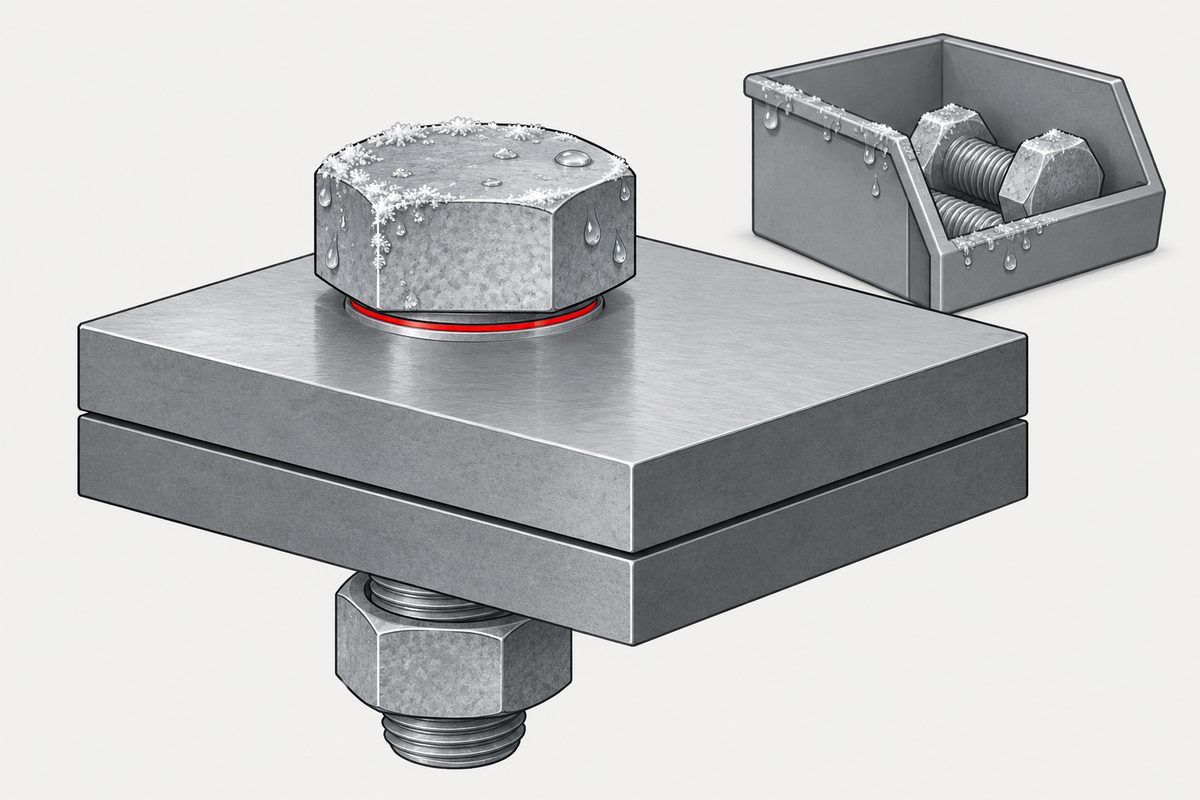
That box spent the night at minus twenty, and your torque figure did not know
A torque figure assumes a friction condition. The site has said that before. What it has not said is that the condition can change in the warehouse — and that the thing which changes it fastest is not age. In a 2022 study, zinc flake bolts held one day at −20 °C and tightened within 30 minutes of coming out needed 11% to 30% less torque to reach the same 25 kN. The under-head friction coefficient fell by 19% to 47%. Not from sitting for months. From one cold night and a warm room.
The experiment
Kumar, Persson, Sherrington and Glavatskih tested four automotive zinc flake systems on M10 bolts, load-controlled to 25 kN, measuring thread and under-head torque separately and computing friction with the Kellermann–Klein relationships. At least five fresh fastener, nut and plate assemblies per condition.
| Condition | What was done |
|---|---|
| Room reference | 21–23 °C, 40–55% RH |
| Warm and humid | 40 °C, ≥95% RH for 2, 7, 14 or 30 days |
| Cold | −20 °C for one day |
| All of them | Tightened at room temperature within 30 minutes of leaving the chamber |
After the cold day, first tightening, against the room reference:
| Coating | Under-head friction | Torque for the same clamp force |
|---|---|---|
| Zn-flake 1 (KL120 + topcoat) | −47% | −30% |
| Zn-flake 2 (KL100 + topcoat) | −19% | −11% |
| Zn-flake 3 (GEOMET 500B) | lower; the paper does not print the figure | −27% |
| Zn-flake 4 (DACROLIT) | −25% | −18% |
Read the torque column as the practical one. If your process is torque controlled and set for the room-condition friction, those same settings put more preload into the joint than you specified — because the friction eating your torque has gone.
It is not shelf life, and the paper is clear about that
The tempting version of this story is “coated fasteners go off in storage, so requalify by age”. The data does not support it.
- The warm, humid effect is much smaller — roughly 10% to 15% in torque at fixed preload, not a halving
- And it saturates fast. Zn-flake 2 dropped 13% after two days and showed no further significant reduction by thirty. Zn-flake 1 changed little for two days, dropped by seven, then flattened
- “The longer it sits, the lower the friction” is not supported. Zn-flake 2 trended slightly upward with further exposure; two others were non-monotonic, with the authors identifying probable outliers. Each formulation appeared to reach a saturation point
We were going to write that a torque figure validated in January may be invalid by June. We are not writing it, because it is not proven. The study ran to thirty days at 40 °C and >95% RH, plus one day at −20 °C. Ordinary warehouse ageing over months was never tested.
The variable is condensation
The cold result is the large one, and the cold parts were not tightened cold. They were brought into a room at 21–23 °C and tightened within half an hour — the window in which a cold steel surface pulls water out of warm air. The authors observed condensation on the fasteners, and in that condition it is plausible that pressure-supported water pockets produce mixed lubrication.
This is the part that turns into an instruction. The risk is not “old stock”. It is cold stock brought into a warm plant and driven straight away — a winter morning, an unheated store, an overnight container, a chilled lorry backed up to the door.
ISO 4042 already warns about this class of problem, noting that water, condensation and dust during storage can impair torque and clamp force properties. ISO 10683 and ISO 4042 impose functional storage requirements — but neither sets a universal numeric shelf life for friction, which is consistent with what the data shows: the driver is the state of the surface at the moment of tightening, not the calendar.
Why this is not covered by “torque has ±25% scatter anyway”
The obvious objection is that torque control already carries a large uncertainty — the tightening factor puts real numbers on it — so why does another 10% or 30% matter?
Because scatter and a shift in the mean are different things. The ±25% figure is a design uncertainty: you size the joint so that the worst corner of that band is still acceptable. A storage-driven friction change does not widen the band — it moves the whole band. The systematic shift adds to the assembly scatter you already allowed for, and it lands on top of it rather than inside it.
And the direction is the unhelpful one. Less friction at the same torque means more preload than intended, which is the direction that yields bolts and crushes soft parent material rather than the direction that leaves a joint loose.
What the paper does not establish
This matters because the mechanism is the part most likely to be repeated as fact.
- Observed: condensation on cold fasteners; different coating morphology, porosity and hardness-depth profiles; different friction responses per coating
- Plausible but not proven: pressure-supported water pockets giving mixed lubrication after cold storage
- Speculative: extra zinc oxide formed by water diffusion lowering friction in warm humid storage. No XRD or XPS identification of new ZnO was reported. The authors write “probably” and call it the most probable explanation
- Not shown: that storage changes nano-hardness. Hardness profiles differed between coatings and correlated with their responses; that is not the same claim. The paper says the reason is “not entirely clear”
- Confounded: the warm test combined 40 °C with >95% RH, so temperature and humidity are not separable. The cold effect cannot be separated from rewarming condensation
So the defensible statement is narrow: the storage environment can change the interfacial state enough to move friction materially, and the effect differs by coating formulation. Anything more specific is the paper's hypothesis rather than its result.
What to do about it
- Let cold stock reach shop temperature before driving it, and let any condensation dry. This is the cheapest countermeasure and it addresses the largest effect in the data.
- If the joint is torque controlled and matters, say so on the purchase specification. ISO 10683 and ISO 4042 already frame storage as a functional requirement; naming it is not an unusual demand.
- Do not treat the coating designation as a friction specification. Four zinc flake systems in one study spanned −19% to −47% under-head friction change under the same treatment. They are not interchangeable for this purpose — and the friction figure belongs on the drawing, as the friction a torque figure assumes sets out.
- If preload really matters, stop inferring it from torque. Angle or yield control, or direct measurement — the same conclusion the tightening factor reaches from a different direction.
- Do not requalify by calendar age alone. The data does not support a shelf-life rule for friction, and a rule that is not supported will be ignored the first time it is inconvenient.
References
- Mayank Kumar, Erik Persson, Ian Sherrington and Sergei Glavatskih, ‘Changes in friction of zinc flake coated threaded fasteners due to humidity, temperature and storage duration’, Tribology International 170, 2022, article 107498, DOI 10.1016/j.triboint.2022.107498 — four zinc flake systems on M10 bolts, load controlled to 25 kN, Kellermann–Klein friction evaluation, at least five assemblies per condition. Cold storage one day at −20 °C; warm humid 40 °C and ≥95% RH for 2 to 30 days; all tightened within 30 minutes of chamber removal
- ISO 4042 — electroplated coating systems for fasteners; warns that water, condensation and dust during storage can impair torque and clamp force properties
- ISO 10683 — non-electrolytically applied zinc flake coating systems for fasteners; functional storage requirements, without a universal numeric friction shelf life
The coating formulations in that study were commercial systems and their exact compositions were confidential, so formulation-level generalisation is limited. Acceptance for any particular joint is governed by your drawing and your own testing.
This page covers step 5, the finish. The whole order is substrate, thread, head, drive, finish, documentation, and why doing it out of order is rework rather than a tweak is in specifying a screw.
Common questions
Does storage really change the friction of coated fasteners?
It can, and by enough to matter. In a 2022 study of four automotive zinc flake systems, bolts held for one day at minus 20 degrees and tightened within 30 minutes of coming out needed 11% to 30% less torque to reach the same 25 kN clamp force, with under-head friction coefficients 19% to 47% lower than the room-condition reference. Warm humid storage at 40 degrees and above 95% relative humidity produced a smaller effect of roughly 10% to 15% in torque at fixed preload.
So coated fasteners have a friction shelf life?
That is not what the data shows. The warm humid effect saturated quickly, with most of the change occurring within two to seven days and little further change out to thirty days, and it was not monotonic for every coating. One system trended slightly upward with longer exposure. The study also ran only to thirty days plus a single cold day, so it cannot support a claim about months of ordinary warehouse ageing, and neither ISO 4042 nor ISO 10683 sets a universal numeric friction shelf life.
What is actually causing it?
The honest answer is that the mechanism is not settled. Condensation on cold fasteners was directly observed, and pressure-supported water pockets producing mixed lubrication is a plausible explanation for the cold result. The suggestion that extra zinc oxide forms through water diffusion in warm humid storage is explicitly framed as the most probable explanation rather than a measured result, and no XRD or XPS identification of new zinc oxide was reported. The authors state that the reason is not entirely clear.
Does this matter when torque control already has plus or minus 25% scatter?
Yes, because scatter and a shift in the mean are different problems. The plus or minus 25% figure is a design uncertainty that you size the joint around, so the worst corner of the band is still acceptable. A storage-driven friction change does not widen that band, it moves it, and the systematic shift adds to the assembly scatter you already allowed for. The direction is also unhelpful: less friction at the same torque gives more preload than intended.
What is the practical countermeasure?
Let cold stock reach shop temperature and let any condensation dry before driving it, since the largest effect in the data came from cold parts tightened within half an hour of coming into a warm room. Beyond that, name the storage requirement on the purchase specification, do not treat a coating designation as a friction specification given that four zinc flake systems spanned minus 19% to minus 47% under the same treatment, and for joints where preload genuinely matters use angle control, yield control or direct measurement rather than inferring preload from torque.
Enquiries
If your line is torque controlled and the parts arrive cold, tell us the coating system by name rather than by category. Four zinc flake systems in one published study responded to the same treatment across a range of −19% to −47% in under-head friction, so which one you have is the question that matters.
Request a quotation
Tell us the part and the quantity. We will come back on feasibility, lead time and price.
Or email us directly sales@tigerfasteners.com