 TIGERFASTENERS
The Roll Pin Has a Rated Shear Load. The Dowel Pin Does Not.
Someone repaired an adjustable basketball hoop, then could not stop thinking about it: the whole backboard appeared to hang off one roll pin about 5 mm across. Why does that not shear? The best answer, at 232 points, suggested drawing a free body diagram and then looked up a number: a hardened steel dowel pin of 5 mm has a double shear rating of about 32 kN. Two things had been swapped in that sentence, and both of them matter.
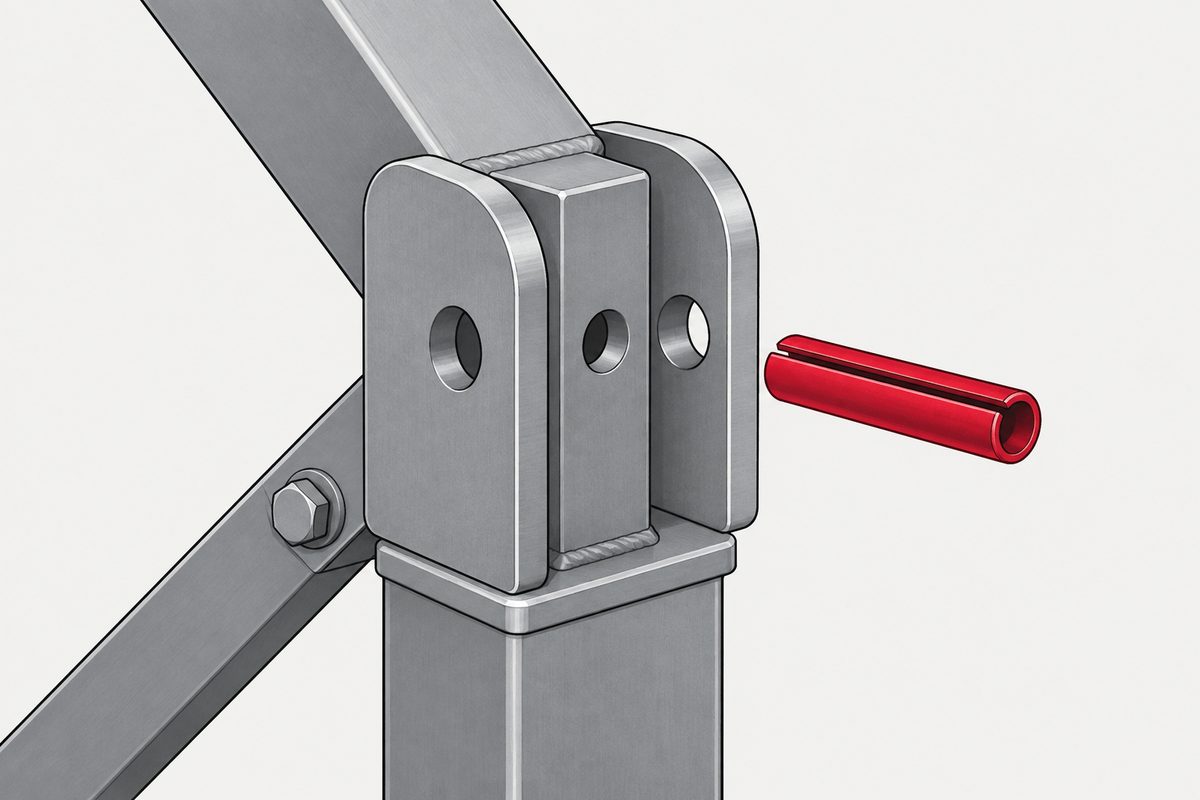
The number the standard actually publishes
A slotted spring pin, the hollow one with the seam down its side, is covered by ISO 8752 for the heavy duty type. Its dimension table carries a column most people never look at: minimum double shear strength, in kilonewtons, for every nominal diameter from 1 to 50 mm. The test method is a separate standard, ISO 8749.
| Nominal d1 | Minimum double shear | Nominal d1 | Minimum double shear |
|---|---|---|---|
| 2 mm | 2,82 kN | 8 mm | 42,76 kN |
| 3 mm | 6,32 kN | 10 mm | 70,16 kN |
| 4 mm | 11,24 kN | 12 mm | 104,1 kN |
| 5 mm | 17,54 kN | 16 mm | 171 kN |
| 6 mm | 26,04 kN | 20 mm | 280,6 kN |
So the pin in the question has a published minimum of 17,54 kN, not 32. The looked-up figure is roughly 1,8 times the standard value for the part that was actually in the hoop, and a factor of nearly two is the difference between a comfortable margin and an argument.
One footnote to that column changes what it covers. The double shear values apply to steel and martensitic stainless steel products only. For austenitic stainless pins, no values are specified. An A2 or A4 spring pin has no rated shear load in the standard at all, so if a drawing calls up stainless for corrosion reasons, the number in the table has quietly stopped applying.
⚠️ That holds for this family only.
ISO 8752 (slotted) publishes no double-shear value for austenitic stainless, but
ISO 8748 and ISO 8750 (coiled) do
— same material, 15.5 kN at 5 mm.
The limit belongs to the family, not to the stainless.
⚠️ The grooved-pin family moved too: its numbers left the product standard in 2025.
And the number the other standard does not publish
The 32 kN belongs to a hardened dowel pin, a solid ground pin covered by ISO 8734. Read that standard's requirements table and it lists material, hardness, surface, surface roughness, workmanship and acceptability. There is no shear row. Hardness is there in detail, 550 to 650 HV30 for the through hardened type and a 600 to 700 HV1 case for the case hardened one, but nothing converts that into a load.
This does not make the 32 kN wrong. Dowel pin shear figures come from manufacturers who test them, and a tested number is a real number. It does mean the two figures are not the same kind of thing: one is a minimum a supplier has to meet to claim conformance, the other is a catalogue value whose test conditions you have to go and read. Quoting them side by side as if they were interchangeable is how a factor of two goes unnoticed.
The location job these pins do, and why two of them and not three, is screws cannot locate. This page is about what happens when the pin is carrying load rather than setting position.
The hole is the design variable, and the slot has to stay open
ISO 8752 spends one short clause on installation and it is worth the whole standard. The hole shall be equal to the nominal diameter of the pin, to tolerance class H12. Nothing else. No interference calculation, no fit table to choose from. Why hole basis is the default in the first place is why fits are hole basis. Worth noting that this clause is unusual: the two standards for solid dowel pins next to it do not mention the hole at all.
The interference comes from the pin. At nominal 5 mm the pin measures 5,4 to 5,6 mm before mounting, while an H12 hole at that size runs 5,000 to 5,120 mm. The pin is up to about half a millimetre oversize on diameter and closes onto the wall as it goes in.
Then comes the line that catches people: when mounted in the smallest permitted hole, the slot shall not fully close. A spring pin that has bottomed out, seam touching seam, is no longer a spring. It has become a badly made solid pin with a crack down the side, and the shear value in the table was not measured on that.
Do not plate it, and the standard says so in an unusual way
Both pin standards have a surface finish clause and the difference in their wording is not decorative.
ISO 8734, for dowel pins, says appropriate plating processes should be employed to avoid hydrogen embrittlement and that plated pins shall be suitably treated immediately afterwards. That is the usual language.
ISO 8752 goes further. Because of the risk of hydrogen embrittlement, spring pins should not be electroplated or phosphate coated. If corrosion protection requires it, and both parties agree, then baking immediately after plating is mandatory, and freedom from hydrogen embrittlement is still not guaranteed. The default supply condition is plain, in natural finish, with a protective lubricant.
The reason is in the part itself. A spring pin is hardened to 420 to 560 HV and then held permanently in tension by its own interference fit. High hardness, sustained tensile stress and absorbed hydrogen are the three ingredients, and this part supplies two of them by design. What the third one does, and why the failure arrives days later, is hydrogen embrittlement.
Two details that explain the shapes on the shelf
- They nest on purpose. A note in ISO 8752's scope says the nominal diameters were chosen so that pins can be fitted one inside the other, or combined with light duty pins to ISO 13337. A pin inside a pin is a designed configuration, not somebody improvising.
- Heavy duty and light duty are separate standards. ISO 8752 covers 1 to 50 mm heavy duty; ISO 13337 covers the light duty version from 2 to 50 mm with its own, lower values. Two pins that measure the same across can be rated differently, so the standard number belongs on the drawing next to the diameter.
What to settle before the pin goes on the drawing
- Which standard. ISO 8752 heavy duty, ISO 13337 light duty, or ISO 8734 solid dowel. They are not interchangeable and only the first two are springs.
- The hole, at H12. Not a fit chosen from a table. And check that the slot will still be open at the small end of the hole tolerance.
- The material, before quoting the shear value. Austenitic stainless has no specified double shear load, so a stainless callout and a shear calculation cannot both come from ISO 8752.
- That the minimum is not an allowable. Where a working figure does come from, and why fastener standards do not issue one, is a working load limit is an authorisation, not a prediction.
- Whether it is being plated. If yes, that is a conversation about baking and about accepting a risk the standard says it cannot remove.
The same split shows up on the other axial locating part: a retaining ring’s thrust rating is the lower of a ring calculation and a groove calculation, and the groove is usually what gives.
This is not one of the six steps. It shows up across them, or after assembly. Where the decisions that lead here were made is in specifying a screw, which sets out the order and why doing it out of order is rework.
Common questions
What is the shear strength of a 5 mm roll pin?
ISO 8752 gives a minimum double shear strength of 17,54 kN for a 5 mm heavy duty slotted spring pin in steel or martensitic stainless steel, tested to ISO 8749. That is a minimum for conformance rather than a design allowable, and it does not apply to austenitic stainless pins, for which the standard specifies no value. A light duty pin to ISO 13337 of the same nominal diameter carries its own lower figure.
Why do dowel pin shear figures differ from source to source?
Because they are not standard values. ISO 8734, which covers hardened parallel dowel pins, specifies material, hardness, surface, surface roughness, workmanship and acceptance, and has no shear requirement at all. Any double shear number for a dowel pin comes from a manufacturer testing its own product, so the test conditions and the definition of the value belong to that manufacturer and have to be read alongside the number.
What size hole does a roll pin go into?
The nominal diameter of the pin, at tolerance class H12. ISO 8752 states it in one sentence and offers no alternative fits. The interference comes from the pin being made oversize: at nominal 5 mm the pin is 5,4 to 5,6 mm before mounting against a hole of 5,000 to 5,120 mm. The standard adds one check that is easy to miss, that the slot must not fully close when the pin is mounted in the smallest permitted hole.
Can I get roll pins zinc plated?
By agreement, but ISO 8752 advises against it. Its surface finish clause says that because of the risk of hydrogen embrittlement the pins should not be electroplated or phosphate coated, that baking immediately after plating is mandatory if coating is used, and that even then freedom from hydrogen embrittlement is not guaranteed. The default is plain with a protective lubricant. The pin is hardened to 420 to 560 HV and held in tension by its own fit, which supplies two of the three conditions embrittlement needs.
Is a roll pin weaker than a solid pin of the same diameter?
Its rated load is lower, and the reason is not simply that it is hollow. The value in ISO 8752 is measured on the pin as supplied rather than calculated from a section, and the material is spring steel hardened to 420 to 560 HV rather than the 550 to 650 HV30 of a through hardened dowel. The useful comparison is between two published figures for the specific parts, not between a rule of thumb about hollow sections and a catalogue page.
References
- ISO 8752:2009 — spring-type straight pins, slotted, heavy duty; clause 1 scope and nesting note, Table 1 minimum double shear strength and pin diameter before mounting, clause 4 hole and slot requirement, Table 2 material, hardness and surface finish
- ISO 8734:1997 — parallel pins of hardened steel and martensitic stainless steel (dowel pins); Table 2 requirements, which contain no shear specification
- ISO 13337:2009 — spring-type straight pins, slotted, light duty, 2 mm to 50 mm
- ISO 8749 — pins and grooved pins, shear test; the method behind the ISO 8752 values
ISO 8752:2009 and ISO 8734:1997 were read from the publicly available preview PDFs, both of which carry the dimension and requirements tables in full, which is where every figure quoted here comes from. ISO 13337 was not read: it is named because ISO 8752 names it, and no value is quoted from it. The ISO 8749 catalogue number was not cross-checked against a second source. The 32 kN dowel pin figure is what the source thread quoted from a search result and we have not traced it to a specific manufacturer document; the point made here is about what kind of number it is, not about whether it is accurate. Nothing on this page is a design allowable. A minimum double shear strength for conformance and a working load for a joint are different quantities, and the joint geometry that decides the second one is not something a pin standard can supply.
Enquiries
If a pin is going on the enquiry, send the standard number and the hole tolerance with the diameter. Heavy duty, light duty and solid dowel look alike in a drawing note and are rated differently, and for spring pins the hole is the part of the specification that decides whether the pin still works as one.
Request a quotation
Tell us the part and the quantity. We will come back on feasibility, lead time and price.
Or email us directly sales@tigerfasteners.com