 TIGERFASTENERS
A Working Load Limit Is an Authorisation, Not a Prediction
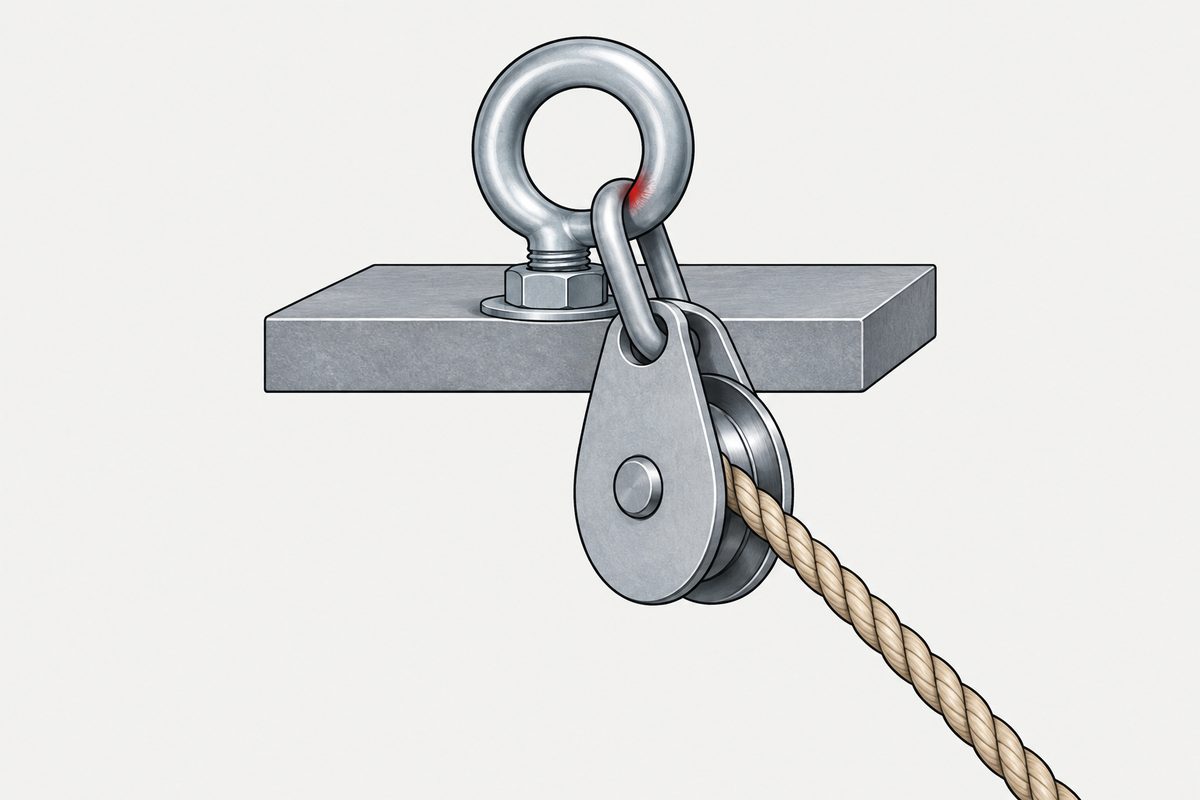
Somebody bought an eye bolt to hang a pulley from, got home, looked it up, and found a working load of five pounds. It is steel, it is zinc plated, it is nearly three inches long, and five pounds sounded like a joke. Seventy replies arrived. The best of them listed corrosion, uneven loading, shock and fatigue, and every one of those is true. None of them said where the number actually comes from, and it comes from a sentence you can go and read.
The definition does the work
EN 13414-1 covers steel wire rope slings, and its terms section defines the quantity that everybody quotes:
Working load limit of a sling: the maximum mass which a sling is authorised to sustain in general service.
Two words are carrying the whole meaning. Mass, not force: it is what you may hang on it, expressed in the units of the thing being lifted. And authorised, not capable. It is a permission, and permissions come from documents rather than from materials.
Read the original question against that. “Surely it can hold more than five pounds” is almost certainly correct and completely beside the point. Nobody claimed it would break at five. The number is what the product is allowed to be used for, and the argument in the thread about whether fatigue is governed by stress or by force never touches that, because a permission is not a failure calculation.
The coefficient is in the scope, and it is not the same number twice
The same standard says where its numbers come from, in the scope, before any table: the standard assumes a working coefficient, a factor of safety, of five. The next sentence draws the boundary that proves it is a real constraint rather than a slogan: the document does not cover single-use slings, that is one trip slings, having a working coefficient lower than five. A different coefficient makes it a different product outside this standard.
| Product | Standard | Coefficient |
|---|---|---|
| Steel wire rope sling | EN 13414-1 | 5, stated in the scope (read) |
| Grade 8 chain sling | EN 818-4 | 4 (summary level, not read) |
| Flat woven webbing sling | EN 1492-1 | 7 (summary level, not read) |
Three products doing the same job, three different numbers. That is the part worth keeping, because it rules out the intuitive explanation. If the coefficient were arithmetic about stress, it would not change with the material of the sling. What changes across those three rows is how the product fails and how much of that failure you can see coming. A chain link deforms and wears in ways a gauge finds. A webbing sling can be cut, abraded or degraded by ultraviolet with very little to look at. The coefficient is paying for what the product can hide.
And a fastener standard gives you none of it
This is where it stops being somebody else's subject. Go looking for the working load limit of a bolt and there is not one. ISO 898-1 gives a proof load, a yield and a tensile strength, which are properties measured on the part in a specified test, and its scope explicitly excludes shear, torque and clamp force relationships, and fatigue performance. What the two digits on the head do promise is 8.8 or A2-70.
That absence is why so many pages here end with the same sentence. A minimum double shear strength is not a design allowable, which is only one of these two pins has a rated shear load. A nut class describes the nut and not the joint, which is the nut has one number. A weld nut's proof load is verified with the projections removed and the nut welded to nothing, which is a weld nut does not have a property class.
The reason is structural, not an oversight. A sling is a finished product used in one recognisable way, so a standard can authorise a mass for it. A bolt is a component in a joint somebody else designs, and the load it may carry depends on the clamped parts, the grip length, the friction, how it was tightened and what the load does over time. There is no one to authorise, because there is no single thing being used.
Which means the number has to be built, and named
When a fastener joint needs an allowable, somebody makes it, from the proof load or yield down through the things the standard does not cover. Whoever does that is choosing a coefficient in the same way EN 13414-1 chose five, and the useful discipline is to write down which of these it was covering.
- What the tightening actually achieved. Preload scatter is the largest single term in most bolted joints and it is not a small correction.
- What is lost after assembly. Embedding and relaxation take clamp force away before any service load arrives.
- Whether the load is steady. A published fatigue limit is a test convention rather than a promise, which is the fatigue limit is a test convention.
- Whether the part can be inspected. This is the one that explains the three-row table above, and it is usually the one nobody writes down.
- Where the standard stops. Temperature, corrosion and shock are outside most fastener standards' scope by their own statement, which is where standards stop.
So was the asker right about the lawyers
Partly, and the honest answer is more interesting than either yes or no.
The industry did change the words. The older term was safe working load, and it was retired in favour of working load limit, because “safe” reads as a guarantee about an operation rather than a limit on a product, and because an SWL could be adjusted in the field while a WLL is a fixed figure tied to a stated coefficient. We have that at summary level rather than from a clause, so treat it as the standard account rather than a quotation.
But the change made the number more honest, not less. A limit that says it is a limit, and a definition that says authorised, are both admitting what the figure is. The version that would deserve the asker's suspicion is the one that called itself safe.
As for why that particular eye bolt is rated at five pounds, that is a question about that particular product and we do not have its specification. Worth knowing generally: a rating belongs to a specific part made to a specific standard, a formed eye that has not been welded or forged closed is a different part from a lifting eye bolt, and for any lifting eye the angle of pull changes what is permitted. If the application is lifting, the document to work from is the one for that product rather than this page.
Correction, added later. The two remarks above were unsourced when this page was written. One of them can now be sourced and is sharper than we put it. ISO 3266 excludes eyebolts that are not forged in one piece, and it defines the working load limit of an eyebolt as the mass it is authorised to sustain along its centreline axis, which means the figure was axial before any angle was applied to it. Both sentences are read in the working load limit of an eyebolt is defined along its centreline axis. The reduction that applies to an inclined pull is still outside the free preview, and we still do not quote one.
How to read a rating you have been handed
- Ask which standard issued it. A number without a document behind it is a marketing figure, and the coefficient it used is unknowable.
- Ask what the coefficient was. It is often in the scope rather than in the tables, and it differs by product family for reasons about inspection and damage rather than about stress.
- Do not compare across product families. A 1,700 lb cord and a 750 lb pulley are not carrying comparable margins, because their standards did not choose the same coefficient.
- For fasteners, expect no rating at all, and expect to build the allowable yourself from a proof load and a list of what the standard did not cover.
This is not one of the six steps. It shows up across them, or after assembly. Where the decisions that lead here were made is in specifying a screw, which sets out the order and why doing it out of order is rework.
Common questions
What does working load limit actually mean?
EN 13414-1 defines the working load limit of a sling as the maximum mass which a sling is authorised to sustain in general service. Two words matter: mass rather than force, and authorised rather than capable. It is a permission attached to a product by a standard, not a prediction of the load at which the product will break.
Why do different products have different safety factors?
Because the coefficient is written into each product standard, and the standards are covering different things. EN 13414-1 states in its scope that it assumes a working coefficient of five for steel wire rope slings. Chain and textile slings carry different figures. If the number were arithmetic about stress it would not change with the material, so what it is really paying for is how each product fails and how much of that failure is visible before it happens: a chain link deforms and can be gauged, a webbing sling can be cut or degraded by ultraviolet with very little to see.
What is the working load limit of a bolt?
There is not one. ISO 898-1 gives a proof load, a yield strength and a tensile strength, which are properties measured on the part in a specified test, and its scope excludes shear, torque and clamp force, and fatigue. A sling is a finished product used in one recognisable way, so a standard can authorise a mass for it. A bolt is a component in a joint that somebody else designs, so the allowable has to be built for that joint rather than issued with the part.
Is safe working load the same as working load limit?
They refer to the same idea and the terminology moved from one to the other. The usual account is that "safe" was dropped because it reads as a guarantee about an operation rather than a limit on a product, and because a safe working load could be adjusted in the field while a working load limit is a fixed figure tied to a stated coefficient. We have that at summary level rather than from a clause, so treat it as the standard account rather than a quotation.
Can I compare the margin on two different products by their ratings?
Not directly, and this is where the original question went wrong in an instructive way. A cord rated at 1,700 lb and a pulley rated at 750 lb are not carrying comparable reserves, because the standards behind them did not choose the same coefficient. Comparing ratings across product families compares two different permissions rather than two capacities.
References
- EN 13414-1 — steel wire rope slings, safety, slings for general lifting service; clause 1 scope, including the working coefficient of five, and 3.3 defining the working load limit
- ISO 898-1 — mechanical properties of bolts, screws and studs; proof load, yield and tensile strength, and the scope exclusions
EN 13414-1 was read from a publicly available preview of the SIST adoption, which carries the scope and the terms and definitions in full; the working coefficient of five, the exclusion of single-use slings below that coefficient, and the definition of working load limit are all quoted from those pages. The coefficients attributed to chain slings and to webbing slings are at summary level from standards listings and supplier documentation, not from clauses we have read, and the table above labels them as such. The account of safe working load being retired in favour of working load limit is likewise at summary level. The remarks about eye bolts were general engineering practice rather than requirements when this page was written, and two of them have since been sourced from ISO 3266 in a later article, which the correction paragraph above links to; no reduction factor for inclined loading is quoted here or there. No conclusion is drawn about the specific product in the source thread because we do not have its specification. The ISO 898-1 scope exclusions are as established on our own pages, where they were checked against the standard at the time.
Enquiries
If a load figure has reached us without the standard that issued it, that is the thing to resolve first. The number and the coefficient behind it travel together, and only one of them is usually written on the part.
Request a quotation
Tell us the part and the quantity. We will come back on feasibility, lead time and price.
Or email us directly sales@tigerfasteners.com