 TIGERFASTENERS
The Working Load Limit of an Eyebolt Is Defined Along Its Centreline Axis
This site said something about eyebolts a while ago and then admitted, in its own footnote, that it had not read the standard. The remark was that the angle of pull changes what a lifting eye is permitted to carry, and it was labelled general engineering practice rather than a requirement. The standard is ISO 3266, and the free preview turns out to settle a different and sharper point than the one we hedged on: the definition of the number itself contains the word axis.
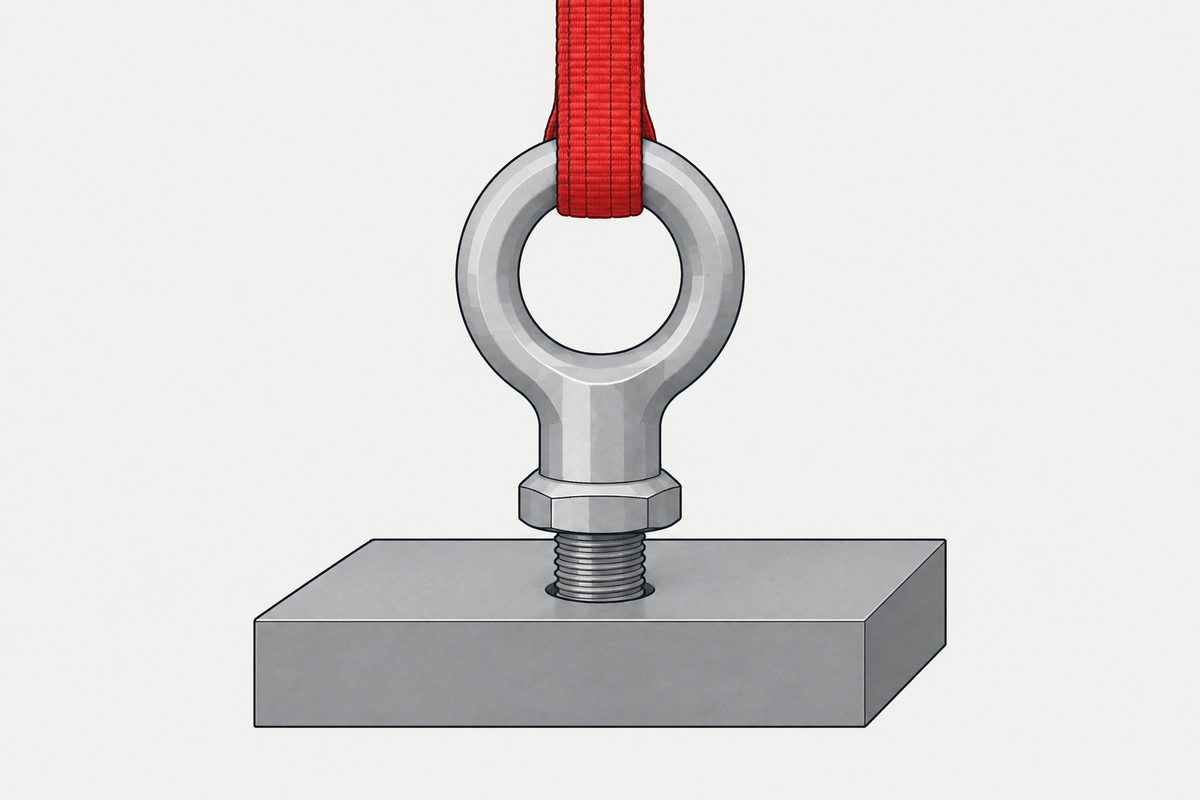
Definition 3.2 of ISO 3266:2010: “working load limit, WLL: maximum mass that an eyebolt is authorized to sustain along its centreline axis in general lifting service.” Two paragraphs earlier, in the scope: “These eyebolts can be used for axial and inclined loading.” The number is defined on one geometry and the product is scoped for two, in the same document, a page apart.
The document is ISO 3266:2010, forged steel eyebolts grade 4 for general lifting purposes, second edition, sixteen pages, ISO/TC 111/SC 3, confirmed as current in a 2026 review. It replaces the 1984 first edition, which it says was technically revised. There is an amendment from 2015 which we have not read, and the catalogue entry also records a draft revision, ISO/DIS 3266, marked deleted.
The free preview runs to page 5 of 16. That gets us the scope, the definitions, the hazard list and the start of the dimensions. It does not get us the reduction table for inclined loading, and this page therefore quotes no reduction factor and gives no angle. If your question is how much a given eyebolt may carry at a given angle, the answer is in a part of the document we have not read, and in the manufacturer’s information, and nowhere on this page.
Nothing here is a lifting instruction and no product is assessed. What follows is a description of a standard.
The word that was doing the work
Our earlier page said that a working load limit is an authorisation, not a prediction, and it read the definition carefully to show that the word authorised is deliberate. What it did not have was the eyebolt version of the definition, which adds a second deliberate phrase.
Along its centreline axis. The WLL of an eyebolt is not a property of the eyebolt in general. It is a property of the eyebolt pulled straight. The standard then defines the two load cases separately and gives them separate symbols: axial loading, Fa, loading along the centreline axis, and inclined loading, Fβ, loading at an angle β to the centreline axis. Both are drawn in Figure 1. Inclined loading is not an abuse case the standard tolerates, it is a defined load case with its own symbol. It just does not share the headline number.
That is the fact we should have had when we wrote the earlier page and did not. The hedged sentence there was that the angle of pull changes what is permitted; the precise version is that the permitted figure was defined on the axis in the first place.
One hazard, four causes, and two of them are information
Clause 4 is a list of significant hazards, and it is short enough to be startling. There is one hazard.
“Injury or death due to being hit by a falling load arising from failure of the eyebolt”
And then four causes of that failure, each pointing at the clauses meant to control it.
| Cause of failure | Clauses that address it |
|---|---|
| Inadequate strength and toughness | 7 to 13 |
| Dimensional incompatibility and errors of fitting | 5, 6, 7, 14 |
| Incorrect selection | 14, 15, 16 and Annex A |
| Inadequate information for use | 14, 16 |
Two of the four causes of somebody being killed by a falling load are not about the metal. They are choosing the wrong part and not being told enough about it. And the clauses assigned to those two are 14, 15 and 16, which are marking, the manufacturer’s declaration, and information for use.
A hazard analysis that puts documentation in the same table as strength and toughness, for the same outcome, is making a claim: that the paperwork is load bearing. Most product standards on this site treat marking as an administrative clause at the back. This one treats it as a control on a fatality.
What the standard refuses to cover
Two exclusions in the scope, and both of them answer questions people ask.
“This International Standard is not applicable to eyebolts which are not forged in one piece.”
“This International Standard is not applicable to forged steel eyebolts grade 4 manufactured before the date of its publication as an International Standard.”
The first is the sentence our earlier page reached for and could not cite. An eye that was bent from bar and closed, rather than forged in one piece, is not covered by this document at all. Whatever is stamped on it comes from somewhere else, and asking where is a fair question.
The second is unusual and worth pausing on. A standard normally describes a product; this one declines to describe parts that already existed when it was published. That makes the publication date part of the specification, which in turn makes a traceability code, defined in 3.3 as the letters or numbers that let the manufacturing history and the cast of steel be traced, more than a serial number.
The scope also fixes the working temperature range at minus 20 to plus 200 degrees Celsius, and explains what the eye is sized for: dimensions permitting direct connection with shackles of the same working load limit as those in ISO 2415, with larger eyes permitted so that sling hooks of similar working load limit can connect directly. The hole is not a generic hole. It is dimensioned against another standard’s hardware at a matching rating.
Type C, and what that buys
The introduction states that this is a type-C standard in the sense of ISO 12100, and then says what that status does: “When provisions of this type-C standard are different from those which are stated in type-A or type-B standards, the provisions of this type-C standard take precedence.”
So where this document and a more general safety standard disagree, this one wins, for equipment designed and built to it. That is worth knowing before quoting a general rule at an eyebolt.
Two small dimensional allowances round out the part of the preview that carries numbers, and they are the sort of thing that only appears in a forged product standard. On the internal diameter of the eye, a positive local deviation of roundness of 5 per cent is permitted. On the diameter of the eye section, a symmetry tolerance of 5 per cent is permitted. The eye is allowed to be visibly out of round and visibly asymmetric, because it was forged, and the standard says by how much rather than leaving an inspector to argue about it. The dimension table itself is past page 5 and is not quoted here.
What we can now say, and what we still cannot
Can say, from the document: the working load limit is defined along the centreline axis; inclined loading is a defined case with its own symbol; parts not forged in one piece are outside the standard; parts made before 2010 are outside it; the temperature range is minus 20 to 200; the eye is sized against ISO 2415 shackles at the same rating; and the hazard list treats selection and information as causes of death.
Cannot say, and did not: any reduction factor or permitted angle, because that table is outside the free preview. Anything from Annex A, the informative recommendations for selection, care and use, for the same reason. Anything from the 2015 amendment. Any dimension from Table 2. And anything at all about whether a particular eyebolt in somebody’s hand is suitable for a particular lift, which is not a question a website should be answering.
The reason to write this down anyway is that the earlier page on this site made a claim about eyebolts and then flagged, honestly, that it had not read the standard. That flag can now come down for one specific sentence, and the sentence turns out to be sharper than the hedge was. Not the angle changes what is permitted. The permitted figure was never about the angle.
This is not one of the six steps. It shows up across them, or after assembly. Where the decisions that lead here were made is in specifying a screw, which sets out the order and why doing it out of order is rework.
Common questions
What does the working load limit of an eyebolt actually refer to?
ISO 3266 defines it as the maximum mass an eyebolt is authorised to sustain along its centreline axis in general lifting service. The definition contains the axis, so the figure describes the eyebolt pulled straight rather than the eyebolt in general.
Does ISO 3266 allow eyebolts to be loaded at an angle?
The scope states that these eyebolts can be used for axial and inclined loading, and the definitions give inclined loading its own symbol, F beta, defined as loading at an angle beta to the centreline axis. Both cases are drawn in Figure 1. The reduction that applies to inclined loading is in a part of the document outside the free preview, and this page quotes no factor and no angle.
Does the standard cover an eye that was bent from bar and closed?
No. The scope states that the standard is not applicable to eyebolts which are not forged in one piece. A part made another way is not covered by this document, whatever is marked on it.
Does ISO 3266 apply to older eyebolts?
No. The scope states that it is not applicable to forged steel eyebolts grade 4 manufactured before the date of its publication as an International Standard. The second edition is dated May 2010.
What hazards does ISO 3266 list?
One: injury or death due to being hit by a falling load arising from failure of the eyebolt. It then lists four causes of that failure, inadequate strength and toughness, dimensional incompatibility and errors of fitting, incorrect selection, and inadequate information for use, and points each at the clauses meant to control it. Two of the four are about selection and documentation rather than the metal.
What temperature range does ISO 3266 cover?
Minus 20 to plus 200 degrees Celsius, stated in the scope.
What is the eye of an ISO 3266 eyebolt sized for?
The scope says the dimensions permit direct connection with shackles of the same working load limit as those defined in ISO 2415, and that larger eyes are allowed so that sling hooks of similar working load limit can also connect directly.
Is grade 4 the same as a property class?
No. Grade 4 here is the eyebolt grade used in the lifting component standards from ISO/TC 111, not a property class from the fastener mechanical property standards. The two numbering systems are unrelated and should not be read across.
Why does the standard allow the eye to be out of round?
Because it is forged. Clause 5 permits a positive local deviation of roundness of 5 per cent on the internal diameter of the eye, and a symmetry tolerance of 5 per cent on the diameter of the eye section. The standard states the allowance rather than leaving it to be argued at inspection.
References
- ISO 3266:2010, Forged steel eyebolts grade 4 for general lifting purposes. Foreword, Introduction, clauses 1 to 5, Figures 1 and 2, Table 1
- A working load limit is an authorisation, not a prediction, the page on this site that declared this gap
- r/Tools, where somebody spent this week looking for an M7 eyebolt
The text used here is the publicly available iTeh preview of ISO 3266:2010, which runs to page 5 of a 16 page document. It contains the foreword, the introduction, clauses 1 to 5, Figures 1 and 2 and Table 1. The reduction applying to inclined loading is outside the preview, and this page quotes no reduction factor and no angle. Annex A, the informative recommendations for selection, care and use, is also outside it and nothing is said about its contents. Table 2, the dimensions, is outside it and no dimension is quoted. The 2015 amendment was not read. The standard is the second edition, sixteen pages, ISO/TC 111/SC 3, stage 90.93, last reviewed and confirmed in 2026, replacing the 1984 first edition; the catalogue entry also shows a draft revision, ISO/DIS 3266, marked deleted. Grade 4 in this standard is the lifting component grade used by ISO/TC 111 and is not a property class from the fastener standards; the two are unrelated. Nothing is quoted from ISO 2415, ISO 12100, ISO 14121-1 or any of the test method standards ISO 3266 references, beyond the sentences of ISO 3266 that name them. This page describes a standard. It is not a lifting instruction, it gives no guidance on rigging or on loading at an angle, and it assesses no product. The forum post is cited only as evidence that somebody was looking for an eyebolt this week; we read the post and not its replies. The reason this article exists is that an earlier page on this site made remarks about eyebolts and stated in its own footnote that nothing there was quoted from ISO 3266; that page has been updated to point here for the one sentence this preview settles.
Enquiries
If an eyebolt is part of something you are specifying, ask which standard the rating came from and whether the part is forged in one piece, because ISO 3266 excludes parts that are not. Ask separately what the rating is for a pull that is not on the axis, since the definition of the figure is axial.
Request a quotation
Tell us the part and the quantity. We will come back on feasibility, lead time and price.
Or email us directly sales@tigerfasteners.com