 TIGERFASTENERS
Stainless spring pins do have a rated shear value, just not the slotted ones
Reading about 10 minutes. If you specified an austenitic stainless spring pin and were told the standard publishes no shear value, that was true of the pin you were holding. It is not true of the family next to it on the shelf.
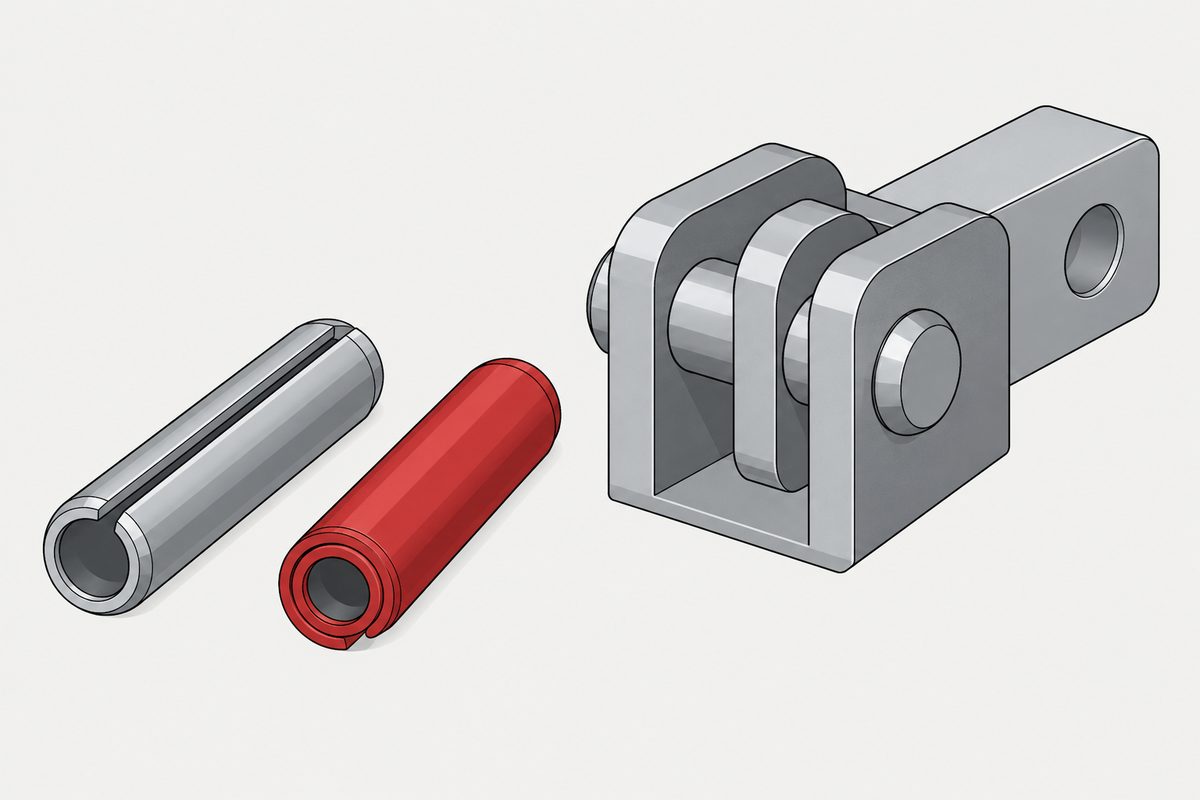
What this page corrects
We have a page that says a spring pin has a rated shear value and a dowel pin does not, and it adds that for austenitic stainless pins the standard specifies no value at all. That sentence is accurate about ISO 8752, the slotted heavy duty pin, and it is what that standard says.
It is easy to carry that away as a fact about stainless. It is not. It is a fact about slotted pins. Coiled spring pins are covered by a different set of standards, and those standards publish a second column of double shear values that applies specifically to austenitic stainless products.
Two families, five standards
Both are spring-type straight pins. Both are inserted into a plain hole and held by radial force against the hole wall. They are made differently: a slotted pin is a tube with a slot down its length; a coiled pin is a strip wrapped around itself.
| Slotted, heavy duty | ISO 8752 — 1 mm to 50 mm |
|---|---|
| Slotted, light duty | ISO 13337 — 2 mm to 50 mm |
| Coiled, heavy duty | ISO 8748 — 1,5 mm to 20 mm |
| Coiled, standard duty | ISO 8750 — 0,8 mm to 20 mm |
| Coiled, light duty | ISO 8751 |
Note the two ends of the range. The coiled standards stop at 20 mm where the slotted ones go to 50 mm, and the coiled standard duty starts at 0,8 mm where the slotted heavy duty starts at 1 mm. If the pin is very small or very large, the choice of family may already be made for you.
The column that only exists on one shelf
Table 1 in ISO 8748 and in ISO 8750 gives minimum double shear strength in two rows: one for steel and martensitic stainless, one for austenitic stainless. ISO 8752 gives one row, with a footnote restricting it to steel and martensitic products.
| Nominal d1 | ISO 8748 coiled, heavy | ISO 8752 slotted, heavy | ISO 8750 coiled, standard |
|---|---|---|---|
| 3 mm | 7,6 / 5,7 kN | 6,32 / — | 5,5 / 4,2 kN |
| 4 mm | 13,5 / 10 kN | 11,24 / — | 9,6 / 7,6 kN |
| 5 mm | 20 / 15,5 kN | 17,54 / — | 15 / 11,5 kN |
| 6 mm | 30 / 23 kN | 26,04 / — | 22 / 16,8 kN |
| 8 mm | 53 / 41 kN | 42,76 / — | 39 / 30 kN |
| 10 mm | 84 / 64 kN | 70,16 / — | 62 / 48 kN |
| 12 mm | 120 / 91 kN | 104,1 / — | 89 / 67 kN |
| 16 mm | 210 / — | 171 / — | 155 / — |
First figure is steel and martensitic stainless; second is austenitic stainless. An em dash means the standard publishes no value for that material at that size.
One distinction worth keeping straight: ISO 8752 still covers austenitic stainless pins. They are a conforming product under that standard. What the standard declines to do is rate their shear. So an austenitic slotted pin is not non-standard; it is unrated.
Two things the table says that are easy to miss
At 5 mm the order is not what the duty names suggest. Coiled heavy duty is 20 kN, slotted heavy duty is 17,54 kN, coiled standard duty is 15 kN. Two pins both called heavy duty differ by about 14 %, and a coiled standard duty pin is not far below a slotted heavy duty one. The word on the label is not the number.
The austenitic column stops at 12 mm. In both coiled standards the austenitic row is empty from 14 mm upward. So the answer to whether a stainless spring pin has a rated shear value is: yes on the coiled family, up to 12 mm, and then no again.
The hole is not quite the same either
ISO 8748 asks for a hole equal to the nominal pin diameter at tolerance class H12, across its whole range. ISO 8750 asks for H12 as well — except that below 1,2 mm nominal it asks for H10. That exception exists because the coiled standard duty range reaches down to 0,8 mm, where an H12 band is a large fraction of the diameter.
The hole is the design variable in both families. The pin arrives larger than the hole and is compressed on the way in; the interference is what holds it. Specifying the pin without specifying the hole leaves out half of the joint. That is the same point our tap drill page makes about threads: the published number describes a band, not a single dimension.
What this does not tell you
None of these figures is a design allowable. They are minimum values a conforming pin must reach in a shear test carried out to ISO 8749. The working load of a joint depends on its geometry, on how the load is shared, and on whether the load is static — none of which a pin standard can supply.
The material choice is also not only a strength choice. Austenitic and martensitic stainless behave differently in a corrosive environment and in contact with other metals, which our A2 and A4 page covers. The coiled standards note that martensitic pins are hardened and tempered while austenitic pins are cold worked, which is why the two get different numbers in the first place.
This is not one of the six steps. It shows up across them, or after assembly. Where the decisions that lead here were made is in specifying a screw, which sets out the order and why doing it out of order is rework.
Common questions
Does a stainless spring pin have a rated shear value?
It depends on the family and the size. For coiled pins to ISO 8748 or ISO 8750, austenitic stainless has published minimum double shear values from the bottom of the range up to 12 mm. For slotted pins to ISO 8752 there is no published value for austenitic stainless at any size.
Which is stronger, a coiled or a slotted spring pin?
At 5 mm in steel, ISO 8748 coiled heavy duty is 20 kN and ISO 8752 slotted heavy duty is 17,54 kN, so the coiled heavy duty pin is higher. But ISO 8750 coiled standard duty is 15 kN, below both. The duty class matters more than the construction.
What hole should I specify for a coiled pin?
A hole equal to the nominal pin diameter at H12, per clause 4 of both standards. ISO 8750 requires H10 instead for nominal diameters of 1,2 mm and below.
References
- ISO 8748:2007 — Spring-type straight pins, coiled, heavy duty; clause 1 scope, Table 1 minimum double shear for both material groups, clause 4 hole tolerance
- ISO 8750:2007 — Spring-type straight pins, coiled, standard duty; clause 1 scope, Table 1, clause 4 hole tolerance including the H10 exception, Table 2 surface finish
- ISO 8752:2009 — Spring-type straight pins, slotted, heavy duty; Table 1 and the footnote restricting it to steel and martensitic products
- ISO 8749:1986 — Pins and grooved pins, shear test; the method behind all of these values, and still the current edition
ISO 8748:2007 and ISO 8750:2007 were read as the official free preview PDFs, both of which contain the complete Table 1 and clause 4; every figure on this page for those two standards comes from those pages. The ISO 8752 figures are carried over from our earlier page, where the same preview was read. ISO 8748 was first published in 1987 and revised in 1997; both are withdrawn and this page cites the 2007 third edition only. ISO 8751 is named because the other two standards name it, and no value from it is quoted here. The ISO 8749 catalogue number and its 1986 edition were confirmed against a second source. Every claim on this page was put to an independent check before publication; all of them held, and the check added the point that ISO 8752 covers austenitic pins without rating them. No figure on this page is a design allowable.
Enquiries
If an enquiry involves spring pins, give the standard number and the hole tolerance alongside the diameter. Coiled and slotted pins of the same nominal size look almost identical on a drawing and carry different published values, and in stainless one of the two families has no published value at all.
Request a quotation
Tell us the part and the quantity. We will come back on feasibility, lead time and price.
Or email us directly sales@tigerfasteners.com