 TIGERFASTENERS
The grooved pin numbers moved out of the product standard in 2025
Reading about 8 minutes. If you keep a copy of a grooved pin standard and look up the shear value where it has always been, the current edition will not have it. The family is being reissued, and the numbers common to all of them have been moved into a separate document. The revision is still in progress, so which edition you hold decides where to look.
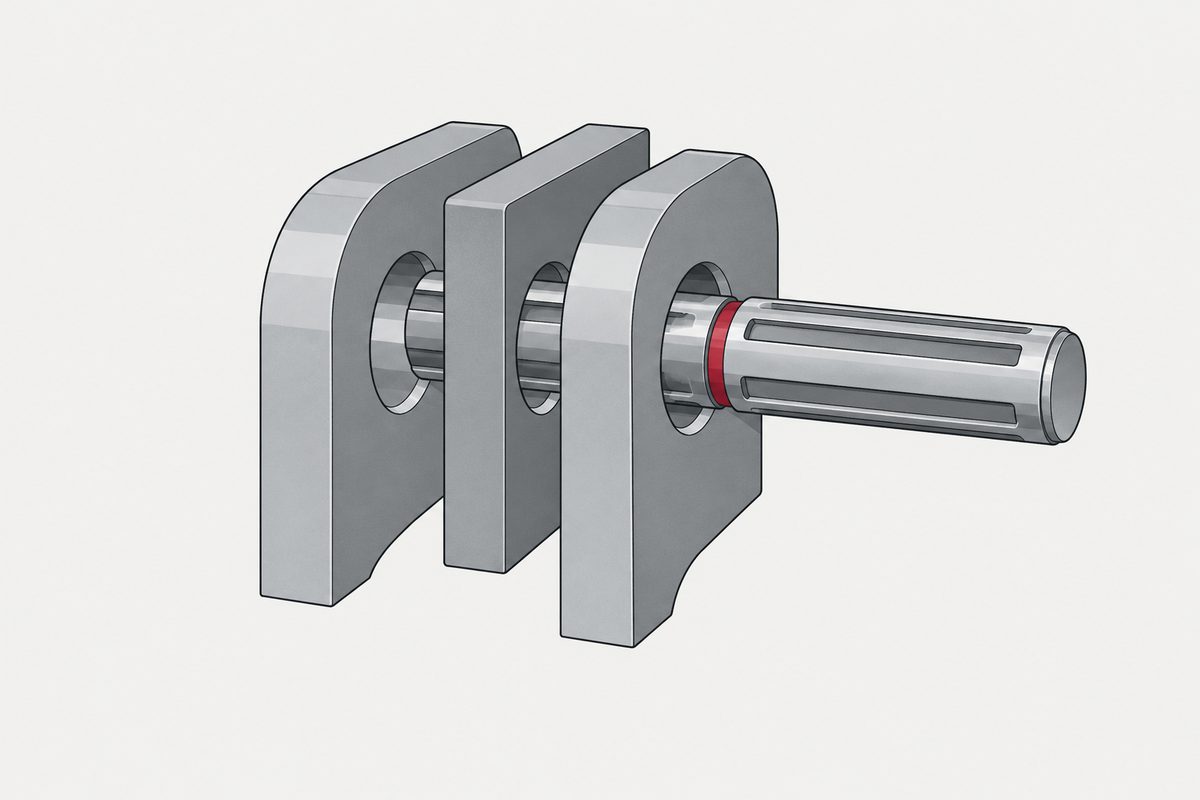
What used to be on the sheet
ISO 8739:1997 covers full-length parallel grooved pins with a pilot. Its Table 1 is a dimension table, and one of its rows is headed minimum shear strength, double, in kilonewtons, paired with the nominal diameter. The values apply to steel pins:
| d1 | Minimum shear | d1 | Minimum shear |
|---|---|---|---|
| 1,5 mm | 1,6 kN | 8 mm | 45,2 kN |
| 2 mm | 2,84 kN | 10 mm | 70,4 kN |
| 3 mm | 6,4 kN | 12 mm | 101,8 kN |
| 4 mm | 11,3 kN | 16 mm | 181 kN |
| 5 mm | 17,6 kN | 20 mm | 283 kN |
| 6 mm | 25,4 kN | 25 mm | 444 kN |
The same edition also told you the hole: equal to the nominal diameter d1, at tolerance class H11. And the material: steel at 125 HV30 to 245 HV30, or A1 stainless to ISO 3506-1 at 210 HV30 to 280 HV30. Everything needed to put the pin on a drawing was on one sheet.
What the current edition says instead
ISO 8740:2025 is the third edition of the chamfer-point pin standard, and its foreword states the change plainly. Terms and definitions, the assembly principles including hole dimensions, control of the expanded diameter and pin straightness, the mechanical and physical properties including shear resistance and hardness, and inspection — all of it, being common to every grooved pin — has been moved into a new reference standard, ISO 13669.
The foreword names the scope of the move: product standards ISO 8739 through ISO 8747, plus ISO 13670 and ISO 13672. That is the whole family.
The effect is easy to check. Searching the current ISO 8740 for the phrase minimum shear returns nothing at all. The clause that used to carry it now says the terms and definitions are those given in ISO 13669.
Four other changes in the same revision
The 2025 foreword is unusually specific, which makes it worth reading rather than summarising. Besides the move:
| Sizes | Non-preferred diameters 1, 3,5, 7, 9, 14 and 18 mm added |
|---|---|
| Expanded diameter | Values for steel raised slightly in the shortest length range, and added for stainless steel, which previously had none |
| Ends | Tolerances for the rounded end added; the chamfer end option deleted — see the note below, this is not the chamfer point in the title |
| Materials | Stainless grades A2, A4, C1 and F1 added. Hardened steel, brass and aluminium are now by agreement rather than standard |
The deleted chamfer end is not the chamfer point in the title. The chamfer point is the insertion-side tip geometry that guides the pin into the hole; it remains a required feature and is what the title names. The chamfer end was a separate optional treatment of the other end. Figure 1 of the 2025 edition still shows a pin with both ends chamfered as a designated variant, so the deletion does not mean the far end must never be chamfered. This distinction is easy to get backwards, and getting it backwards would change what you order.
The stainless change is the one most likely to matter in practice. The 1997 edition recognised A1 only. If a drawing says A2 or A4 grooved pin and cites a pre-2025 edition, the citation and the material do not agree with each other.
And two numbers that reached publication in 2025
Two product standards reached publication as International Standards in 2025: ISO 13672 in February, for parallel grooved pins with half-length diamond grooves, and ISO 13670 in September, for reverse-taper grooved pins with quarter-length progressive grooves on both sides.
The numbers themselves are older than that. Both were registered in April 2022 and had reached committee and enquiry draft stages during 2023. What changed in 2025 is that they became published standards, not that the numbers appeared.
Either way, a search that starts from a list of ISO 8739 to 8747 will miss two members of the family, and a list that predates 2025 will miss three published documents once ISO 13669 is counted.
The revision is not finished
It would be tidy to say the family was reissued in 2025 and leave it there, but that is not what happened. ISO 8742 and ISO 8743 are still on their earlier editions; their third editions are scheduled for April and May 2026.
So for a period the family is split: some members defer their common requirements to ISO 13669, and others still carry their own. Which behaviour you get depends on which pin type you looked up, not on the date you looked it up.
Why this is worth knowing beyond grooved pins
We have a page arguing that a spring pin has a rated shear value and a dowel pin does not. That page is about which standard publishes a number. This one is about the same number changing address.
Both failure modes look identical from the outside: you look somewhere reasonable, find nothing, and conclude the number does not exist. The difference is that in the first case it really does not, and in the second it is one document away. The only way to tell them apart is to read the foreword of the current edition, which is the part of a standard almost nobody opens.
What this page did not establish
The shear values quoted above are from ISO 8739:1997, the pilot-point pin. The absence of a shear row was verified in ISO 8740:2025, the chamfer-point pin. These are two different pin types, and this page does not claim their shear values are the same. They are set side by side because ISO 8740:2025 states in its own foreword that the move covers ISO 8739 through ISO 8747.
ISO 13669:2025 itself has not been read here. Its title, its first edition status, its July 2025 publication date and its 1 mm to 25 mm range come from the ISO catalogue entry, not from the document. What the replacement shear values are, and whether they equal the old ones, is not something this page can tell you.
This is not one of the six steps. It shows up across them, or after assembly. Where the decisions that lead here were made is in specifying a screw, which sets out the order and why doing it out of order is rework.
Common questions
Where are the grooved pin shear values now?
In ISO 13669, Fasteners — Grooved pins — General requirements, published as a first edition in 2025. The foreword of ISO 8740:2025 states that shear resistance, hardness, hole dimensions and inspection were moved there from the individual product standards.
Does this affect all grooved pin standards or just one?
The foreword names ISO 8739 through ISO 8747, plus ISO 13670 and ISO 13672, so the intent covers the whole product family. The changeover is not finished: ISO 8742 and ISO 8743 are still on earlier editions, with third editions scheduled for April and May 2026.
Can I still specify an A1 stainless grooved pin?
The 1997 edition recognised A1. The 2025 edition adds A2, A4, C1 and F1. If a drawing pairs a grade with an edition, check that the grade existed in the edition cited.
References
- ISO 8740:2025 — Parallel grooved pins with chamfer point, full-length diamond grooves; the foreword listing every change in this revision, clause 1 scope, clause 2 naming ISO 13669, clause 3 deferring the definitions to it
- ISO 8739:1997 — Full-length parallel grooved pins with pilot, now superseded; Table 1 including the minimum shear row, the hole clause, and Table 2 materials and hardness
- ISO 13669:2025 — Fasteners, grooved pins, general requirements; catalogue entry only, first edition, July 2025
- Our page on where pin shear values are published
ISO 8740:2025 and ISO 8739:1997 were read as the official free preview PDFs. The foreword of the 2025 edition, its scope, its normative references and its terms clause are all inside that preview, as is the whole of Table 1 in the 1997 document. The claim that the current edition no longer carries a shear row was tested by searching the full preview text for the phrase, which returns nothing. ISO 13669:2025 was not read: its title, edition, publication month and diameter range come from the ISO catalogue entry. ISO 13670:2025 and ISO 13672:2025 likewise appear here on the strength of catalogue entries only. Every claim on this page was put to an independent check before publication, and that check corrected an error in the first draft: it had said the numbers ISO 13670 and ISO 13672 did not exist before 2025, when in fact both were registered in April 2022 and were already at draft stage in 2023. The check also established that the chamfer end deleted in 2025 is not the chamfer point named in the title, supplied the H11 hole tolerance and the formal column heading, and pointed out that ISO 8742 and ISO 8743 have not yet been revised. The scheduled 2026 dates for those two, and the publication months of ISO 13670 and ISO 13672, come from that check rather than from a document read here. No figure on this page is a design allowable, and the 1997 shear values are quoted to show what the table used to contain, not as current specification.
Enquiries
If an enquiry is for grooved pins, give the standard number with its year. The 2025 revision changed which document carries the shear value, deleted the chamfer end option and added stainless grades that did not exist before, so an undated citation now points at two materially different documents.
Request a quotation
Tell us the part and the quantity. We will come back on feasibility, lead time and price.
Or email us directly sales@tigerfasteners.com