 TIGERFASTENERS
The Vocabulary Draws a Two Start Thread, and the General Plan Has Nowhere to Write One
Somebody on an engineering question site noticed that every major bolt thread standard is single start, and asked why. Twelve votes, five answers. Why is a design argument and this page will not have it. What it can do is open the two documents that decide what a metric thread is allowed to be, and show that one of them defines a two start thread and even draws it, while the other is a table with no place to put it.
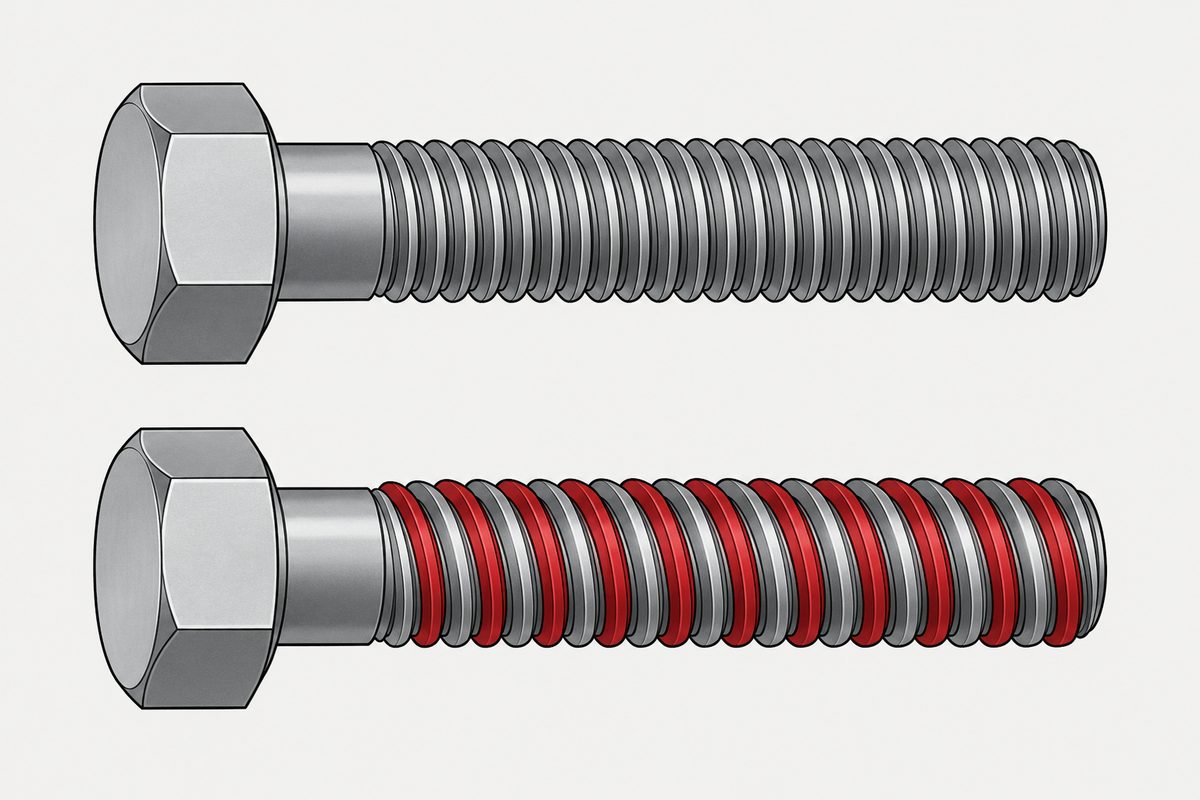
ISO 5408 clause 2.10 defines a multi-start thread as “a screw thread with two or more starts” and points at Figure 5, captioned “Two-start right-hand external thread”. ISO 261, the general plan for metric threads, is a grid of nominal diameters against pitches. It has no third column.
Where the question came from. The browser tooling this site normally uses was unavailable again, so the question was pulled from a public engineering question site through its open interface instead. Twelve votes, five answers. We read the question and not its answers, and no username appears here.
The asker put it plainly: every thread description lists the number of starts as a basic property, and yet “all of the major standard bolt threads are single-start”, with one exception they had found that can also come multi start. We are not going to explain why, because the reasons are design arguments and the documents do not contain them. We are going to read the documents.
The words are there, and so is the picture
The vocabulary standard for cylindrical screw threads has both terms, side by side and numbered consecutively.
2.9 single-start thread: a screw thread with only one start (see figures 2, 3 and 4).
2.10 multi-start thread: a screw thread with two or more starts (see figure 5).
And Figure 5 exists. It is a drawing of a two start right hand external thread, sitting in the same row as the single start ones. So the concept is not missing from the vocabulary, not deprecated, and not hidden in an annex. It has a definition, a number and an illustration.
The plan is two dimensional
The general plan is where a metric thread becomes a thing you can order. Its Table 2 is nominal diameter down the side and pitch across the top, and clause 5.3 tells you how to use it: “For the diameter (or the diameter range) selected, choose one of the pitches shown on the corresponding line.”
A diameter and a pitch. That is the whole selection, and the table has no third column to put anything else in.
That is an observation about this document, not a rule it states. The plan does not forbid a multi start metric thread. It has no way of selecting one, which is a different thing, and the next section is where that difference turns out to matter.
Two other things in that clause are worth taking while we are here. Clause 5.2 says the words coarse and fine are used to conform to usage and that “no concept of quality shall, however, be associated with these words”, and that the coarse pitches are simply the largest metric pitches used in current practice. And clause 5.1 adds that pitches shown in parentheses are to be avoided as far as possible, which is the same quiet demotion this site found in the bracketed lengths of another table.
The designation language does have a form for it
A correction to the first version of this page. It said there was no field for the number of starts anywhere on the path from plan to designation. That was wrong, and it was wrong because the designation is set by a document we had not opened. We have now opened it.
Clause 5.2 of the tolerance standard designates an ordinary thread as the letter M, the nominal diameter, the multiplication sign and the pitch, which is the familiar M8 × 1,25. And then clause 5.3 exists, headed Designation of multiple-start screw threads.
“Multiple-start metric screw threads shall be designated by the letter M followed by the value of the nominal diameter, the sign ×, the letters Ph and the value of the lead, the letter P and the value of the pitch, a dash, and the tolerance class.”
EXAMPLE: M16 × Ph3P1,5 − 6H
“For extra clarity the number of starts, i.e. the value of Ph divided by P, may be added in verbal form and in parenthesis.”
EXAMPLE: M16 × Ph3P1,5 (two starts) − 6H
So the language is complete. Lead first, pitch second, and the number of starts is the one divided by the other: 3 over 1,5 is two, and in the left hand examples of the next clause, M14 × Ph6P2 (three starts) is 6 over 2. Those divisions are ours; the examples are the standard’s.
Two things are worth noticing. The designation leads with the lead, the quantity the general plan never mentions, and puts the pitch second. And the standard offers the words two starts as an optional extra for extra clarity, which is a standard quietly allowing that a reader may not divide Ph by P on sight.
What survives of the original point is narrower, and still true. The general plan is a table of diameters against pitches and there is no column in it for a second start, so a multi start thread cannot be selected from the plan. It can be written down perfectly well. It is simply not one of the things the plan offers.
A thread does not have a lead angle
Before anything can be said about what a second start would do, there is a definition worth reading slowly. The vocabulary gives the lead angle of a helix as the angle whose tangent is the lead divided by the circumference, tan φ = Ph / πd. Then it adds a note.
“In fact, every point on a thread follows its own helix. All the helices have a common axis, the thread axis, and the same lead, but the tangent of the lead angle is inversely proportional to the radial distance from the helix to the axis.”
So there is no such thing as the lead angle of a thread. There is a lead angle at the crest, another at the pitch diameter, another at the root, and they are all different. Take M8 × 1,25 and put the published diameters into that formula. The arithmetic below is ours.
- At the crest, d = 8,000: tangent 0,0497, angle 2,85 degrees
- At the pitch diameter, d2 = 7,188: tangent 0,0554, angle 3,17 degrees
- At the root, d3 = 6,466: tangent 0,0615, angle 3,52 degrees
The ratio of the two extreme tangents is 8 ÷ 6,466 = 1,237, which is exactly the diameter ratio, exactly as the note requires. The same thread climbs nearly a quarter more steeply at its root than at its crest, and any single figure quoted for it is a choice of where to measure.
The whole coarse series sits in one degree of each other
Now do it for every coarse pitch in the series, at the pitch diameter, which is the usual place to take it. Diameters from the basic dimensions table, arithmetic ours.
M3 3,41° M4 3,60° M5 3,25° M6 3,41° M8 3,17° M10 3,03° M12 2,94°
M16 2,48° M20 2,48° M24 2,48°
The diameter goes up by a factor of eight and the angle moves by a factor of less than one and a half, from 2,48 to 3,60 degrees. Whatever else the series is, it is a series that keeps this quantity almost still.
And the last three are not approximately equal, they are equal. M16, M20 and M24 all have a pitch that is exactly one eighth of the diameter: 2 over 16, 2,5 over 20, 3 over 24. Since the pitch diameter is the nominal minus a fixed multiple of the pitch, holding the pitch to diameter ratio fixed holds the pitch diameter to pitch ratio fixed too, and the tangent comes out the same to five figures. That is our algebra, and it is the reason three different bolts wind at an identical angle.
A second start would step outside that band
The lead is what doubles. The note above says all the helices of one thread share the same lead, and the definition of lead is the axial movement of a point going once round. Two starts means the axial movement per turn is two pitches instead of one, so the tangent of the angle doubles.
For M8 × 1,25 at the pitch diameter that puts the tangent at 0,1107 and the angle at 6,32 degrees. Compare that with the band the entire single start coarse series occupies, 2,48 to 3,60. A two start M8 would climb more steeply than any single start size in the plan, including the smallest.
That is a geometrical statement and we are stopping there. Turning it into a claim about whether the thread would loosen requires a coefficient of friction, and this page has no source for one, so it does not make that step. What the arithmetic does show is narrower and safer: a second start does not adjust a thread slightly, it moves it out of the range the standardised series was drawn inside.
The ceiling nobody quotes
One more thing from the general plan, because it is the kind of limit that never makes it onto a drawing. If threads finer than the table are needed, only nine pitches may be used at all: 3; 2; 1,5; 1; 0,75; 0,5; 0,35; 0,25 and 0,2 millimetres. And then a warning, with a table attached to it.
“There is increasing difficulty in complying with tolerances as the diameter is increased for a given pitch.” So Table 1 gives a maximum nominal diameter for each of those pitches.
0,5 → 22 0,75 → 33 1 → 80 1,5 → 150 2 → 200 3 → 300
Divide each by its pitch, which is our arithmetic: 44, 44, 80, 100, 100, 100. From a pitch of 1,5 upwards the standard is holding the diameter to a hundred times the pitch and no more, and the two finest pitches are held to less than half of that. There is a shape in there that the table does not announce.
What to take from it
- The vocabulary defines a multi-start thread and illustrates a two start one. The concept is standardised
- The general plan selects a diameter and a pitch, and nothing else. Its table has no column for a second start, so one cannot be picked off it
- The designation standard does have a form for one. Clause 5.3 gives M16 × Ph3P1,5 − 6H, with the lead written before the pitch and the number of starts optionally spelled out in words
- A thread has no single lead angle. Every point follows its own helix and the tangent of the angle is inversely proportional to the radius
- M8 climbs at 2,85 degrees at its crest and 3,52 at its root, a ratio of 1,237, which is the diameter ratio
- The whole coarse series lies between 2,48 and 3,60 degrees at the pitch diameter, while the diameter changes by a factor of eight
- M16, M20 and M24 give an identical angle because their pitch is exactly one eighth of their diameter
- A second start doubles the tangent, putting M8 at 6,32 degrees, outside the whole band. What that means for loosening needs a friction figure this page does not have
- Coarse and fine carry no concept of quality, and a pitch has a maximum diameter it may be used up to
The question was why single start threads are so common. The honest answer from the documents is not a reason at all. It is that a metric thread is chosen off a table with two axes, and a second start is not on either of them, even though the language for writing one down has been standardised the whole time. What gets made is what the selection table offers.
This page covers step 2, the thread. The whole order is substrate, thread, head, drive, finish, documentation, and why doing it out of order is rework rather than a tweak is in specifying a screw.
Common questions
Do the standards allow a multi-start metric thread?
Yes, and there is a designation for one. The vocabulary standard defines a multi-start thread in clause 2.10 and illustrates a two start one in its figure 5, and clause 5.3 of the tolerance standard gives the designation form, for example M16 × Ph3P1,5 - 6H, with the number of starts optionally added in words. What has no column for it is the general plan, which selects only a nominal diameter and a pitch, so a multi start thread cannot be chosen off that table.
What is the lead angle of an M8 bolt?
The question does not have one answer. The vocabulary notes that every point on a thread follows its own helix, all sharing the same lead, and that the tangent of the lead angle is inversely proportional to the radial distance from the axis. For M8 × 1,25 our arithmetic gives 2,85 degrees at the crest, 3,17 at the pitch diameter and 3,52 at the root.
How much does the lead angle vary across the metric coarse series?
Very little. Taken at the pitch diameter, our figures run 3,41 degrees at M3, 3,60 at M4, 3,25 at M5, 3,41 at M6, 3,17 at M8, 3,03 at M10, 2,94 at M12 and 2,48 at M16, M20 and M24. The diameter changes by a factor of eight and the angle by less than one and a half.
Why do M16, M20 and M24 give the same angle?
Because their pitches are exactly one eighth of their nominal diameters: 2 over 16, 2,5 over 20 and 3 over 24. Since the pitch diameter is the nominal less a fixed multiple of the pitch, a fixed pitch to diameter ratio produces a fixed pitch diameter to pitch ratio, and the tangent is identical to five figures. That is our algebra rather than a statement in the standard.
What would a two start thread change?
The lead doubles, so the tangent of the lead angle doubles. A two start M8 × 1,25 would sit at about 6,32 degrees at the pitch diameter, above every single start size in the coarse series. This page stops at that geometrical statement and does not convert it into a claim about loosening, which would require a coefficient of friction it has no source for.
Does coarse mean lower quality than fine?
No, and the standard says so directly. It states that the words coarse and fine are given to conform to usage and that no concept of quality shall be associated with them, and that the coarse pitches are simply the largest metric pitches used in current practice.
Is there a limit on which pitch can be used at which diameter?
Yes, for the finer pitches. The general plan says that if threads finer than its main table are needed, only nine pitches may be used, and gives a table of maximum nominal diameter for each: 22 mm at a pitch of 0,5, then 33, 80, 150, 200 and 300 mm at 0,75, 1, 1,5, 2 and 3. The reason given is increasing difficulty in complying with tolerances as diameter increases for a given pitch.
Why are single start threads so common?
This page does not answer that. The reasons are design arguments and the documents quoted here do not contain them. What the documents show is that the table a standard metric thread is selected from has two axes, diameter and pitch, and a second start is on neither of them, even though the designation standard has had a form for writing one down all along.
Does any of this apply to inch threads or to trapezoidal threads?
Nothing here is about them. The vocabulary standard covers cylindrical screw threads generally, but the plan and the dimensions quoted are the metric ones. The inch series and the trapezoidal series have their own standards and none of them has been read for this page.
References
- ISO 5408:1983, Cylindrical screw threads, Vocabulary, read from the free nine page preview of the 1998 national adoption, English and French in parallel
- ISO 261:1998, ISO general purpose metric screw threads, General plan. Free eight page preview covering clause 5 and Table 1
- ISO 724:2023, Basic dimensions, used here only for the pitch and minor diameter values that the arithmetic runs on
- The question, on a public engineering question site. Twelve votes, five answers
Two free previews were read for this page: the vocabulary standard, from a national adoption whose nine page preview carries the English and French definitions in parallel, and the general plan, whose eight page preview reaches clause 5 and Table 1. The vocabulary scan is poor and its extracted text is badly broken, so every sentence quoted from it was read off a rendered image of the page rather than the text layer. The same was done for Table 1 and clause 5 of the general plan. The pitch and diameter values the arithmetic runs on come from the basic dimensions table, which this site used and image checked for an earlier page about the wall between two threads; this is the second use of that document and nothing from that page is repeated here. The following are our own arithmetic, not statements by any of the documents: every lead angle on this page; the ratio 1,237 between the tangents at crest and root; the observation that the coarse series spans 2,48 to 3,60 degrees while the diameter spans a factor of eight; the algebra showing why M16, M20 and M24 coincide; the doubled tangent for a two start thread; and the ratios 44, 44, 80, 100, 100, 100 from Table 1. The geometrical result about a second start is not a claim about whether such a thread would loosen. Making that step needs a coefficient of friction, this page has no source for one, and it therefore says nothing about self locking. The question came from a public engineering question site rather than from the forum tooling this site normally uses, which was unavailable again. We read the question and not its answers, and no username appears here. We give no design advice and name no product. The tolerance standard, the basic profile standard and the selected sizes standard have not been read for this page, only the first rows of Table 2 of the general plan were visible, and the inch and trapezoidal thread standards have not been read at all. Correction. The first version of this page said there was no field for the number of starts anywhere on the path from the general plan to the designation. That was wrong. Clause 5.3 of the tolerance standard designates multiple-start metric threads, in the form M16 × Ph3P1,5 − 6H, and allows the number of starts to be added in words. We had declared that document unread at the time, which was true but did not make the sentence any less wrong; the page now quotes clause 5.3 and the claim has been narrowed to what the general plan actually does. The free preview of that standard reaches printed page 5, which covers clauses 5.2 to 5.4, and the passage quoted was read off a rendered image of the page.
Enquiries
If a drawing calls for a thread that is not a diameter and a pitch off the general plan, the useful thing to send is the whole callout as written, including the lead if a second start is intended. That is the part a standard designation cannot carry, so it has to travel as words.
Request a quotation
Tell us the part and the quantity. We will come back on feasibility, lead time and price.
Or email us directly sales@tigerfasteners.com