 TIGERFASTENERS
Nobody Picked That Thread Length: It Is Two Diameters Plus Six
Someone asked a good beginner question on an engineering forum: how is the length of a bolt decided, and if you only need one thread past the nut, why do so many bolts carry thirty more? Fifty one replies. The part almost nobody says is that neither number is a decision. The overall length is a rung on a ladder that was fixed in 1968, and the threaded length is arithmetic. The standard that sets both is two pages long.
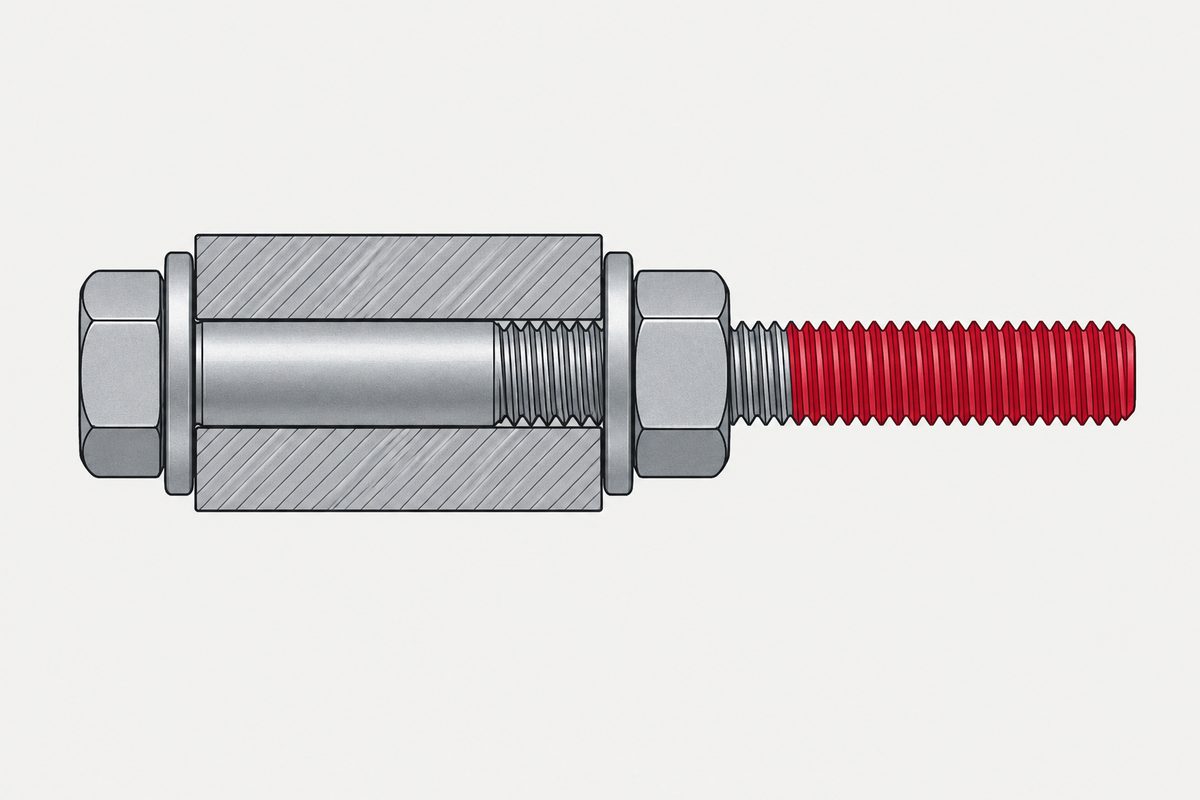
In the first edition of ISO 888, the threaded length b of a general purpose bolt is 2d + 6 for lengths up to 125 mm, 2d + 12 from 125 to 200, and 2d + 25 above 200, where d is the nominal diameter. We checked all 89 filled cells of its allocation table against those formulae. Eighty eight are exact. The one that is not is the smallest size in the table.
One warning before any of it is useful. Everything numeric on this page comes from the 1976 first edition, which is withdrawn. The current edition is ISO 888:2012, its foreword says it is a technical revision, and we have read only its cover, contents and foreword. A third edition is at ballot. So read what follows as the shape of the thing, not as a current dimension to put on a drawing.
This page also settles something this site left open. An earlier article about the five pitches of thread run out said we had not read ISO 888, the document its own source standard names for nominal and thread lengths. We have now read the first edition of it, in full, because at two printed pages the free sample is the whole document.
The overall length is a rung, not a number
Clause 3 of the 1976 edition puts 54 nominal lengths in one table, running from 2 mm to 300 mm and, in a parallel column, from 1/16 in to 12 in. That is the whole answer to the second half of the forum question. You do not decide a length. You take the first rung that clears your joint.
Twelve of the 54 are printed in brackets, and the standard says what that means in one line: “Lengths in brackets should be avoided as far as possible.” The bracketed metric values are 7, 9, 11, 18, 22, 28, 32, 38, 95, 105, 115 and 125.
That single sentence explains a lot of purchasing behaviour. A 20 mm screw and a 22 mm screw are both in the standard, but one of them is a rung everybody stocks and the other is a rung the standard itself asks you to avoid. If a quotation for an 18 or a 38 comes back longer and dearer than the sizes either side of it, the table is the reason.
The standard also does not tell you where the length is measured from. It hands that to another document: “For dimensioning of nominal lengths, see ISO 225.” We have not read ISO 225 and quote nothing from it. It matters more than it sounds, because on a countersunk head the length usually includes the head and on a hexagon head it usually does not.
The two columns are not conversions of each other
The scope says so itself, and it is easy to read past: “Table 1 indicates the comparable basic lengths in the two systems, but values are not intended to be identical.” Comparable, not equal. The arithmetic below is ours, and it shows how far from equal.
- The very first row pairs 2 mm with 1/16 in, which is 1,5875 mm. The metric value is 26 % larger. That is the biggest relative gap in the table, and it is in row one
- The biggest absolute gap is near the top: 220 mm against 9 in, which is 228,6 mm. The metric rung is 8,6 mm shorter
- Two rows later the sign flips. 260 mm against 10 in, which is 254 mm, and now the metric rung is 6 mm longer
- Between 130 mm and 300 mm the sign of the difference changes six times
- Eleven metric lengths have no inch partner at all: 7, 9, 18, 32, 38, 60, 85, 115, 125, 160 and 240
So these are two independent ladders printed side by side, and they cross over each other. A 9 in bolt is not a 220 mm bolt with the label changed.
The threaded length is arithmetic
Now the first half of the forum question, the thirty extra threads. Clause 4 says the thread lengths in the tables were calculated, and gives the formulae.
| Nominal length l | Thread length b |
|---|---|
| up to 125 mm | 2d + 6 |
| over 125 to 200 mm | 2d + 12 |
| over 200 mm | 2d + 25 |
| up to 5 in | 2d + 1/4 |
| over 5 to 8 in | 2d + 1/2 |
| over 8 in | 2d + 1 |
d is the nominal diameter of the bolt.
Read that as an answer to the question and it is blunt. The number of threads on a bolt has nothing to do with your joint. It is set by the diameter and by which of three length bands the bolt falls in. An M12 at 60 mm long and an M12 at 120 mm long carry the same 30 mm of thread; the second one just has 60 mm more plain shank. Nobody sized that thread for the nut you are going to put on it.
Which is why the extra threads past the nut are not waste in the sense the question implies. They are what is left when a fixed thread length meets a rung you chose for a different reason.
One more consequence worth stating. Cross the 125 mm boundary and the thread jumps 6 mm longer at every diameter. Cross 200 and it jumps another 13 mm. So two bolts of the same diameter, one at 120 mm and one at 130 mm, differ in threaded length by 6 mm on top of the 10 mm difference in overall length. The plain shank grows by only 4 mm.
Eighty eight cells out of eighty nine
The allocation table gives b for every diameter from 1,6 to 150 mm in each of the three length bands. Not every combination exists: the smallest sizes appear only in the first band, and the largest only in the third. Counting the cells that carry a number, there are 89.
We checked every one against the formula for its band. Eighty eight agree exactly. The exception is the first cell in the table:
At d = 1,6 mm, the formula gives 2 × 1,6 + 6 = 9,2 mm. The table prints 9.
We checked that cell against a rendered image of the printed page rather than trusting text extraction, because a 1976 scan is exactly where a false anomaly comes from. It says 9. The obvious reading is that a table of whole millimetres cannot carry a 9,2, and 1,6 is the only diameter in the series that is not a whole number. We are not claiming that is the committee’s reason, only that it is the one cell where the arithmetic and the print disagree.
The inch formulae, by contrast, come out exact every time, because a quarter inch added to twice a fractional diameter is still a clean fraction. We have not image checked the inch allocation table and quote no cell from it.
The metric constants are the inch constants, rounded down
Put the two halves of the formula table beside each other and something falls out. This is our arithmetic, not a statement by the standard.
- 1/4 in is 6,35 mm. The metric constant is 6
- 1/2 in is 12,7 mm. The metric constant is 12
- 1 in is 25,4 mm. The metric constant is 25
- 5 in is 127 mm. The metric band boundary is 125
- 8 in is 203,2 mm. The metric band boundary is 200
All five truncated to whole millimetres rather than rounded to the nearest, which is why 12,7 became 12 and not 13. The standard does not say which system came first and we do not claim to know. What we can say is that the metric thread lengths in this edition are 0,35 to 0,7 mm shorter than the inch rule applied to the same bolt would give.
Five member bodies voted against making it a standard
The foreword of the 1976 edition is a page of history that most standards do not print any more. ISO 888 did not begin as an International Standard. Before 1972 this work was published as an ISO Recommendation, and this one “replaces ISO Recommendation R 888-1968 to which it is technically identical”. So the numbers above date from 1968.
Then the foreword names names, in three lists.
- 33 member bodies approved the Recommendation
- Two expressed disapproval on technical grounds: France and the United States
- Five disapproved the transformation of the Recommendation into an International Standard: Canada, France, Japan, the Netherlands and the United States
Read the third list against the first and the interesting part appears. Three of the five, Canada, Japan and the Netherlands, are in the approving list. They were content with the content and voted against promoting it. The standard was published anyway, in May 1976, and stayed in force for thirty six years.
We do not know why any of them voted as they did. The document gives no reasons, and we are not going to invent a story about inch tables and national interests from a list of country names. The fact is worth having on its own: a document that fixes something as uncontroversial as how long a bolt is went out with five member bodies on record against it.
What the current edition changed, and what we cannot tell you
ISO 888:2012 is the second edition, six pages, from ISO/TC 2/SC 7, last confirmed in 2023 and now at stage 90.92, to be revised. Its foreword says it “cancels and replaces the first edition (ISO 888:1976), which has been technically revised.” Our sample stops at that foreword, so we have no clause and no table from it.
Three things can be said from outside the document. First, the title changed. The 1976 title ends “and thread lengths for general purpose bolts”; the 2012 title drops that qualifier, and the contents list adds separate subclauses for headless screws and set screws and for studs and similar fasteners. The thread length half got wider.
Second, ISO’s own abstract for the 2012 edition says it “applies to bolts, screws and studs with ISO metric screw thread according to ISO 68-1”. The inch tables are gone.
Third, the document keeps growing. Two pages in 1976, six in 2012, and the draft third edition now at ballot is twelve. A standard about nothing but how long a bolt is has sextupled in fifty years while losing half its coverage.
So do not take 2d + 6 to a drawing on the strength of this page. It is what the withdrawn first edition says. If you need the current rule, the current document is six pages and costs less than an hour of anybody’s time.
Back to the question that started it
The forum post asked two things. The second one is answered above: the length is a rung and the thread is arithmetic, so the extra threads are a by-product rather than a design decision.
The first one, whether only the part between the head and the nut carries tension, is a question about mechanics and ISO 888 has nothing to say about it. It is a length standard. It does not mention load, tension or joints anywhere we read. That question is answered elsewhere on this site, in what the clamped length is actually doing and in why a bolt behaves as a spring.
What the length standard does add to that discussion is the bit people miss: whether the plain shank or the thread ends up inside your joint is decided by which rung you picked, and the run out between the two is five pitches of neither.
What to take from it
- Nominal length is a fixed list. 54 values in the first edition, 2 to 300 mm, and 12 of them are in brackets with a note to avoid them where possible
- Thread length is calculated, not chosen. 2d plus 6, 12 or 25 mm depending on which of three length bands the bolt falls in
- Two bolts of the same diameter carry the same thread length as long as they are in the same band, however different their overall lengths
- Crossing 125 mm adds 6 mm of thread at every diameter, and crossing 200 mm adds another 13
- 88 of the 89 filled cells match the formula exactly. The exception is d = 1,6 mm, where 9,2 is printed as 9
- The metric and inch columns are not conversions. The standard says the values are not intended to be identical, and at one row the two ladders differ by 8,6 mm
- All of the above is the withdrawn first edition. The current second edition is metric only and technically revised, and a third is at ballot
Two printed pages, from a text agreed in 1968, that quietly decide how much of every bolt in the building is threaded. And five member bodies who did not want it to be a standard at all.
This page covers step 2, the thread. The whole order is substrate, thread, head, drive, finish, documentation, and why doing it out of order is rework rather than a tweak is in specifying a screw.
Common questions
How is the length of a bolt decided?
It is selected from a fixed list rather than calculated. The first edition of ISO 888 tabulates 54 nominal lengths from 2 mm to 300 mm, and twelve of them are printed in brackets with the instruction that lengths in brackets should be avoided as far as possible. Where the length is measured from is left to ISO 225, which we have not read.
How long is the threaded part of a bolt?
In the first edition of ISO 888 it is 2d + 6 mm for nominal lengths up to 125 mm, 2d + 12 from 125 to 200, and 2d + 25 above 200, where d is the nominal diameter. In inches the same three bands give 2d + 1/4, 2d + 1/2 and 2d + 1. This is the withdrawn first edition and the current one has been technically revised.
Why do bolts have more threads than the nut needs?
Because the threaded length is a function of diameter and length band, not of your joint. An M12 at 60 mm and an M12 at 120 mm both carry 30 mm of thread by that formula. The extra threads past the nut are what is left over, not a decision somebody made about your assembly.
Does a longer bolt have a longer thread?
Only if it crosses a band boundary. Within a band the thread length depends solely on diameter. Cross 125 mm and the thread grows by 6 mm at every diameter; cross 200 mm and it grows by a further 13 mm. Otherwise the extra length is all plain shank.
Which bolt lengths should be avoided?
The first edition prints twelve metric lengths in brackets and says they should be avoided as far as possible: 7, 9, 11, 18, 22, 28, 32, 38, 95, 105, 115 and 125 mm. They are legitimate sizes, but the standard itself asks you to prefer the neighbours, which is usually reflected in price and availability.
Is a 9 inch bolt the same as a 220 mm bolt?
No. Nine inches is 228,6 mm, so the two rungs differ by 8,6 mm, which is the largest gap in the table. The standard is explicit that the two columns give comparable lengths but that the values are not intended to be identical. Two rows further on the difference reverses sign, with 260 mm running 6 mm longer than 10 in.
Does the formula work for every size in the table?
For 88 of the 89 filled cells, exactly. The exception is the smallest diameter, 1,6 mm, where 2d + 6 gives 9,2 mm and the table prints 9. We checked that cell against a rendered image of the printed page rather than extracted text. The standard gives no note about it.
Is ISO 888:1976 still current?
No. It is withdrawn at stage 95.99 and was replaced by ISO 888:2012, which its own foreword describes as a technical revision. The 2012 edition is six pages, was confirmed in 2023, and is itself flagged to be revised, with a draft third edition of twelve pages now at ballot.
Does ISO 888 still cover inch sizes?
The first edition did, with four tables covering both systems. ISO’s abstract for the current 2012 edition says it applies to bolts, screws and studs with ISO metric screw thread according to ISO 68-1. We have read only the foreword of that edition, so we describe the change and quote nothing from its tables.
References
- ISO 888:1976, Bolts, screws and studs, nominal lengths and thread lengths for general purpose bolts. Withdrawn first edition, read in full from the free sample
- ISO 888:2012, the current second edition. Cover, contents and foreword only
- ISO/DIS 888, the draft third edition, catalogue entry giving stage and page count
- r/AskEngineers, where the question about bolt length and the threads past the nut was asked
ISO 888:1976 is two printed pages and the publicly available sample contains all of it: foreword, scope, and Tables 1 to 4. That is why this page can quote its tables rather than describe them. It is withdrawn. Catalogue facts were read from ISO’s own pages in a browser: ISO 888:1976 is a first edition, May 1976, two pages, ISO/TC 2/SC 7, withdrawn at stage 95.99; ISO 888:2012 is a second edition, April 2012, six pages, published, confirmed in 2023, at stage 90.92; ISO/DIS 888 is a draft third edition of twelve pages at stage 40.20. Of the 2012 edition we have read only the cover, contents and foreword, so nothing on this page should be taken as a current dimension, and we quote no clause or table from it. The statement that the current edition is metric only comes from ISO’s published abstract, not from the document. Table 1, Table 2, Table 3 and the voting lists in the foreword were all checked against rendered images of the printed pages rather than extracted text, because a 1976 scan is where false readings come from. Table 4, the inch allocation table, was not image checked and no cell from it is quoted. ISO 225 and ISO 68-1 have not been read. The following are our own arithmetic, not statements by the standard: the count of 89 filled cells and the finding that 88 match the formula, the observation that the metric constants and band boundaries are the inch ones truncated to whole millimetres, the comparison of the metric and inch ladders including the 26 % gap at 2 mm and the 8,6 mm gap at 220 mm, the count of eleven metric lengths with no inch partner, and the page counts across the three editions. We offer no reason for the d = 1,6 entry and no reason for any member body’s vote; the document gives neither. The question of where tension acts along a bolt is not addressed by this standard and is not answered here. We read the forum post and not its replies, and no company or product brand is named. This page discharges a gap declared on an earlier article, which stated that ISO 888 had not been read; that sentence has been rewritten.
Enquiries
If a length on your drawing is one of the bracketed values, say so and we will tell you whether it is worth the premium or whether the rung either side does the same job. And if you need a specific threaded length rather than the one the formula gives, that is a special and needs to be called out, because on a standard bolt the thread length is not something anybody chooses.
Request a quotation
Tell us the part and the quantity. We will come back on feasibility, lead time and price.
Or email us directly sales@tigerfasteners.com