 TIGERFASTENERS
Why fastener holes are staggered
The short version: design codes really do reward staggering, but not in the way it is usually explained. Eurocode 5 does not let you reduce the spacing between rows; it lets you stop discounting the row — a factor that can be as low as 0.5 goes back to 1.0. Steel codes give you a separate credit on net section. And the standard that actually fixes the hole pattern in a commercial hinge is not talking about wood at all.
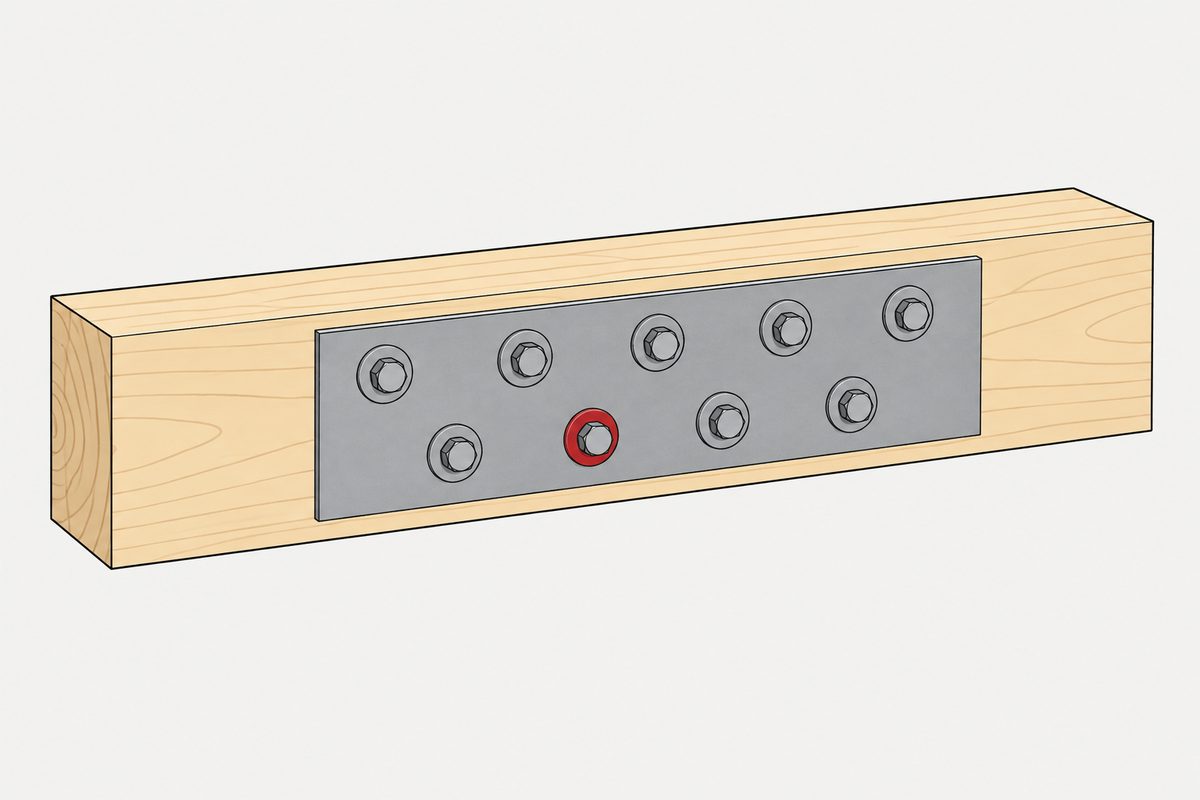
The question, and three answers that all sound right
“Why are screw holes in most door hinges in zigzag orientation?” has been read nearly 6,000 times on Engineering Stack Exchange. The three highest-voted answers give three different mechanisms: avoiding a plane of concentrated stress, stopping the wood splitting along the grain between screws, and giving more screws a chance to land in sound material rather than making a “toilet paper perforation pattern”.
All three are pointing at something real. None of them is what the relevant standards actually say, and the standards are more interesting.
What Eurocode 5 actually gives you
EN 1995-1-1 has a clause for nails in a row parallel to the grain. If they are not staggered, you cannot use all of them at full value. The row is discounted to an effective number:
nef = nkef
and kef depends on how far apart they are along the grain:
| Spacing a1 | kef |
|---|---|
| ≥ 14d | 1.0 |
| 10d | 0.85 |
| 7d | 0.7 |
| 4d, pre-drilled | 0.5 |
The clause then says this discount does not apply “unless the nails of that row are staggered perpendicular to grain by at least 1 d”. So the reward for offsetting the holes by one diameter is that a row that would have been discounted at 0.7, or 0.5 when closely spaced and pre-drilled, counts in full.
What it does not do, and we assumed wrongly before checking: it does not relax the minimum spacing between rows. The Table 8.2 minimum perpendicular spacing stands whether you stagger or not. The benefit is entirely about how many fasteners you are allowed to count — which is a bigger effect than a spacing tweak would have been.
Clause and table numbers here are EN 1995-1-1:2004+A2:2014, which remains a valid version. A second-generation edition exists; we have not verified its final wording, and its draft handled the same idea through the effective number as well, not through spacing.
Steel codes pay for staggering too, in a different currency
When a tension member has a chain of holes running diagonally, both major steel codes let you add something back to the net width for the diagonal legs of the path. AISC 360 gives:
bn = bg − Σdh + Σ s²/(4g)
with s the pitch along the member between staggered holes and g the gage across. EN 1993-1-1 states the same idea as a deduction. You check every straight and zigzag path through the holes and the smallest net area governs.
Read what that term is doing. A straight line of holes removes their full width. Offset them and the tear path has to travel diagonally, which is longer, and the code hands you back s²/4g for the trouble. Two very different materials, two very different failure modes, and both codes are paying you to not put the holes in a line.
What actually fails, in wood, has four names
“A plane of weakness” is the folk version. Timber connection research separates at least four brittle modes, and they are not the same thing:
- Splitting — a crack running along the grain through the row, driven by tension perpendicular to the grain.
- Row shear (row tear-out) — two roughly parallel along-grain shear cracks tearing out a narrow strip containing the row.
- Group tear-out — a whole block bounded by several rows pulled out; called block shear where fasteners pass through the full thickness, plug shear where they penetrate part way.
- Net tension — the remaining section between holes failing across the member, not along the row.
For a hinge leaf with one row of three screws, the defensible statement is narrow: collinear screws driven along the grain can promote splitting, and where there is meaningful transverse shear a row-shear path is also possible. Calling it block shear or group tear-out would be wrong; there is no block bounded by several rows.
And it is a risk, not a certainty. It rises with screws in line along the grain, spacing too tight, no pilot hole, dry timber, and species prone to splitting. Plenty of collinear screws never split anything.
About the perforation analogy. It is a good image and we are keeping it, but it is not the mechanism. Toilet paper tears along its perforations mainly because the net section there is small and the perforations are deliberate notches. Wood usually fails by cross-grain tension or along-grain shear, which is a different process arriving at a superficially similar place. Use it to remember the idea, not to explain it.
And then the hinge standard says something else
Here is the part that reframed this article for us.
Commercial hinge hole patterns are not improvised. They are fixed by ANSI/BHMA A156.7 for template hinges, and the stated purpose of that standard is dimensional interchangeability — so that any conforming hinge drops into any door and frame prepared to the same template. The standard does not claim the staggering is there to stop wood splitting.
Both things can be true at once, and it is worth holding them apart: the mechanical benefits of staggering are real and codified elsewhere; the specific pattern in front of you was standardised so that parts would interchange. We could not establish that wood mechanics is the primary reason any given hinge looks the way it does, and we are not going to assert it.
The transferable question
The useful habit here is not “always stagger”. It is: when a pattern looks deliberate, find out which standard fixed it and what that standard was optimising. Sometimes it is strength, and the code will tell you exactly how much it is worth — a kef of 0.5 going back to 1.0, or an s²/4g term. Sometimes it is interchangeability, and the mechanics are a happy side effect that nobody was designing for.
What the parent material will do is the question underneath all of this. See when the parent cannot be the nut and screws for plastic; the wider order of decisions is in specifying a screw.
References
- EN 1995-1-1:2004+A2:2014 — Eurocode 5, clause 8.3.1.1(8) and Tables 8.1, 8.2
- AISC 360, Section B4.3b — net width for staggered hole chains
- EN 1993-1-1:2005+A1:2014, 6.2.2.2(4) — staggered-hole deduction
- COST Action FP1402, Design of Connections in Timber Structures — brittle failure modes
- ANSI/BHMA A156.7 — template hinge dimensions
- “Why are screw holes in most of the door hinges in zigzag orientation?”, Engineering Stack Exchange
This page explains the reasoning behind a convention and where the design codes quantify it. Values for any particular connection are governed by your drawing and the standards it invokes.
This page covers step 1, the substrate. The whole order is substrate, thread, head, drive, finish, documentation, and why doing it out of order is rework rather than a tweak is in specifying a screw.
Common questions
Does Eurocode 5 let you reduce spacing if fasteners are staggered?
No. Staggering does not relax the minimum spacing between rows. What clause 8.3.1.1(8) does is remove the effective-number discount: a row of nails parallel to the grain is otherwise counted as n to the power k_ef, where k_ef can be as low as 0.5 for closely spaced pre-drilled fasteners. Staggering perpendicular to the grain by at least one diameter means the row counts in full.
Why do steel codes care about staggered holes?
Because the tear path through a diagonal chain of holes is longer than through a straight one. AISC 360 Section B4.3b adds s squared over 4g back to the net width for each diagonal leg, where s is the pitch along the member and g the gage across it. EN 1993-1-1 expresses the same idea as a deduction. You check every straight and zigzag path and the smallest net area governs.
Will screws in a straight line split the wood?
They can, and the risk rises with screws in line along the grain, spacing too tight, no pilot hole, dry timber and species prone to splitting. It is not a certainty. The formal modes are distinct: splitting is a crack along the grain driven by cross-grain tension, while row shear tears out a strip along the fastener line. A single row of three screws is not group tear-out or block shear.
Are hinge holes staggered for strength?
Not according to the standard that fixes them. ANSI/BHMA A156.7 governs template hinge dimensions and its stated purpose is dimensional interchangeability, so any conforming hinge fits any door prepared to the same template. The mechanical benefits of staggering are real and are codified in timber and steel design codes, but we could not establish that they are the reason for any particular hinge pattern.
Is the toilet paper perforation comparison accurate?
As an image, yes; as a mechanism, no. Perforated paper tears mainly because the net section at the perforations is small and the notches are deliberate. Wood connections usually fail by tension perpendicular to the grain or shear along it, which is a different process that ends up somewhere superficially similar. It is a good way to remember the idea and a poor way to explain it.
Enquiries
If a drawing has reached you with a fastener pattern you are unsure about — a row that looks tight, or a stagger that looks arbitrary — the question worth asking first is what the parent material is. Send that and the pattern over and we will tell you what we would check.
Request a quotation
Tell us the part and the quantity. We will come back on feasibility, lead time and price.
Or email us directly sales@tigerfasteners.com