 TIGERFASTENERS
The oxide layer does not cause galling. It delays it.
The short version: almost everything you have read about why stainless seizes is inverted. The passive layer is not the culprit — on 316L a thicker pre-formed oxide measurably reduced galling damage, because the layer has to be worn through before metal can weld to metal. And carbon steel is not immune; NIST galled plain 1018 and 1541 severely. What actually drives it is being soft and ductile.
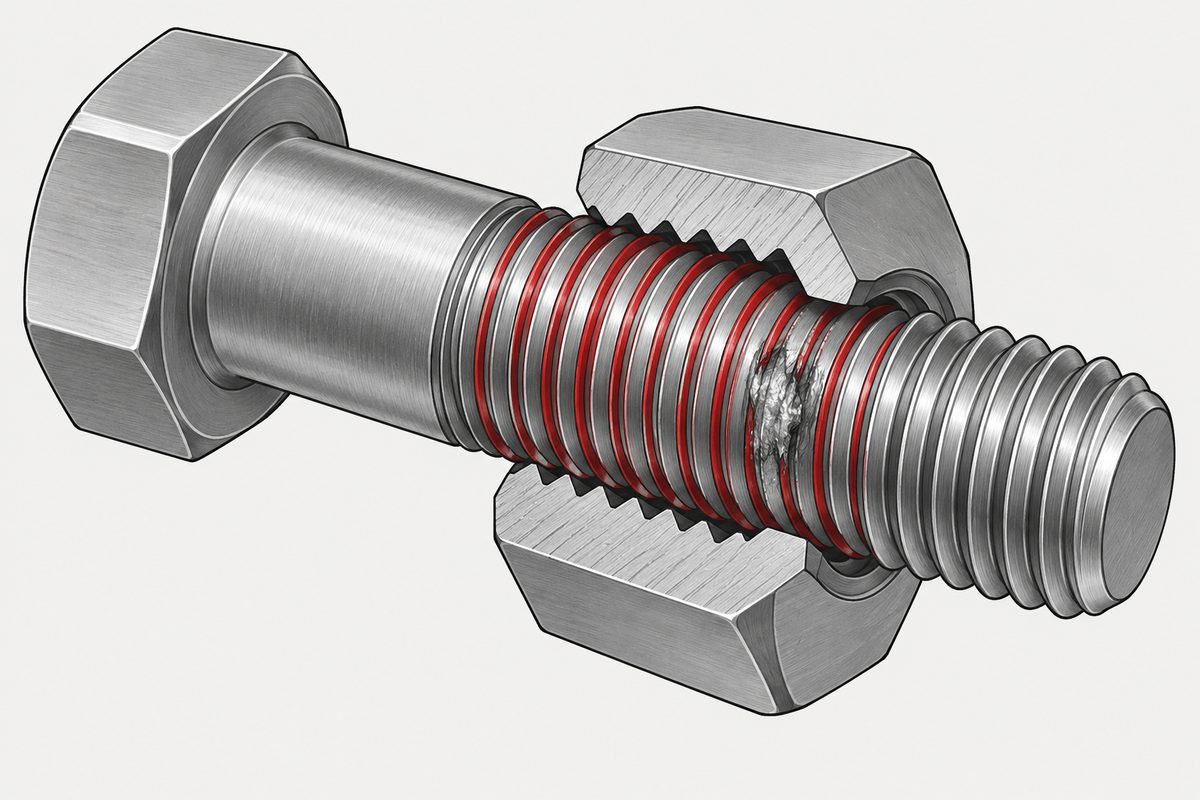
What galling is, before why
ASTM G40 defines galling as surface damage between sliding solids, characterised by macroscopic, usually localised roughening and the creation of protrusions above the original surface. The defining feature is plastic flow, sometimes with material transfer.
Three things follow from that definition and all three get muddled in practice:
- It is not a scratch. Material has moved and piled up, not just been ploughed aside.
- It is not seizure. Seizing is the functional outcome — relative motion stops. Severe galling can cause it. Galling that has not yet caused it is still galling.
- “Cold welding” is not a synonym. Cold welding is solid-state joining. It is a common initiating event, but galling is the damage morphology that develops afterwards. ASTM's definition does not even require demonstrable material transfer.
The explanation we were about to write, and why it is wrong
The story told everywhere — and the one we had drafted — goes: the passive oxide layer that makes stainless corrosion-resistant is rubbed off at the asperities, the freshly exposed stainless is chemically very active, and it cold-welds to whatever it is touching. The property you bought is the property that fails you.
It is a satisfying story. The oxide runs the other way.
Work on 316L found that a thicker pre-formed oxide layer significantly reduced galling damage. The oxide lowers adhesion; it has to be worn away or mechanically mixed into the surface before galling proceeds. The layer is a barrier standing between you and the failure, not the mechanism of it.
The second half of the story is wrong too. Carbon steel galls. NIST's wear testing produced severe galling on plain 1018 and 1541. Whatever separates stainless from carbon steel in practice, “carbon steel does not do this” is not it.
What is actually happening
The sequence, stated the way the research supports it:
- Load and sliding produce high contact stress and plastic deformation at the asperities — the high points doing the actual touching.
- That deformation destroys whatever separating layer is present — oxide, contamination, lubricant.
- Bare metal meets bare metal and forms strong adhesive junctions.
- Continued sliding shears those junctions inside the substrate rather than at the interface, so material transfers, wedges build up, and plastic flow repeats.
- The result is the macroscopic roughening and protrusions ASTM describes — and in a thread, a fit that was clearance a moment ago is now interference.
Notice that step 4 is where the material property matters most. A soft, ductile surface lets the junction shear deep and lets the plastic flow keep going. Annealed austenitic stainless — 304, 316, which is to say A2 and A4 — is soft and very ductile. That is the real answer, and it is a mechanical property, not a chemical one.
A candidate we tested and had to drop. We assumed austenitic stainless galls because its work-hardening rate is high. It is the other way round: guidance from the British Stainless Steel Association points to high ductility and low work-hardening rate as the conditions that favour galling, and NIST notes that alloys with restricted plastic flow can resist it. Two other candidates also failed: low thermal conductivity, which modelling of 316L found had little effect at these speeds; and “no free graphite”, which is not a distinction from carbon steel at all — graphite belongs to cast iron.
Which grades, and the pairing question
Annealed 304 and 316 gall more readily than hardened martensitic grades, and for the reason above: they are softer and more ductile, so large-scale plastic flow is available to them. A hardened martensitic grade can reach a hardness at which that flow is much harder to start.
Like against like is a strong risk factor, not a rule. Self-mated materials are metallurgically completely compatible, so strong adhesive junctions form readily, and NIST's pure-metal work generally found self-pairs damaged worse than dissimilar pairs. But dissimilar austenitic grades still gall, and there are austenitic alloys developed specifically to self-mate with high resistance. So treat matching materials as a warning, not a verdict.
What the test standards will and will not tell you
If someone quotes a galling number at you, it is worth knowing what it is.
- ASTM G98 gives a threshold galling stress from an unlubricated, low-speed, intermittent button-on-block test. ASTM states plainly that it is for preliminary ranking of material couples and is not to be used directly for quantitative design, and that it does not cover lubricated sliding under that method.
- ASTM G196 uses quantified damage measurement and is more repeatable; ASTM positions G98 as the preliminary screen.
Both simulate low-speed, intermittent, unlubricated contact, which does include thread engagement. Neither produces an allowable stress for your bolt.
What this does not change
Nothing here says stainless is a bad choice. It says the reason it seizes is mechanical rather than chemical, that its oxide is helping rather than hurting, and that a carbon steel screw is not immune to the same failure.
The genuine trade-off in choosing stainless is a different one, and it is set out in zinc or stainless: at the same size the stainless screw is the weaker one, and that half of the bill rarely reaches the change note. What the grade letters mean is in A2 against A4. Where material choice sits in the order of decisions is in specifying a screw.
References
- ASTM G40 — Standard Terminology Relating to Wear and Erosion (definition of galling; adhesive wear)
- ASTM G98 — Standard Test Method for Galling Resistance of Materials (threshold galling stress; scope and limitations)
- ASTM G196 — Standard Test Method for Galling Resistance of Material Couples
- Rogers et al. — The interaction of galling and oxidation in 316L stainless steel
- NISTIR 89-4064 — wear testing including plain carbon steels
- British Stainless Steel Association — galling and galling resistance of stainless steels; factors affecting wear and galling
- “What causes a fastener to lock?”, Engineering Stack Exchange
This page explains a mechanism and corrects a common account of it. Acceptance for any particular joint is governed by your drawing, the standards it invokes, and where required an actual test.
This page covers step 5, the finish. The whole order is substrate, thread, head, drive, finish, documentation, and why doing it out of order is rework rather than a tweak is in specifying a screw.
Common questions
Does the passive layer cause stainless to gall?
No, and the usual explanation has this backwards. Work on 316L found that a thicker pre-formed oxide layer significantly reduced galling damage: the oxide lowers adhesion and has to be worn away or mechanically mixed into the surface before galling proceeds. The layer stands between you and the failure rather than causing it.
Does carbon steel gall?
Yes. NIST wear testing produced severe galling on plain 1018 and 1541 carbon steels. Whatever distinguishes stainless in practice, immunity in carbon steel is not it.
So why does annealed stainless gall so readily?
Because it is soft and very ductile. Galling develops when adhesive junctions between bare metal shear inside the substrate rather than at the interface, and a soft ductile surface lets that shearing go deep and the plastic flow continue. Hardened martensitic grades resist better for the same reason in reverse. Guidance from the British Stainless Steel Association points to high ductility and low work-hardening rate as the conditions that favour galling.
Is galling the same as cold welding or seizing?
No. Cold welding is solid-state joining and is a common initiating event. Seizing is the functional outcome, where relative motion stops. Galling is the damage morphology in between: ASTM G40 defines it as macroscopic localised roughening with protrusions above the original surface, characterised by plastic flow. Severe galling can cause seizure; galling that has not yet done so is still galling.
Can I design to a galling number?
Not directly. ASTM G98 gives a threshold galling stress from an unlubricated low-speed test, and ASTM states it is for preliminary ranking of material couples and not for quantitative design use. ASTM G196 quantifies damage and is more repeatable. Both simulate low-speed intermittent unlubricated contact, which includes threads, but neither produces an allowable stress for a particular bolt.
Enquiries
If stainless screws are seizing on your line, the useful things to send are what is being screwed into what, whether either part is hardened, and whether anything is on the threads. The pairing and the surface condition decide this more than the grade does.
Request a quotation
Tell us the part and the quantity. We will come back on feasibility, lead time and price.
Or email us directly sales@tigerfasteners.com