 TIGERFASTENERS
A Property Class Is Partly a Temperature, and an Arc Goes Past It
Somebody on r/fabrication needed a spacer thicker than the ones being sold and asked whether two graded spacers could be welded together. The top reply, at 43 points, said welding would destroy the heat treatment that made them graded in the first place. That is correct, and it contains no number, which is why it convinces people who already agree and nobody else. The standard behind the class does have a number, and it is sitting in a table most people never open.
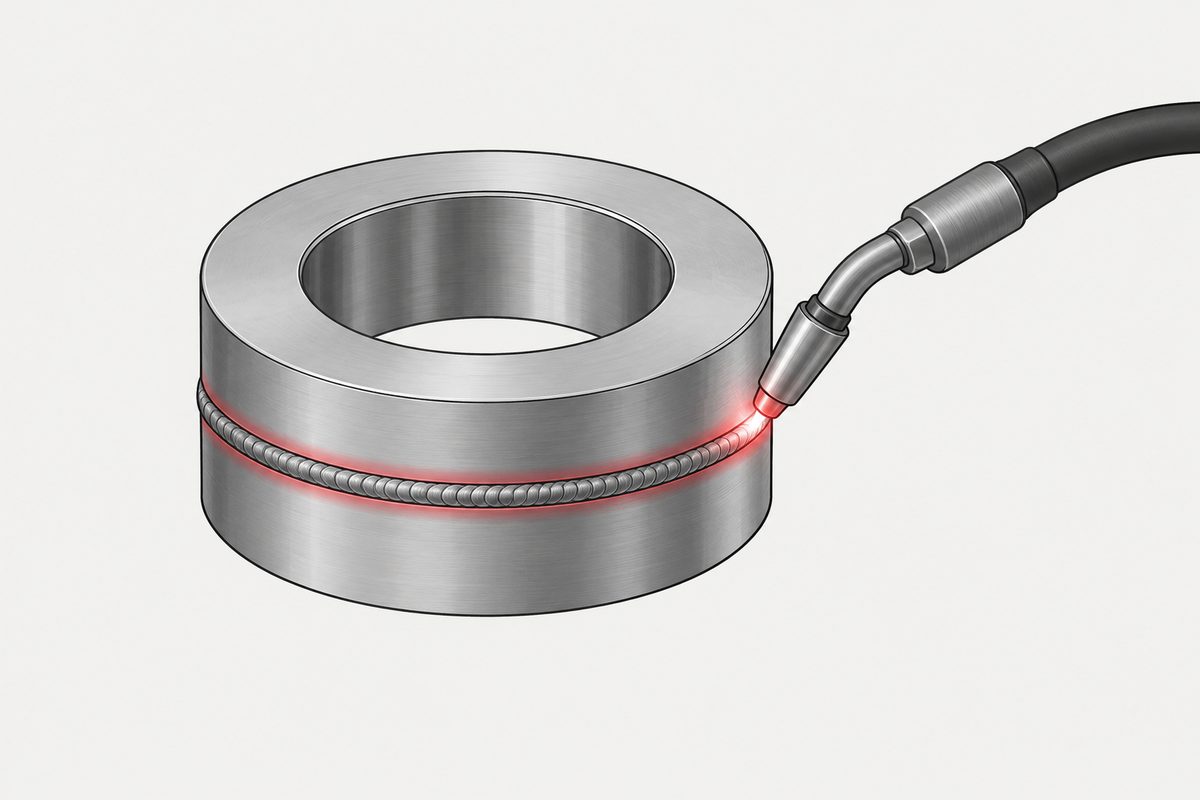
For classes 8.8 and 9.8 the standard prints a minimum tempering temperature of 425 °C. Alongside it, a footnote requires the material to reach roughly 90 per cent martensite in the core before that tempering happens. So a class number above 8.8 is not naming a steel. It is naming a route through two temperatures, and part of what it asserts is that nothing has taken the part back up since.
The document is ISO 898-1:2013, and the relevant part is clause 6, which opens by saying exactly what Table 2 is for: it specifies limits for the chemical composition of steels and minimum tempering temperatures for the different property classes of bolts, screws and studs. Composition and temperature, in one table, defining the same thing.
One caveat before the numbers. The thread was about an inch-series grade, and we hold the ISO document rather than the inch one, so no figure from the inch standard appears anywhere on this page and nothing here converts one grading system into the other. What carries across is the argument, because both systems grade these fasteners by quenching and tempering.
What Table 2 actually fixes
| Class | Material and heat treatment | Carbon, cast analysis | Minimum tempering temperature |
|---|---|---|---|
| 4.6, 4.8 | Carbon steel or carbon steel with additives | up to 0,55 % | Not specified |
| 5.6, 5.8, 6.8 | Carbon steel or carbon steel with additives | 0,13 to 0,55 % depending on class | — |
| 8.8, 9.8 | Three permitted routes, all quenched and tempered: carbon steel with additives, plain carbon steel, or alloy steel | 0,15 to 0,55 % depending on route | 425 °C |
| 12.9 | Alloy steel quenched and tempered | 0,30 to 0,50 % | 425 °C |
| 12.9 | Carbon steel with additives, quenched and tempered | 0,28 to 0,50 % | 380 °C |
The 10.9 row carries the same three material routes, and its tempering temperature cell was obscured by the watermark on the copy we read, so it is not quoted here. The argument does not need it.
Read down the last column. Below 8.8 there is nothing to state, because those classes are not defined by a quench and temper at all. From 8.8 upward there is a number, and a number in a minimum column is a floor the manufacturer had to clear. That is the part worth sitting with: the class was awarded partly on the basis of a temperature the part was taken to and then, by implication, not taken past again.
The footnote that says what is actually in there
Hanging off classes 8.8, 9.8, 10.9 and 12.9 is a footnote that describes the microstructure rather than the chemistry. The material must have sufficient hardenability to ensure a structure consisting of approximately 90 per cent martensite in the core of the threaded sections, in the as-hardened condition, before tempering.
Martensite is what the quench produces and what the tempering then partly relieves. The standard is describing a state that was arrived at deliberately and is being kept. A weld does not consult that description. It applies its own thermal cycle to a small volume and lets the surrounding metal decide the cooling rate, and the standard offers nothing about what the result should be, because the standard was never describing a steel that could be re-graded afterwards.
Which leads to the negative fact that settles the practical question. ISO 898-1 contains no route back. There is no clause explaining how a property class is re-established, re-verified or re-declared after a later thermal cycle. The property class is issued for a part in a condition, and the standard does not describe a way to reissue it.
And you cannot get at the number a welder would want
The reason this cannot be rescued by a careful welding procedure is that the class does not give you the inputs. Look again at the 8.8 row: it permits three different material routes, carbon steel with additives such as boron, plain carbon steel, or alloy steel, and the carbon range differs between them, spanning 0,15 to 0,55 per cent across the three. Two fasteners both correctly marked 8.8 can be substantially different steels.
So a class number does not tell you the composition within a useful band, and this page will not offer a weldability criterion or a formula, because we hold no welding standard and the input a welding engineer would start from is not available from the marking. What the fastener standard says about its own limits is already set out on our page about what the class number never claimed, where weldability appears in the list of properties clause 1 declines to specify.
One more thing the thread raised and this page will not answer. A reply pointed out that the parts were plated and suggested removing the coating first. That is a real concern in two directions at once, the weld and the fume, and we hold no welding safety document, so the honest instruction is that it belongs to your own welding procedure and safety documentation rather than to a fastener page.
The part designed to be welded gives the opposite answer
It is worth putting the two cases side by side, because the same instinct produces the wrong answer in one of them. When a weld nut fails, people reach for the same hypothesis: the welding must have ruined the heat treatment. On our page about why a weld nut has no property class, that hypothesis runs into the default part having no quench and temper to lose in the first place.
| Part | Was it quenched and tempered? | What welding does to the grading argument |
|---|---|---|
| A fastener at class 8.8 and above | Yes, and to a stated minimum tempering temperature | The condition the class describes is exactly what a later thermal cycle changes |
| A standard weld nut | Not by default; quenched and tempered is the version you have to ask for | There is often no heat treatment for the weld to have ruined |
Same suspicion, opposite conclusion, and the thing that decides it is whether the part was ever in the state the argument assumes.
What to do with the actual problem
The poster wanted a thicker spacer and did not have time to wait for one. That is a real constraint and the thread answered it well: buy the size, or cut a tube, or turn a piece of round stock and drill it. All three produce a part that is honestly ungraded rather than a part carrying a marking it no longer supports, and one commenter said as much while suggesting the round stock.
The general rule underneath it is worth keeping. If a part has to be welded, specify it as a welded part rather than as a fastener with a class, because the class is a claim about a condition and welding is an operation on that condition. The marking on the head will still be there afterwards, which is the awkward part. What a head marking is evidence of is a separate question, and the short version is that it is evidence about the part as manufactured.
And the numbers a class is built out of have their own procedure behind them. A tensile strength is force divided by the area the bar started with, and the yield is usually a line drawn at two parts in a thousand of permanent stretch.
This page covers step 1, the substrate. The whole order is substrate, thread, head, drive, finish, documentation, and why doing it out of order is rework rather than a tweak is in specifying a screw.
Common questions
Can I weld a class 8.8 or higher bolt?
The standard does not forbid it and does not help you either. ISO 898-1 defines classes from 8.8 upward by a quench and temper, and Table 2 states a minimum tempering temperature, 425 °C for 8.8 and 9.8. A welding arc is a thermal event well past that, and the standard contains no clause describing how a property class is re-established or re-verified after a later thermal cycle. So the class on the part is a statement about a condition that welding acts on, and nothing in the document lets you restate it afterwards.
What temperature does a property class actually specify?
A minimum tempering temperature, for the classes that are quenched and tempered. ISO 898-1 Table 2 gives 425 °C for classes 8.8 and 9.8, and for 12.9 gives 425 °C on the alloy steel route and 380 °C on the carbon steel with additives route. Classes 4.6 and 4.8 have the cell marked not specified, because those classes are not defined by a quench and temper. The 10.9 cell was obscured on the copy we read and is not quoted here.
Is the property class a material specification?
Not in the way people expect. For class 8.8 the standard permits three different material routes: carbon steel with additives such as boron, plain carbon steel, and alloy steel, with carbon ranging from 0,15 to 0,55 per cent across them. Two fasteners both correctly marked 8.8 can be substantially different steels, which is why a class number cannot be used as the starting point for a welding assessment.
Does the standard say anything about weldability?
It says it does not specify it. Clause 1 of ISO 898-1 lists weldability among the properties the standard does not cover, alongside corrosion resistance, shear resistance, torque and clamp force performance, and fatigue resistance. Our page on what the class number never claimed goes through that list. What Table 2 does supply is the heat treatment condition, which is what makes the welding question answerable at all.
Why is welding a weld nut different?
Because a standard weld nut is generally not quenched and tempered in the first place, so there is no heat treatment for the weld to have destroyed. Quenched and tempered is the version you have to ask for. That is the mirror image of a graded bolt, where the quench and temper is exactly what the class number is describing, and it is why the same suspicion gives opposite answers on the two parts.
What should I use instead if I need a thicker graded spacer?
Buy the size, cut a piece of tube to length, or turn round stock and drill it. All three give you a part that is openly ungraded rather than one carrying a marking that no longer describes it. If the spacer is in a load path that needed the grade, the honest move is to change the design rather than the part, because the marking will still be legible after welding even though the condition it describes has changed.
References
- ISO 898-1:2013 — Mechanical properties of fasteners made of carbon steel and alloy steel, part 1. Clause 6 and Table 2, the steels, carbon limits, minimum tempering temperatures and the martensite footnote
- r/fabrication — the thread this began in, where the correct answer was given without a number attached
Clause 6 and Table 2 of ISO 898-1:2013 were read from the publicly available preview, and the quoted limits, temperatures and footnote wording are that text. The tempering temperature cell for class 10.9 was obscured by the preview watermark on our copy and is deliberately not quoted. The thread concerned an inch-series grade and we hold only the ISO document, so no figure from the inch standard appears here and no conversion between the two grading systems is offered; the argument is carried by the shared fact that both grade these fasteners by quenching and tempering. No carbon equivalent, weldability criterion or welding procedure is given, because we hold no welding standard and, as the page argues, the composition input such an assessment would start from is not recoverable from a class marking. No welding fume or coating removal guidance is offered for the same reason; the commenter’s point about plating is reported rather than answered. The statement that the standard contains no route to re-establish a class after a later thermal cycle is a negative finding from reading the document, and should be read as an absence we looked for rather than a prohibition it prints.
Enquiries
If a part in your assembly has to be welded, say so in the enquiry and describe the load it carries, rather than asking for a graded fastener that will then be welded. Those are two different parts with two different sets of paperwork, and the second one stops being describable by its own marking the moment the arc strikes.
Request a quotation
Tell us the part and the quantity. We will come back on feasibility, lead time and price.
Or email us directly sales@tigerfasteners.com