 TIGERFASTENERS
What the markings on a bolt head mean
The short version: the number is the property class and the letters are the manufacturer, and both are required — on some heads, at some sizes. That qualifier is the part worth learning. A head with nothing on it is usually not evidence of anything, because several entire head styles and every size below 5 mm are normally not marked at all.
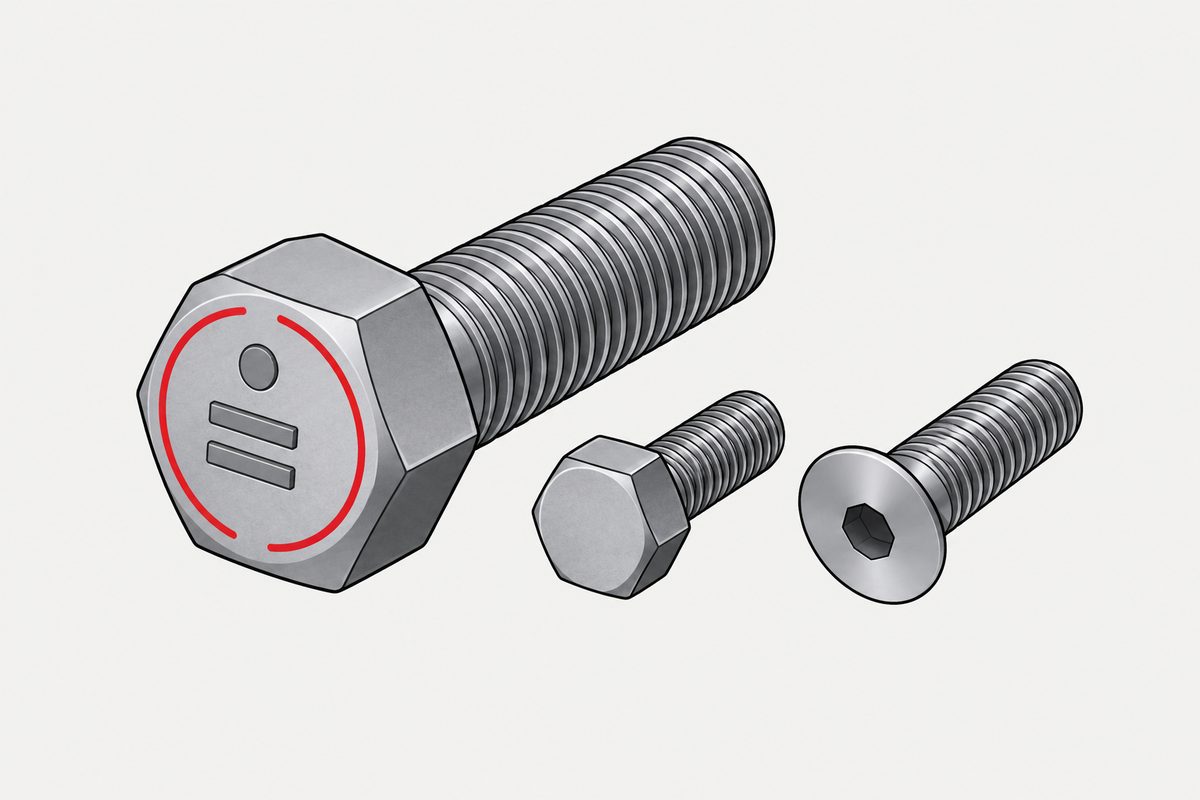
The two things on a metric hex head
Nearly forty thousand people have asked what the letters on a hex bolt mean. The answer is short: the number is the property class, the letters are the manufacturer's identification mark, and ISO 898-1 requires them together.
The requirement is stated the useful way round. Any fastener carrying a property class symbol must also carry the manufacturer's mark. They travel as a pair, so a class number with no maker beside it is itself an anomaly.
A version trap worth knowing. You will still read that the manufacturer's mark is only required from class 8.8 upward. That was true in ISO 898-1:1999, and only for socket-head and hexalobular socket screws — ordinary hex heads were already all classes in that edition. From the 2009 edition onward, socket heads follow the same rule. In the current 2013 edition, for hex and socket heads at d ≥ 5 mm, marking applies to every property class in the table.
Why it is not always where you looked
“It should be stamped on top” is a half-rule, and the half that is missing explains a lot of fruitless squinting.
| Head | Preferred | Also permitted |
|---|---|---|
| Ordinary hex | Top, indented or raised | Side of the head, indented |
| Socket / hexalobular socket | Side of the head, indented | Top, indented or raised |
| Flange | Top | On the flange, where the process cannot mark the top |
So for a socket cap screw the standard's preference is the side. If you have been turning one over looking at the top face, that is why.
Two reasons the number does not look like a number
Beginners hit these and assume the fastener is unmarked or counterfeit. Both are in the standard. How much the mark itself proves is a separate question: a 10.9 on the head is a claim, not a certificate.
- The decimal point may be omitted. So you will not always see a literal 8.8.
- Small screws, or heads with no room, may use clock-face symbols instead of the class number — a set of marks read like positions on a clock. If you find a head with dashes or dots in an arrangement that means nothing to you, this is probably what you are looking at.
The inch system, and a mnemonic that is only a mnemonic
The radial lines on an inch hex head come from SAE J429, which requires the grade symbol and the manufacturer to be permanently and legibly marked.
| Grade | Radial lines |
|---|---|
| 2 | none |
| 5 | 3 |
| 8 | 6 |
Hence the familiar “count the lines and add two”. Treat that as a memory aid for grades 2, 5 and 8 only. It is not an equation the standard defines, and it does not work for grades 1, 5.1, 5.2, 8.1 or 8.2, which are unmarked or use their own arrangements.
One correction while we are here: ASTM F568M is sometimes cited as the source of this system. It is not — F568M is a metric standard covering M1.6 to M100. And not every inch ASTM fastener uses SAE radial lines; other specifications use letters, numbers or their own symbols.

Stainless says three things, and sometimes only one
ISO 3506-1 builds the stainless mark from three parts: the steel grade, a hyphen, the property class, and the manufacturer's mark alongside. So the familiar A2-70 plus a maker's symbol.
At d ≥ 5 mm this is required for hex and socket heads across all stainless grades and all property classes.
And a case that looks wrong but is not. Where a fastener is reduced-load and its threaded length is too short to run a tensile test, the standard requires the steel grade only and forbids marking the property class. A head reading just A2 with a maker's mark, and no number, can be exactly what the standard asked for.
What an unmarked head actually tells you
We drafted this article ending on a neat line: a bare head is a warning sign. Checking that turned out to demolish it, and the list of legitimate exemptions is long enough that the neat version would have had readers condemning perfectly conforming screws.
| What | Under |
|---|---|
| Anything below d = 5 mm | ISO 898-1 — below the threshold for the marking requirement |
| Countersunk, raised countersunk, pan heads | ISO 898-1 — normally not marked unless the purchaser asks |
| Every internal-drive screw, all sizes | SAE J429 — explicit exemption |
| Anything below 1/4 in | SAE J429 — explicit exemption |
| Studs | SAE J429 — explicit exemption |
| Decorative products | SAE J429 — end user may waive marking and position |
So the honest reading is the other way round. An unmarked head carries almost no information by itself. What carries information is an unmarked head on a style and size where the standard requires a mark — a plain 8 mm hex head with nothing on it is worth a question; a plain M4 countersunk screw is not.
One marking that is easy to miss entirely: ISO 898-1 requires a left-pointing arrow on left-hand bolts at 5 mm and above. See left-hand threads.
What it is for
The letters are not branding. They are the point at which a fastener stops being anonymous: a mark that ties this screw to a maker who declared a class for it. That is the same job a mill test certificate does on paper, done in steel and readable without the paperwork.
What the class number itself means is in what the property class numbers say; where marking sits among the other things a drawing has to state is in specifying a screw.
This page covers step 6, the documentation. The whole order is substrate, thread, head, drive, finish, documentation, and why doing it out of order is rework rather than a tweak is in specifying a screw.
Common questions
What do the letters on top of a hex bolt mean?
They are the manufacturer identification mark. ISO 898-1 requires that any fastener carrying a property class symbol also carries the maker mark, so the number and the letters travel as a pair. For hex and socket heads at 5 mm diameter and above this applies to every property class in the table.
Is the manufacturer mark only required from class 8.8 upward?
Not in the current standard. That rule comes from ISO 898-1:1999 and applied only to socket-head and hexalobular socket screws; ordinary hex heads were already all classes in that edition. From the 2009 edition socket heads follow the same rule, and the current 2013 edition requires marking across all property classes for those head types at 5 mm and above.
Why can I not find any marking on my screw?
Very often because none is required. Anything below 5 mm diameter is outside the requirement, and countersunk, raised countersunk and pan heads are normally not marked at all unless the purchaser asks. Under SAE J429 every internal-drive screw is exempt regardless of size, as are fasteners below a quarter inch, studs and decorative products. An unmarked head is only informative when the standard would have required a mark for that head style and size.
What do the radial lines on an inch bolt mean?
They are the SAE J429 grade symbol. Grade 2 has none, grade 5 has three and grade 8 has six, which is where "count the lines and add two" comes from. Treat that as a mnemonic for those three grades only; it is not defined by the standard as an equation and does not work for grades 1, 5.1, 5.2, 8.1 or 8.2.
My stainless screw says only A2 with no number. Is it wrong?
Possibly not. ISO 3506-1 composes the mark from steel grade, hyphen, property class and manufacturer mark, giving the familiar A2-70. But where a fastener is reduced-load and its threaded length is too short for a tensile test, the standard requires the steel grade alone and forbids marking a property class. A head reading A2 with a maker mark can be exactly what was asked for.
References
- ISO 898-1:2013 — clause 10.2 (manufacturer's mark accompanies the class symbol), 10.3.2 and Tables 19–20 (class symbols, clock-face marking), 10.3.3.1–10.3.3.5 (positions by head type; d ≥ 5 mm; heads normally not marked)
- ISO 898-1:1999 — clause 9.3, the superseded rule often still quoted
- ISO 3506-1:2020 — clauses 10.1.1–10.1.2 (mark composition), 10.2–10.3.2 (requirement and positions)
- SAE J429:2014 — section 7 and Table 1 (grade symbols, manufacturer marking, exemptions)
- ASTM F568M — metric standard, cited here only to correct a common misattribution
- “What is the meaning of the letters on the top of a common hex bolt?”, DIY Stack Exchange
This page describes marking requirements as written in those standards. Acceptance for any particular part is governed by your drawing and the standards it invokes.
Enquiries
If a marking on an incoming batch does not match what the drawing called for, photograph the head and send it with the specification. Which of the two is wrong is usually settled quickly, and it is worth settling before the parts go into anything.
Request a quotation
Tell us the part and the quantity. We will come back on feasibility, lead time and price.
Or email us directly sales@tigerfasteners.com