 TIGERFASTENERS
Change the screw or change the housing: how to cost it properly
First, what this page will not do: give you a figure. Modifying an injection tool, a stamping die or a screw die costs what it costs depending on the part, the cavitation, the steel and the toolmaker — anyone quoting you a “typical” number is guessing. What follows is which line items belong in the comparison, and who to ask for each number.
Comparing prices is the job, and the prices are comparable
Two suppliers, same drawing, same quantity, two numbers. One is lower. There is nothing wrong with that comparison and it is what a buyer is measured on.
It is also the only part of the decision that arrives in a form you can put in a spreadsheet. Everything the screw does after it is fitted arrives later, on somebody else's budget.
So compare the quotes — and the cheaper screw is the expensive decision
The usual approach is to obtain a quotation for each route and compare them. That misses three categories of cost, and the missing three are frequently larger than the quotations:
- Schedule cost. Delayed launch, a line waiting on parts, scheduled labour standing idle
- Verification cost. What has to be re-tested afterwards, by whom, over how long
- Risk cost. The probability the change fails, and what returning to the start then costs
The third is the one usually treated as zero. But the two routes do not carry the same probability, and they do not fail the same way: a failed screw change loses a batch of screws; a failed tooling change loses a die.
What belongs in each column
| Item | Change the housing | Change the screw |
|---|---|---|
| Tooling | Modify or re-cut, depending on cavitation and extent | Die adjustment or a different specification — possibly no tooling at all, if a standard part covers it |
| Trials and samples | Tool trials, measurement, possibly iterated | Samples, generally faster |
| First article and documents | New first article; drawing and BOM revision | New first article; drawing revision |
| Re-verification | Depends on the change; may reach structure, appearance, regulatory status | Depends which item changed — length and head are mostly geometric; material and finish pull preload, fatigue, corrosion and embrittlement |
| Existing stock | Housings already produced may be dead stock in full | Screws already produced are dead stock too — at far lower unit value and volume |
| Upstream effects | May move other mating parts and the dimensional chain | Usually confined to this one cell |
| Cost of failure | A die | A batch of screws |
Fill both columns in and the answer usually presents itself. The point is not which column holds the smaller number — it is which column has fewer entries. Fewer entries means fewer things move, and fewer things moving means fewer surprises.
A case that actually happened
A customer had an aluminium extrusion die made. The dimensions were all to the specification originally set, and the die itself was not the problem — the tapping was. The threads had not been cut cleanly.
The result: standard screws snapped, and snapped during tightening rather than in service.
Where it broke is itself the diagnosis. A fastener that fails under load once the product is running points to fatigue or insufficient preload. One that shears while being driven says the resistance was already too high during assembly.
Badly cut threads leave the minor diameter of the hole undersize — either the pilot hole was drilled small, or the tap tore and left material behind. The crests of the screw thread then bear against the root of the hole thread: radial interference. Aluminium against steel is especially prone to galling, so friction torque climbs until the torsional stress exceeds what the screw can carry, and it breaks.
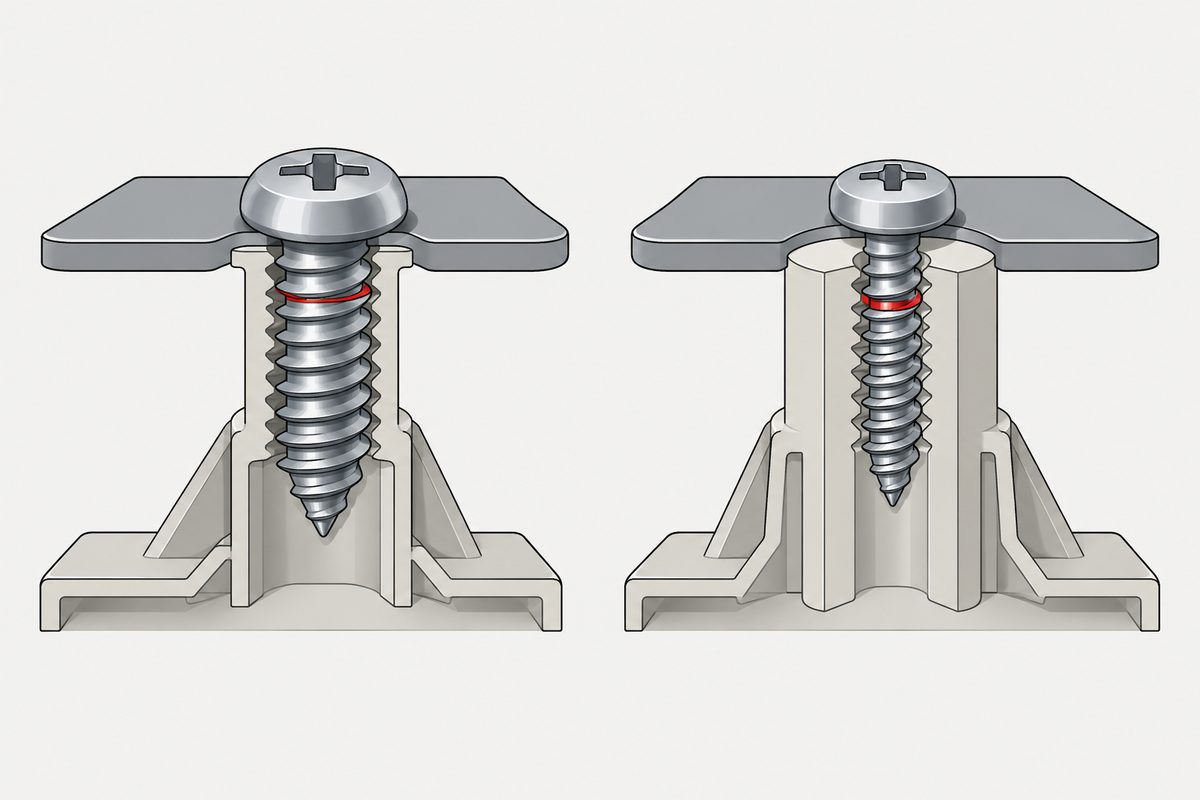
What we did was take the major diameter down, so the crests clear the root of the hole. Major diameter, not pitch diameter — they control different things. Pitch diameter governs how tight the fit is; major diameter is what meets the minor diameter of the hole. Whether the crests collide with the bottom of that hole is a major diameter question. Diagnose it wrong and you change the wrong dimension.
What the case actually demonstrates
Taking the major diameter down means that screw sits below the minimum major diameter for its tolerance class. Inspected against the ISO specification, it fails. And it mates with a hole that is equally out of specification. Neither part is standard, and together they work.
Which is why a catalogue supplier says no. They sell parts that conform, and this problem needed something that deliberately does not.
Back to the table: the die was already cut, so that column had a long list of items, while the screw column had one.
⚠️ But this solution has a price and is not a general remedy. Reducing the major diameter reduces the sheared thread area, and joint strength falls with it. It holds only if what remains is still sufficient — and that has to be calculated rather than assumed.
When the answer is “change the housing”
This section argues against our own interest, and it is what decides whether the table above is worth trusting:
- The screw is safety-critical or already certified. Re-running a certification usually costs more time and money than modifying a die
- The correction needed exceeds what a screw can give. Accumulated error at the millimetre level is not reasonable to absorb in a fastener — that is a dimensional chain problem, not a selection problem
- The housing has to change anyway. If there is another reason to open that tool, solving this at the same time has a marginal cost near zero
- Changing the screw would cost joint reliability. Too little engagement, too little bearing area — the saving comes back out during the warranty period
If your situation falls under any of those, we will say so. We do not get that order — but you do not discover the problem after production has started, and you come back with the next one.
Who to ask for each number
| What to ask | Who to ask |
|---|---|
| Tool modification cost and number of trials | The toolmaker or the housing supplier |
| Existing housing stock and work in progress | Your own materials function |
| Die adjustment cost; one-off or charged again on repeat orders | The screw supplier |
| Sample lead time and production lead time | The screw supplier |
| Whether a stock specification exists to test with first | The screw supplier |
| Which re-verification applies, and the hours involved | Your quality function, or your customer's requirements |
Ask the third row properly, because practice varies. Whether tooling is charged once or amortised into the unit price, whether it is charged again on a repeat order, how long tooling is retained, and who carries it if it breaks — these are contract terms rather than technical questions, and they change the total.
One thing to do before spending anything
Validate the diagnosis with a standard part.
You believe the problem is 0.2 mm of length. Prove that with stock first.
- If the assumption was wrong, it cost a batch of stock parts and neither die was touched
- If it was right, you hold physical evidence to negotiate a custom part with, not an inference
- And it is the fastest route — stock needs no scheduling
Talk about a custom part after that, when what you need is production consistency rather than a trial — which is exactly what tooling is for. Tooling is not consumed by a single order; it is a one-off cost up front.
Related
- Tolerance stack-up, and why the screw ends up changing — how you get here in the first place
- Before you change the screw, price the re-verification — the re-verification row above, expanded
- Plating M1–M1.4: the tolerance sets nothing aside — the easiest trap when the finish changes
This page provides a comparison framework and contains no cost or schedule estimates. Actual figures depend on your part, tooling, suppliers and verification requirements, and should be obtained from each source and entered above.
Enquiries
Stuck between modifying tooling and changing the fastener? Send the drawing or a sample of what is fitted now. We will fill in the screw column for you — including the cases where we would tell you to change the housing instead.
Request a quotation
Tell us the part and the quantity. We will come back on feasibility, lead time and price.
Or email us directly sales@tigerfasteners.com