 TIGERFASTENERS
Hexalobular is not called T20
The drive everyone calls Torx has a standard, and the standard does not use that name or those numbers. ISO 10664 designates it hexalobular socket no. 20. TORX is a registered trademark, and T20 and T25 are themselves registered marks. On a drawing that distinction is not pedantry — it decides whether what you wrote is a specification or a brand.
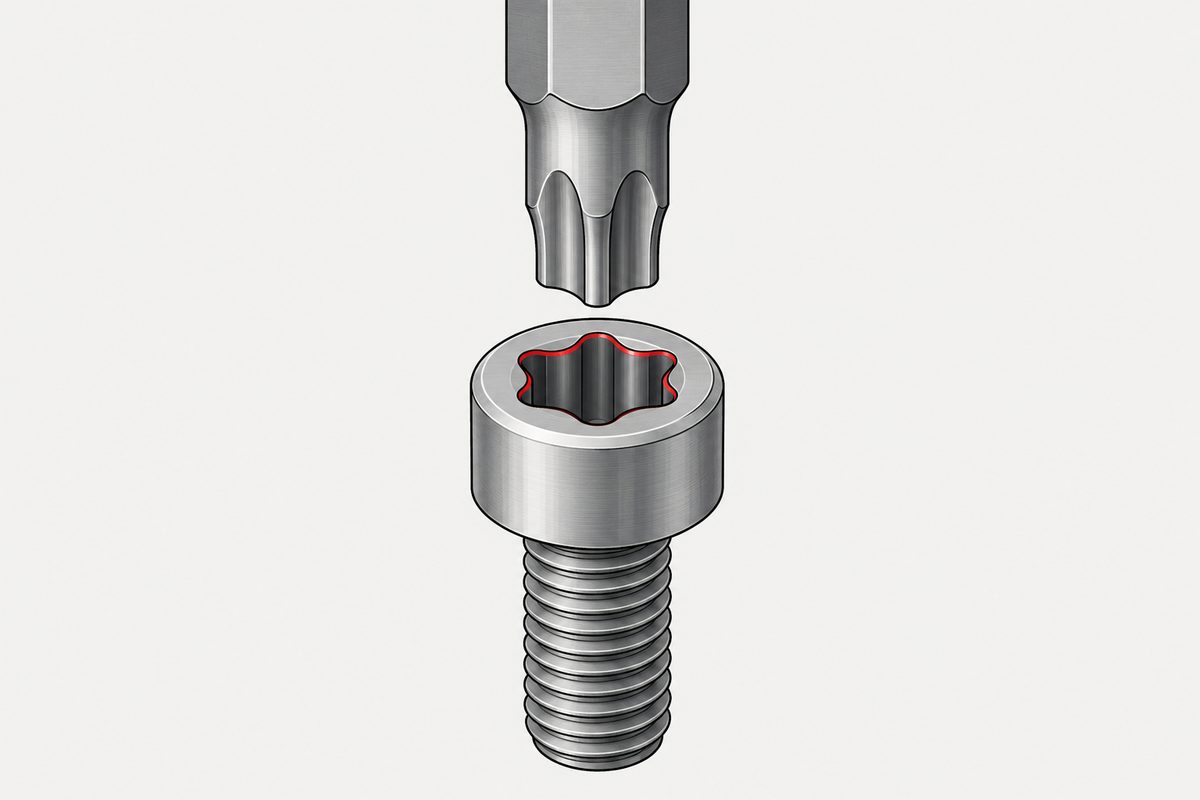
What the standard actually says, and how to write it
ISO 10664:2014, Hexalobular internal driving feature for bolts and screws, is the third edition, published October 2014 and confirmed current after ISO's 2024 systematic review. The 1999 and 2005 editions are withdrawn.
The designation is not T20. ISO uses hexalobular socket no., written out as Hexalobular internal driving feature ISO 10664 – 20. T and TX are TORX commercial terminology. TORX is a registered trademark whose current owner is Acument Intellectual Properties, LLC, operating and licensing as Camcar Innovations — and T20 and T25 themselves carry trademark registrations.
The T notation also collides with something it should not: the size numbers and small-fastener torque values occupy the same integers, and only the unit tells them apart.
The size series runs from no. 1 to no. 100, and it is not continuous: 1 through 10, then 15, 20, 25, 27, 30, 40, 45, 50, 55, 60, 70, 80, 90, 100. So there is no no. 35, and asking for one is asking for something the standard does not define.
The standard covers the recess. It does not cover the driver.
This surprised us, and it matters when a supplier says their bits are “to ISO 10664”.
ISO 10664's scope is the shape, basic dimensions, profile curvature and GO/NO-GO gauging of the recess in the screw. ISO states it is intended to provide recess inspection data and is not suitable as a manufacturing standard. It says nothing about the geometry, material or strength of a general commercial driver bit.
And we could not find a published general-purpose hexalobular driver-tip standard at all. ISO 1173 governs only the bit's connection end and its torque test, not the hexalobular tip. ISO/DIS 25765 is an aerospace TORX® driver bit document still at draft stage. ISO 4580:2021 exists but applies to TORX PARALOBE aerospace bits, which are a different geometry.
Hexalobular button heads now have their own parts, ISO 7380-3 and -4 of March 2026: marked 08.8.
Why it behaves differently from a cross recess
The mechanism is real, and it is worth stating precisely rather than the way it usually gets stated.
A traditional Phillips recess has drive walls that are inclined along the axis. Torque acting on an inclined contact face produces a reaction with an axial component that pushes the bit out of the recess, and that component grows with torque. A Phillips-related patent describes exactly this, and the maker's own literature lists the angled side walls as an installation torque-limiting mechanism.
A hexalobular recess has drive walls roughly parallel to the screw axis. Normal, coaxial, fully inserted engagement therefore does not rely on inclined walls to transmit torque, and there is no equivalent built-in axial ejection component.
| Drive | Drive angle |
|---|---|
| ISO 10664 / standard TORX | about 15° |
| TORX PLUS | 0° |
| Original TORX patent design range | 10° to 20° |
That 15° is not a wall inclination. It is an effective force-transmission angle defined in the top-view section, describing how contact force divides between tangential torque transmission and a radial component. Do not read it as the wall's tilt relative to the screw axis; the two are different quantities and swapping them produces a wrong picture.
Two claims about it that are too strong
- “It needs no axial force.” The maker's own wording is little to no end load, which is the honest version. In practice you still need axial force to complete insertion, hold depth, correct misalignment, get through contamination, or drive a self-drilling or tapping point.
- “It cannot cam out.” The geometry nearly eliminates the axial cam-out that inclined walls produce. It does not eliminate slipping. Misalignment, insufficient insertion, tolerance, wear and overload all still cause it, and patent literature on parallel-wall drives says plainly that a tool off axis can still be pushed out.
What overload actually looks like is different, and that is the more useful thing to know. Instead of the bit backing cleanly out, you get torsional fracture of the bit, plastic deformation of the lobes, rounding, or recess stripping. Experimental work has observed Torx driver buckling and fracture as well as recess stripping and material displacement. A hexalobular joint tends to fail by damage rather than by ejection.
The performance numbers, and where they actually come from
We went looking for the figures that get quoted and could not stand behind either.
- “X% more torque than Phillips.” No general figure from ISO, NASM, SAE or ASTM. ISO 10664 is a dimensional and gauging standard and does not rank drive types. Independent experiment does support Torx over cruciate in specific specimens — one study on 2 mm medical screws — but the result depends on recess size, depth, material and failure location, so it does not extrapolate to a general percentage.
- “N times the bit life.” The 2 to 10 times and “100% improvement” figures in circulation are TORX PLUS vendor claims and customer case studies against standard hexalobular — not standard hexalobular against Phillips.
There is a formal way to measure recess torque capability if a supplier ever puts numbers in front of you: NASM 1312-25 Rev. 2 (2023), the driving recess torque quality conformance test. Narrower requirements exist too — ISO 898-5:2012 §9.4 for proof torque on 45H socket set screws, and EN 3905 with EN 3911 for certain aerospace recesses. All of them are test procedures, not published comparisons between drive types.
The variants, and one thing we had backwards
We were going to warn that the tamper-resistant series is a separate size system whose numbers cannot be mapped across. That is wrong.
TR is the same hexalobular profile with a central post added, and the matching bit is the same profile with a centre hole. So no. 20 and TR20 have the same nominal lobe size. A plain bit is blocked by the post, but a TR bit will generally drive a plain recess of the same number. TR, TT and TxxH are trade notations, not ISO 10664 designations.
External hexalobular is genuinely different, because it is a head form rather than a recess — a lobed male head driven by a socket. It uses its own E series: E4, E5, E6, E8 and upward to E44. That series does not correspond to the internal numbers.
What to write on a drawing
- Name the standard and the socket number, not the trademark: Hexalobular internal driving feature ISO 10664 – 20.
- Check the number exists in the series. There is no no. 35, and no. 27 only entered the standard in 2014, along with sizes 1 to 9.
- Do not expect ISO 10664 to control the bit. If bit geometry matters to you, it has to be specified separately or agreed with the supplier.
- If a torque capability is being claimed, ask which test method produced it.
Why a recess cams out at all is in why the driver slips; what sets the limit on a drive is in what bounds the drive; and the two drives that share the name Y are in two different drives are both called Y. Where the drive sits among the other decisions is in specifying a screw.
References
- ISO 10664:2014 — Hexalobular internal driving feature for bolts and screws; third edition, confirmed 2024; scope, designation, Table 1 size series
- ISO 1173 — bit connection end and torque test; ISO/DIS 25765 (aerospace TORX® bit, draft); ISO 4580:2021 (TORX PARALOBE aerospace bits)
- US 3,584,667 — original TORX patent, 10° to 20° design range; US 4,187,892 — inclined Phillips recess walls and axial removal force; US 5,378,101 — tamper-resistant variant
- NASM 1312-25 Rev. 2 (2023) — driving recess torque quality conformance test; ISO 898-5:2012 §9.4; EN 3905 with EN 3911
- Choi et al., 2018 — recess comparison on 2 mm screws; Örtengren et al. — measured axial force by drive type
- Acument Intellectual Properties, LLC — TORX trademark registrations (USPTO); Camcar Innovations technical literature; Bossard hexalobular drive technical document (15° against 0°)
TORX® and TORX PLUS® are registered trademarks of Acument Intellectual Properties, LLC. Acceptance for any particular part is governed by your drawing.
This page covers step 4, the drive. The whole order is substrate, thread, head, drive, finish, documentation, and why doing it out of order is rework rather than a tweak is in specifying a screw.
Common questions
Is T20 the correct way to specify a Torx recess?
Not on a drawing that means to cite a standard. ISO 10664 designates it as a hexalobular socket number, written as Hexalobular internal driving feature ISO 10664 – 20. T and TX are TORX commercial terminology; TORX is a registered trademark owned by Acument Intellectual Properties, LLC and operated as Camcar Innovations, and T20 and T25 themselves carry trademark registrations.
Does ISO 10664 cover the screwdriver bit?
No. Its scope is the shape, basic dimensions, profile curvature and GO/NO-GO gauging of the recess in the screw, and ISO states it is intended for recess inspection and is not suitable as a manufacturing standard. We could not find a published general-purpose hexalobular driver-tip standard: ISO 1173 covers only the bit connection end and its torque test, ISO/DIS 25765 is an aerospace draft, and ISO 4580:2021 applies to TORX PARALOBE aerospace bits, which are a different geometry.
Why does hexalobular cam out less than a cross recess?
A traditional Phillips recess has drive walls inclined along the axis, so torque on an inclined face produces an axial component that pushes the bit out, growing with torque. A hexalobular recess has drive walls roughly parallel to the screw axis, so coaxial fully inserted engagement has no equivalent built-in ejection component. It is not immune: misalignment, insufficient insertion, tolerance, wear and overload still cause slipping, and overload typically ends in a fractured bit, deformed or rounded lobes, or a stripped recess rather than a clean ejection.
Is a TR20 recess a different size from a number 20?
No. The tamper-resistant version is the same hexalobular profile with a central post added, and the matching bit is the same profile with a centre hole, so the nominal lobe size is the same. A plain bit is blocked by the post, but a TR bit will generally drive a plain recess of the same number. TR, TT and TxxH are trade notations rather than ISO 10664 designations. External hexalobular is different again — it is a head form, not a recess, and uses its own E series from E4 upward.
How much more torque does hexalobular transmit than Phillips?
We could not find a general figure to quote. ISO 10664 is a dimensional and gauging standard and does not rank drive types, and no ISO, NASM, SAE or ASTM source gave a cross-size coefficient. Independent experiment supports Torx over cruciate in specific specimens, but results depend on recess size, depth, material and failure location. The 20 and 50 per cent figures in circulation are mostly TORX PLUS or PARALOBE claims against standard hexalobular, not standard hexalobular against Phillips.
Enquiries
If a drawing reaching you specifies a drive by trademark alone, send it over with the part. Translating it into a standard designation before tooling is ordered avoids a conversation that is much more expensive later.
Request a quotation
Tell us the part and the quantity. We will come back on feasibility, lead time and price.
Or email us directly sales@tigerfasteners.com