 TIGERFASTENERS
There Is No Size 28, and Size 27 Only Joined the Standard in 2014
Somebody stripped a caliper screw last month and posted about it, saying the recess felt like it was between a T27 and a T30, and adding that as far as they could tell T28 and T29 do not exist at all. A hundred and fifty three replies. They were right that nothing sits between those two numbers, and the reason is more interesting than the absence: 27 itself is a late arrival. Put the current edition of the standard next to the previous one and 27 is not in the older table.
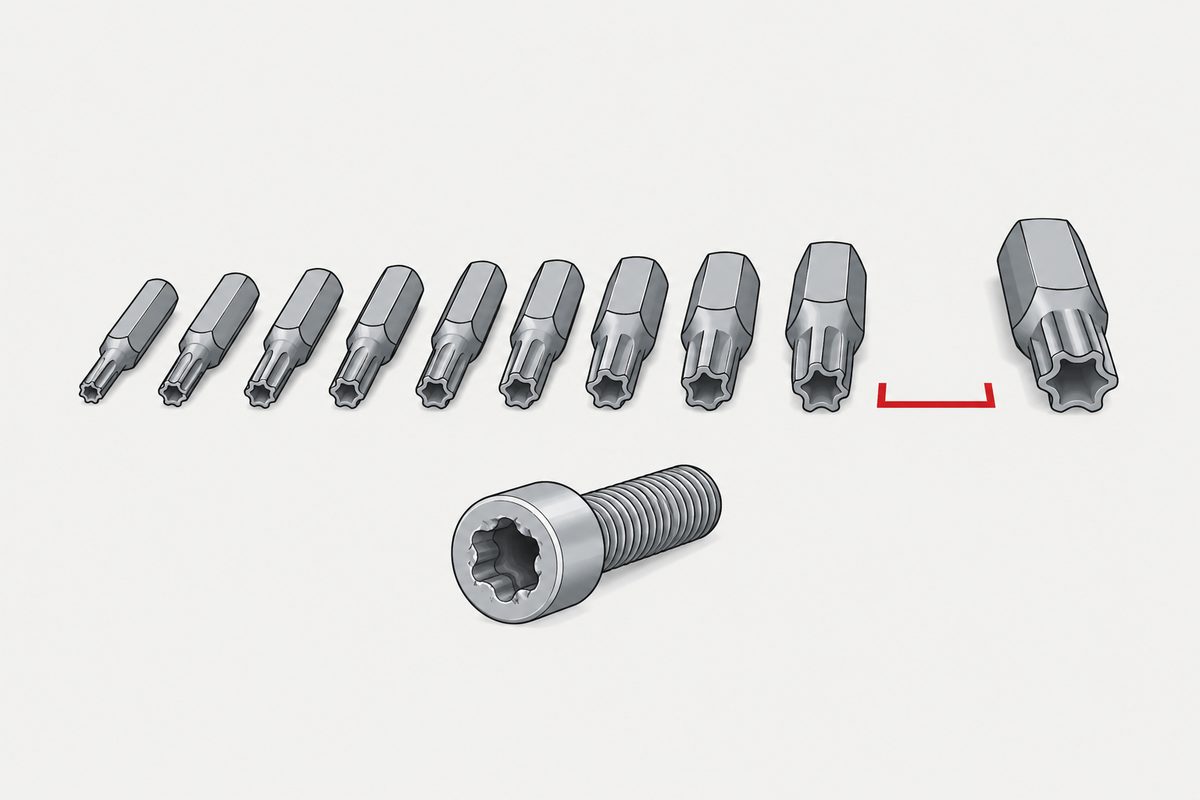
ISO 10664:2005 lists sixteen hexalobular socket sizes and the smallest is number 6. ISO 10664:2014 lists twenty four, and the eight that were added are 1, 2, 3, 4, 5, 7, 9 and 27. Seven of them fill in the small end. The eighth sits between 25 and 30. And the sixteen sizes that already existed did not move by a hundredth of a millimetre.
The document is ISO 10664:2014, hexalobular internal driving feature for bolts and screws, third edition, eight pages, ISO/TC 2/SC 11, confirmed as current in 2024. Its own foreword names the change in one line: the third edition “has been technically revised with the following changes: several sizes of the driving feature have been added with respective values in Tables 1 to 5.” It does not say which sizes. Putting the two tables side by side does, and the arithmetic below is ours.
This site has already covered what this standard is and what it is not called, including the fact that it covers the recess rather than the driver. What follows is the size series, which that page does not go into.
The numbers, and the one that breaks the pattern
The current series runs 1 to 10 consecutively, then 15, 20, 25, 27, 30, then 40, 45, 50, 55, 60, then 70, 80, 90, 100.
Read that again and one number is out of place. 27 is the only number above 10 in the whole table that is not a multiple of five. There is no 28 and no 29, and there is no 35, no 65 and no 75 either. The forum poster was right that the gap is real; what they could not know from a search is that the gap used to be twice as wide.
| Socket no. | A | B | In 2005? |
|---|---|---|---|
| 10 | 2,8 | 2,05 | yes |
| 15 | 3,35 | 2,4 | yes |
| 20 | 3,95 | 2,85 | yes |
| 25 | 4,5 | 3,25 | yes |
| 27 | 5,1 | 3,68 | no |
| 30 | 5,6 | 4,05 | yes |
| 40 | 6,75 | 4,85 | yes |
Now the arithmetic that explains why it exists, which is ours and not the standard’s. Take the steps in dimension A across the neighbours of 27:
- 15 to 20 is 0,60 mm
- 20 to 25 is 0,55 mm
- 25 to 30, if 27 did not exist, would be 1,10 mm
- with 27 in place, 25 to 27 is 0,60 and 27 to 30 is 0,50
Without 27, that one rung of the ladder is twice the height of every rung around it. With it, the spacing is back in line. The standard gives no reason and we are not claiming one, but a size that turns a double step into two normal steps is doing an obvious job.
What half a millimetre looks like in the hand
Dimension A is 5,1 for a size 27 and 5,6 for a size 30, so half a millimetre separates them, which is about a tenth of the size. That is the whole space in which a recess could feel like it was between the two, and the standard defines nothing in it.
So a recess that takes a 27 badly and refuses a 30 is not a size that got left out of the table. It is a size 27 that is worn, or damaged, or made to a different geometry, or a recess from another system that happens to look similar. We do not have that screw and we are not going to guess which. What we can say is that the standard leaves no room for a legitimate answer of the form it is a 28.
Two more numbers from the preview bound the fit. The counterbore c at the mouth of the recess is limited to 0,13 mm up to socket no. 15 and 0,25 mm above it. And the fallaway allowance, how far a NO GO gauge may enter before the recess is rejected, is 1,02 mm for a size 27 and 1,12 mm for a size 30. The tolerance on the feature is not tiny; it is roughly a millimetre of gauge travel.
The standard says it is not a manufacturing standard
The scope contains a disclaimer that is worth repeating whenever someone tries to make a recess from this document.
“The intent of this International Standard is to provide the details necessary for inspection of the hexalobular driving feature. It is not suitable for, nor intended to be used as, a manufacturing standard.”
Which is consistent with how it works. Conformance is by gauge: the GO gauge shall enter freely to the penetration depth, and the NO GO gauges shall not enter deeper than the fallaway allowance. And the penetration depth itself is not here. Figure 1 says “Penetration depth, t: see relevant product standard”, so how deep the recess goes belongs to whichever standard describes the screw. A note adds that the contour of the bottom of the socket beyond the gauge is at the option of the manufacturer. Below where the gauge reaches, the shape is nobody’s business.
What a revision that adds sizes tells you
The interesting part of the comparison is not the eight additions. It is the sixteen non-additions. Every size that existed in 2005 has exactly the same A and B in 2014, sixteen for sixteen. A committee that was willing to reopen the table and add to it left every existing value alone.
That is worth knowing if you are reading an old drawing. A size 30 recess specified against the 2005 edition is dimensionally the same feature as a size 30 specified against the 2014 one. What changed is the length of the menu, not the items on it.
The 2005 edition is itself the second, replacing a 1999 first edition which we have not read. So the small sizes 1 to 9 and the size 27 arrived somewhere in the last decade of an internal driving feature that has been standardised since the nineties, and the table has been getting longer at both ends rather than being redrawn.
What to take from it
- There is no 28 or 29. The series is 1 to 10, then 15, 20, 25, 27, 30, 40, 45, 50, 55, 60, 70, 80, 90, 100
- 27 is the odd one out. It is the only number above 10 that is not a multiple of five, and by our arithmetic it halves what would otherwise be a double-width step
- 27 is newer than the tools that predate it. It is not in ISO 10664:2005, and a bit set bought against the older table has no reason to contain one
- Existing sizes did not change. All sixteen sizes common to both editions carry identical A and B
- Conformance is by gauge, not by measurement. GO enters freely to the penetration depth, NO GO must not pass the fallaway allowance, and the depth itself comes from the product standard
The poster in that thread reached the right conclusion by searching, and then had to strip a second screw to be sure. The table settles it in one line, and the version history settles the part the search could not reach.
This page covers step 4, the drive. The whole order is substrate, thread, head, drive, finish, documentation, and why doing it out of order is rework rather than a tweak is in specifying a screw.
Common questions
Is there a T28 or T29?
Not in ISO 10664. The hexalobular socket numbers are 1 to 10 consecutively, then 15, 20, 25, 27, 30, then 40, 45, 50, 55, 60, then 70, 80, 90 and 100. Nothing sits between 27 and 30, and nothing sits between 30 and 40 either.
Why does size 27 exist when everything else above 10 is a multiple of five?
The standard gives no reason. By our own arithmetic on its Table 1, the step in dimension A from size 25 to size 30 would be 1,10 mm without it, roughly twice the 0,60 and 0,55 mm steps on either side of that part of the table. With 27 at 5,1 mm the two steps become 0,60 and 0,50, in line with the rest.
When was size 27 added to the standard?
It is not in ISO 10664:2005 and it is in ISO 10664:2014. The 2014 foreword states that several sizes of the driving feature have been added but does not list them. Comparing the two tables, which is our own comparison, the additions are 1, 2, 3, 4, 5, 7, 9 and 27.
Did the existing sizes change in the 2014 edition?
No. All sixteen sizes that appear in both editions carry identical values of A and B. The revision lengthened the table without altering any entry that was already in it.
How much bigger is a size 30 than a size 27?
Dimension A is 5,1 mm for a size 27 and 5,6 mm for a size 30, so half a millimetre, which is about a tenth of the size.
What is the fallaway allowance?
The depth to which a NO GO gauge is permitted to enter the recess before it is rejected. ISO 10664 tabulates it per size; it is 0,90 mm at size 25, 1,02 mm at size 27 and 1,12 mm at size 30.
Does ISO 10664 give the depth of the recess?
No. Figure 1 states that the penetration depth t is to be found in the relevant product standard. A note adds that the contour of the bottom of the socket beyond the gauge is at the option of the manufacturer.
Can a recess be manufactured to ISO 10664?
The standard says not. Its scope states that the intent is to provide the details necessary for inspection of the hexalobular driving feature, and that it is not suitable for, nor intended to be used as, a manufacturing standard.
What should I do about a screw that takes a 27 badly and will not take a 30?
This page cannot tell you, and does not try. The standard defines nothing between the two sizes, so the possibilities are a worn or damaged size 27, a feature made to a different geometry, or a recess from another system. We do not have the screw and we do not guess.
References
- ISO 10664:2014, Hexalobular internal driving feature for bolts and screws. Foreword, scope, Figure 1, Tables 1 and 2, clause 3.1
- ISO 10664:2005, the withdrawn second edition, used here only to compare the size table
- r/MechanicAdvice, where a stripped caliper screw produced the question and a hundred and fifty three replies
Both editions were read from the publicly available iTeh previews, which reach the scope, Figure 1, Table 1, Table 2 and the opening of the gauging clause. ISO 10664:2014 is the third edition, eight pages, ISO/TC 2/SC 11, stage 90.93, last reviewed and confirmed in 2024; it supersedes the 2005 second edition, which itself replaced a 1999 first edition that we have not read. Tables 3, 4 and 5, the gauge dimensions, and Annex A are outside both previews and no figure from them is quoted. The following are our own arithmetic and comparison, not statements by either standard: the list of eight sizes added in 2014, the observation that all sixteen pre-existing sizes are unchanged, the observation that 27 is the only number above 10 that is not a multiple of five, and the step sizes in dimension A that show 25 to 30 would otherwise be a double-width step. The 2014 foreword states that several sizes were added but does not name them; naming them is our comparison of the two tables, and both tables were checked against rendered images of the printed pages. The standard offers no reason for the existence of size 27 and we do not claim one. We do not diagnose the screw in the forum thread; a recess that behaves that way could be worn, damaged, made to a different geometry, or from another system, and we do not have it. No vehicle, component or tool brand is named, and we read the post and not its replies. What this standard is called and what it does and does not cover are on an earlier page and are not repeated here.
Enquiries
If a hexalobular recess is on your drawing, give the socket number from ISO 10664 and the product standard that fixes the penetration depth, because the depth is not in ISO 10664. If the size is 27 or any of 1 to 9, say which edition you are working to, since those sizes are not in the 2005 table.
Request a quotation
Tell us the part and the quantity. We will come back on feasibility, lead time and price.
Or email us directly sales@tigerfasteners.com