 TIGERFASTENERS
Two Numbers Live Next to That Bolt and Only One Is a Torque
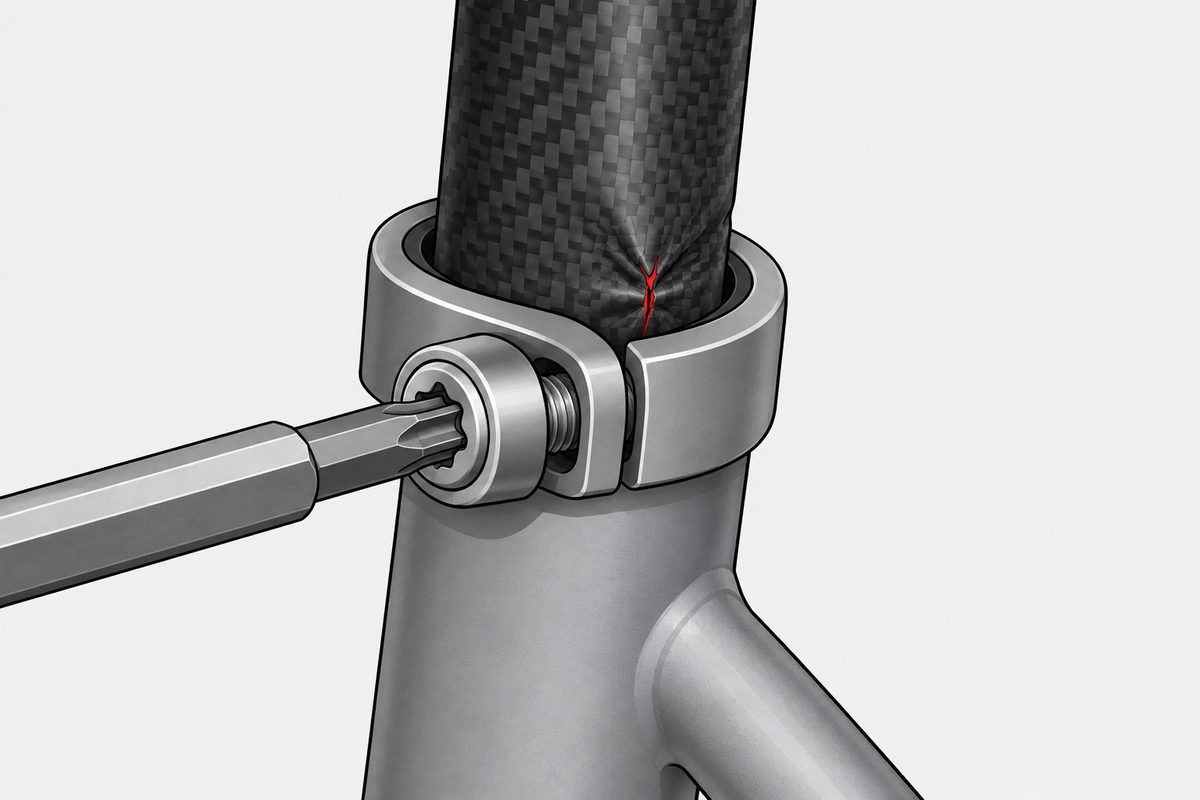
Somebody on r/bikewrench had a fifteen-day-old bike and two crushed seatposts. He used carbon assembly paste, he used a torque wrench, he set it to 4 N·m against a clamp marked 5 N·m maximum, and the same spot pinched both times, on two different posts. Two hundred and thirteen replies later, the one at the top is a single question: is he reading T25 as a torque spec?
Why that question is worth more than a diagnosis
Nobody in that thread can examine the bike, and neither can we. The reply that took the most votes is a hypothesis, not a finding, and this page is not going to pretend otherwise. What makes it worth writing about is that the confusion it describes is available to anyone, and the reason it is available can be checked without seeing anybody’s seatpost.
If a marking reading T25 were taken as 25 N·m, that is five times the maximum printed on the clamp itself. Two crushed posts is the sort of thing five times the limit does. The question is how a tool size and a tightening torque came to be confusable at all.
The two series share their integers
The hexalobular drive comes in a size series that this site has read out of ISO 10664 before: no. 1 through 10, and then 15, 20, 25, 27, 30, 40, 45, 50, 55, 60, 70, 80, 90, 100, which is not continuous, so there is no no. 35 to ask for.
Now set that against the range small fasteners are tightened in. A bicycle clamp bolt carries a maximum of a few newton metres, a stem bolt somewhat more, a cassette lockring or a bottom bracket a good deal more. The integers that appear on those specifications are the same integers.
| Number | As a hexalobular size | As a torque |
|---|---|---|
| 20 | A valid size, very common | A plausible tightening torque |
| 25 | A valid size, very common | A plausible tightening torque |
| 30 | A valid size | A plausible tightening torque |
| 40 | A valid size | A plausible tightening torque |
| 5 | A valid size, small | A plausible tightening torque |
There is no number in the overlap that resolves itself. The two quantities are not distinguished by magnitude, by range, or by which fastener they sit next to. They are distinguished by one thing only, and it is the thing that gets left off.
The defence is the unit, and the unit is what gets dropped
A torque figure without its unit is not a torque figure. 5 N·m is a specification. A bare 5 next to a bolt head is an unanswered question, and on a component that also carries a drive size, it is a question with two answers.
Which is why the ISO notation does not create this problem. ISO 10664 does not call it T25. The designation is written out as Hexalobular internal driving feature ISO 10664 – 25, with no letter T anywhere in it, because T and TX are TORX commercial terminology and TORX is a registered trademark. A drawing written the ISO way carries a phrase that cannot be mistaken for a torque under any reading. The collision belongs to the shorthand, not to the standard, and the rest of what the standard does and does not cover is hexalobular is not T20.
The other candidate, which the rider raised himself
He added a detail that deserves its own paragraph: he had been lining the seatpost clamp’s slit up with the frame’s slit, and had since read that they should be offset.
That one is geometry rather than arithmetic. A clamp closes by pulling a gap shut, and the frame it closes on has a gap of its own. Put the two gaps at the same angular position and the clamp is applying its load exactly where the frame has no material to spread it, so it arrives at the two edges of the slot instead of around the tube. Offset them and the support under the clamp is continuous.
We cannot tell which of the two explanations applies to his bike, and neither can the thread. Both are consistent with what he described, and they are not exclusive. What they have in common is the more useful lesson: the torque number was met, twice, and the part failed anyway, because torque does not describe where the pressure ends up. It is not even a reliable statement about how much force there is, which is torque and clamp force.
Three questions a marking can be answering
The generalisation is worth carrying past bicycles. A number stamped near a fastener is answering one of several unrelated questions, and the notations are not designed to keep them apart:
| Question | Looks like | Where to check it |
|---|---|---|
| What tool fits | T25, and on the ISO side a socket number | The recess standard, which covers the recess and not the driver |
| How tight | 5 N·m, or a bare 5 if somebody was careless | The component maker’s own document, not the fastener |
| How strong | 8.8, 10.9, A2-70 | The property class system. See what the head markings mean |
The middle row is the one with no standard behind the marking itself. A property class mark is defined by a fastener standard and means something checkable; a drive size is defined by a recess standard. A torque printed on a component is that manufacturer’s instruction, and the only thing that makes it unambiguous is the unit. What a marking is entitled to claim in general is a mark is a claim, not a measurement.
This page covers step 4, the drive. The whole order is substrate, thread, head, drive, finish, documentation, and why doing it out of order is rework rather than a tweak is in specifying a screw.
Common questions
Does T25 mean 25 newton metres?
No. It is a drive size, the hexalobular recess the tool has to fit. The size series runs 1 through 10 and then 15, 20, 25, 27, 30 and upward, and those integers overlap almost completely with the range of torque values used on small fasteners, which is why the confusion exists at all. ISO does not use the T notation: the designation is written out as hexalobular internal driving feature ISO 10664 followed by the number, with no letter T in it.
How do I tell a tool size from a torque value on a part?
By the unit, and there is no other reliable test. A torque is a force times a length and has to be written with one, so 5 N·m is a specification and a bare 5 is not. If a number near a bolt has no unit, treat it as unresolved and find the component maker’s document rather than guessing, because the same integer is a valid answer to both questions.
Can a joint fail at the specified torque?
Yes, and the case behind this page is one. Torque is an input to a friction problem, so the clamp force it produces varies widely, and clamp force in turn says nothing about where the resulting pressure is concentrated. A clamp whose slot lines up with the slot in the part it is closing on delivers its load to two edges rather than around the circumference, at any torque you like.
Should a clamp slit be aligned with the frame slit or offset from it?
Offset is the usual advice and the geometry supports it: aligning the two gaps puts the clamp load exactly where the inner part has no material to spread it. This page does not diagnose any particular bicycle, and the manufacturer’s own instructions govern. The general principle is that a clamp needs continuous support under it, and two coincident gaps remove that support at the one place the load is highest.
Is carbon assembly paste a substitute for getting the torque right?
It is a different lever, not the same one. Friction paste raises the coefficient of friction at the interface, so a given clamp force holds against more slip, which means the required clamp force can be lower. It does nothing about where that force is concentrated, and it does not change what happens if the number being followed is not a torque in the first place.
References
- ISO 10664:2014 — hexalobular internal driving feature for bolts and screws; the source of the size series and of the designation form, read for our earlier page on this standard
- r/bikewrench — two crushed seatposts at a torque below the stated maximum, and the top reply asking whether a drive size was being read as one
The ISO 10664 material here, the size series and the fact that the designation contains no letter T, comes from our earlier page on that standard, which was written from the standard itself. The suggestion that a drive size was being read as a torque is a hypothesis offered by a commenter on the source thread, not an established fact, and this page does not diagnose that bicycle: we have not seen the bike, the clamp or the posts, and both explanations discussed here are consistent with what was described. The slot-alignment argument is geometry and is presented as such; the rider raised it himself and the manufacturer’s instructions govern any particular machine. No torque value for any bicycle component is given here, because those belong to component makers’ manuals and we hold none of them; the only figures quoted are the ones the rider stated about his own case. We make no claim about the strength of any composite tube, having found no measurement we were willing to cite. The observation that the hexalobular integers and small-fastener torque values occupy the same range is our own, and can be checked by setting the two series side by side.
Enquiries
If a drawing or an enquiry carries a bare number next to a fastener, tell us which question it is answering. Drive size, property class and tightening torque are three different specifications that reach us written the same way, and the one that is most often missing its unit is the one that breaks parts.
Request a quotation
Tell us the part and the quantity. We will come back on feasibility, lead time and price.
Or email us directly sales@tigerfasteners.com