 TIGERFASTENERS
Anti-seize does not make preload uncertain
The short version: the compound is not the problem. An unrecorded compound is. One maker publishes a nut factor of 0.13 against an unlubricated baseline of 0.185, and states a 30% torque reduction for the same clamp load. Another maker tells you to use normal torque values and forbids their paste on wheel nuts entirely. Both instructions are correct — for their own product.
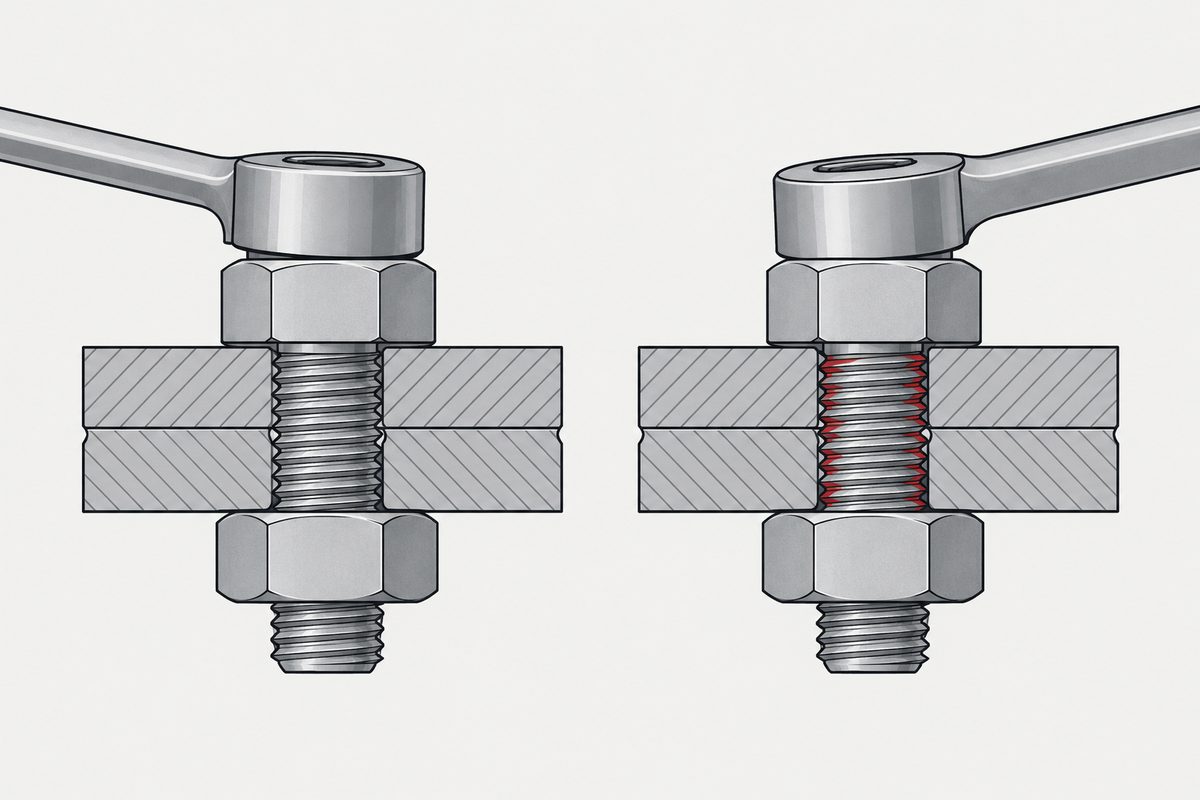
Is it a lubricant or an abrasive?
This is the question asked most often, and it has a clean answer that most arguments miss.
An anti-seize is a carrier oil or grease with solid lubricants dispersed in it, plus thickeners and corrosion inhibitors. The solids vary by product: one common formulation lists graphite, copper flake, aluminium powder and zinc oxide; a nickel grade lists 20% pure nickel flake in a high-temperature carrier; a molybdenum paste can be over 60% MoS2. Manufacturers call these solid lubricants — they form a separating film, reduce stick-slip, and suppress fretting, galling and seizing.
The word “abrasive” does appear in the standards — about something else. ASME PCC-1 identifies rust, paint flakes and grit as abrasive particles that can change the nut factor. Those are contamination. Confusing formulated solid lubricants with debris on the threads is the error underneath most of the argument.
What it does to the number
Published figures, each specific to a product and a test:
| Product | Figure |
|---|---|
| A copper/graphite grade | nut factor K = 0.13 |
| Various industrial grades | K = 0.13, 0.15, 0.16 |
| A solid-lubricant paste, M12 class 8.8 black oxide | thread μ = 0.13, under-head μ = 0.08 |
| Unlubricated carbon steel baseline | K = 0.185 |
From that baseline, the copper/graphite maker states that the same clamp load can be reached with up to 30% less torque. The arithmetic checks: 0.13 ÷ 0.185 = 0.703, so 29.7%.
One trap in reading those sheets: the same product also lists a four-ball test coefficient of 0.06. That is not the bolt nut factor and the two are not interchangeable.
Why there is no universal percentage
It is tempting to take “30%” away as the rule. It is not one.
Published nut factors for anti-seize products already span roughly 0.13–0.16, and one major maker's own anti-seize data sheet instructs users to apply normal torque values — and separately prohibits that product on wheel nuts and studs altogether. Two manufacturers, two different instructions, both correct for their own product.
And one figure that should end the search for a fixed number. ASME PCC-1 records a single lubricant whose nut factor moved from 0.155 to 0.105 across a 0–40 °C test range. That is a 50% swing from temperature alone, with the same paste and the same hardware. A universal percentage cannot survive that.
What the standard recommends instead is to derive the relationship for your actual lubricant, material, size, coating and temperature — or to stop inferring preload from torque and measure it, with a load cell, an instrumented bolt or ultrasonic length.
The correction we had to make
We drafted this article around a tidy trade-off: anti-seize buys you removal later at the cost of certainty now. The second half is wrong.
ASME PCC-1 makes the opposite point: applying a specified lubricant consistently makes the nut factor more consistent, which improves how evenly load is shared between bolts. Controlled lubrication gives you both the removability and the tighter distribution.
So the honest statement is narrower and more useful: anti-seize changes and redefines the friction condition. If the torque figure was not calibrated for that product and that application method, the preload you assumed no longer follows. The uncertainty comes from the mismatch, not from the paste.
Which is the same conclusion as a torque figure assumes a friction condition, arrived at from the other direction. Friction is not the enemy. Unrecorded friction is.
Where the specification says to use it
If anti-seize were simply hazardous, no specification would call for it. They do, and the instructive cases pair it with a torque figure.
- A fitting maker's valve service instruction has the gland nut threads coated liberally with anti-seize, then torqued to a table on the same page — 55–60 ft·lb for one size. The torque figure and the paste are issued together.
- A vehicle safety recall required a thin coat of high-temperature nickel anti-seize on the rotor-to-hub mating face of specific vehicles — while explicitly prohibiting it from reaching the stud threads.
That second one is the sharpest illustration on this page. Two surfaces a few millimetres apart: one specified to receive the compound, one specified to stay clean. Only one of them is in the tightening friction path.
The rotor face, stated carefully
The brake rotor question is asked a lot and deserves precision.
The rotor-to-hub face is not one of the two rotating friction interfaces that set the torque-to-preload relationship — those are the thread flanks and the bearing face under the nut or head. So a film there does not change the torque conversion the way thread lubrication does, provided it stays where it was put.
That is not the same as saying it is mechanically irrelevant. It is still a clamped, load-transmitting joint face, and manufacturers are specific about what may go on it. The recall above required the compound to be free of dirt and rust, because debris there can cause excessive rotor runout — and other manufacturers restrict the compound to the wheel pilot bore and keep it off the mounting face entirely.
So the answer is not yes or no. It is interface-specific and manufacturer-specific, and the useful question is which surface the instruction actually names.
What to do with this
Three things follow, and none of them is a percentage:
- If a specification names a compound, use that one, there, and use its torque. The figure and the paste were issued as a pair.
- If nothing is specified, applying anti-seize means the existing torque figure no longer corresponds to the preload it was written for. Either derive the relationship for your combination, or measure preload directly.
- Consistency is worth as much as the value. The standard's point is that applying a specified lubricant the same way every time tightens the distribution — which is often what a joint actually needed.
How the underlying relationship works is in torque and clamp force; why changing a surface changes the joint without changing the number is in a torque figure assumes a friction condition; and the seizing failure anti-seize exists to prevent is in why stainless galls.
A coating changes the same friction term before any compound is applied, which is why choosing a finish and plating and thread tolerance belong to the same decision as this one.
There is a prior question about what was on the fastener before anything was applied. The general requirements standard makes clean and lightly oiled the default delivery condition, and then says nothing at all about how much.
This page covers step 5, the finish. The whole order is substrate, thread, head, drive, finish, documentation, and why doing it out of order is rework rather than a tweak is in specifying a screw.
Common questions
Is anti-seize a lubricant or an abrasive?
A lubricant. It is a carrier oil or grease with solid lubricants dispersed in it — graphite, copper, aluminium, nickel or molybdenum disulphide depending on grade — plus thickeners and corrosion inhibitors. Manufacturers describe those solids as forming a separating film that reduces stick-slip and suppresses fretting, galling and seizing. The word abrasive appears in ASME PCC-1 about something else: rust, paint flakes and grit, which are contamination rather than formulated solids.
How much should I reduce torque when using anti-seize?
There is no universal figure. One copper and graphite product publishes a nut factor of 0.13 against an unlubricated carbon steel baseline of 0.185 and states up to 30% less torque for the same clamp load. Published nut factors across products span roughly 0.13 to 0.16, and another major maker instructs users to apply normal torque values with its product while prohibiting it on wheel nuts. Follow the instruction for the product you actually have.
Does anti-seize make preload unpredictable?
Not by itself. ASME PCC-1 notes that applying a specified lubricant consistently makes the nut factor more consistent, which improves how evenly load is shared between bolts. The uncertainty comes from a mismatch: if the torque figure was not calibrated for that product and application method, the preload you assumed no longer follows. Friction is not the problem; unrecorded friction is.
Should anti-seize go on the back of a brake rotor?
It depends on the vehicle and the surface named. One safety recall required a thin coat of high-temperature nickel anti-seize on the rotor-to-hub mating face of specific vehicles while explicitly prohibiting it on the stud threads. Other manufacturers restrict it to the wheel pilot bore and keep it off the mounting face. The rotor face is not one of the rotating friction interfaces that set torque-to-preload, but it is still a clamped joint face and debris there can cause excessive runout.
Why do published nut factors vary so much?
Because the nut factor is a property of the whole assembly condition rather than the compound. ASME PCC-1 records a single lubricant whose nut factor moved from 0.155 to 0.105 across a 0 to 40 degree Celsius test range, a 50% swing from temperature alone with the same paste and hardware. That is why the standard recommends deriving the relationship for your own lubricant, material, size, coating and temperature, or measuring preload directly.
References
- ASME PCC-1 — Pressure Boundary Bolted Flange Joint Assembly: abrasive contamination, lubricant consistency, and Appendix K on deriving the torque-preload relationship
- Manufacturer technical data sheets for anti-seize compounds (nut factors, composition, application instructions and prohibitions)
- Vehicle safety recall requiring nickel anti-seize on a rotor-to-hub face while prohibiting it on stud threads
- Fitting manufacturer valve service instruction pairing anti-seize with a torque table
- “Is Anti-Seize a lubricant, abrasive, or both?” and related questions, Mechanics Stack Exchange
This page explains a relationship and cites published instructions as examples. For any actual joint the governing document is the equipment or vehicle manufacturer's specification.
Enquiries
If a drawing specifies a torque without naming the surface condition, or names an anti-seize without adjusting the torque, that gap is worth closing before assembly. Send us both and we will tell you which one is missing.
Request a quotation
Tell us the part and the quantity. We will come back on feasibility, lead time and price.
Or email us directly sales@tigerfasteners.com