 TIGERFASTENERS
What “It Passed the Vibration Test” Leaves Out
Someone on r/AskEngineers asked which locking washer is second best after the expensive one. The thread answered it properly: cotter pin if it absolutely must not back out, nylon insert or adhesive at moderate temperature, and the helical spring washer does nothing. All of that is right, and this site says the same in two places. What nobody asked is where the ranking came from, and the ranking has a document behind it.
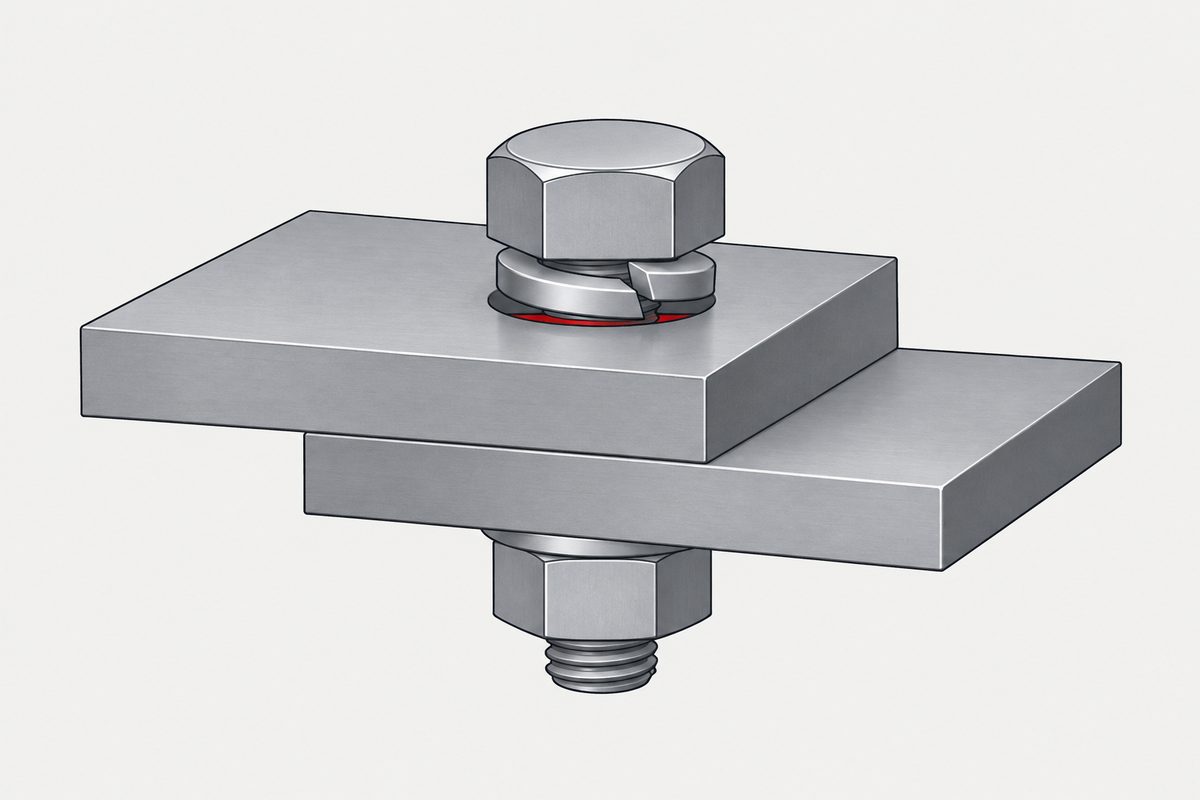
The test says what it is for, and it is narrower than people think
Locking devices are ranked by a transverse-vibration test, the family of test that Gerhard Junker started in the late 1960s. In the aerospace series it is written down as ISO 16130. Two sentences in its scope decide how the rest of this page reads:
Because test apparatuses differ, testing to this standard does not allow an absolute statement to be made on the locking behaviour of bolted assemblies under service loads. The objective is a comparative evaluation of locking elements under defined test conditions.
The same clause adds that the standard is mainly intended for development work. So a ranking is exactly what the test produces, and a ranking is all it claims to produce. The person asking which washer is second best was asking the question the test is built to answer. The trouble starts one step later, when a rank gets read as a service life.
How the test condition is chosen, which is the part worth knowing
The procedure has two halves. The second half tests your device. The first half decides what it will be tested against, and it is done on a joint with no locking device in it at all, assembled the same way and to the same parameters.
On that unsecured joint, the stroke is varied until the operator finds the transverse displacement at which the preload is completely lost within 300 ± 100 load cycles. That has to be established three times, with new parts each time. That displacement becomes the condition for the verification test.
Read what that means. The condition is not a service condition and was never intended to be one. It is the amount of transverse movement that kills a bare joint inside three hundred cycles, measured on that particular rig. A device that survives it survived something calibrated to be lethal, which is the right way to run a comparison and the wrong way to read a warranty.
It also explains why the standard says results are not transferable between machines. The reference displacement comes out of the rig’s own stiffness distribution, so two labs testing the same washer are not applying the same severity unless they say so.
The default numbers, and the sentence that lets them move
Clause 7 gives typical settings for self-locking elements, which the standard lists as nuts, washers, split pins and lock wire:
| Parameter | Typical setting |
|---|---|
| Transverse displacement ts | ±0,5 mm up to and including M12; ±0,8 mm above |
| Frequency | 12,5 Hz (the machine must offer 10 to 15 Hz, held to ±3 %) |
| Clamp force | Per the standard’s tables, representing 75 % of the calculated ultimate clamp force, adjusted to the weaker of bolt and nut |
| Length to diameter ratio | As short as possible, preferably around 2,0 to 2,5 |
| Gap at the fastener, under load | 1 mm ± 0,05 mm |
Two of those rows deserve a second look. The grip is specified as short as the geometry allows, and a short grip is the condition under which a joint gives up the largest share of its preload for a given amount of settling, which is worked through in the two failures that both get called loosening. The test is not being kind.
And then the line that matters most for anybody comparing two suppliers’ claims: different test settings may be defined by the test requester. The standard immediately lists the four things that must then be stated unambiguously for the result to be reproducible: initial clamp force, test frequency, effective transverse displacement, and how the fixture was adjusted to the fastener length. Those four are the reason two “passed the vibration test” claims are not necessarily comparable, and they are the four to ask for.
No axial load is applied at all
The test principle is one paragraph and contains a sentence that surprises people. The fastener is tightened to a defined clamp force and then subjected to dynamic transverse loading, and no additional axial operating force is applied. What gets measured is the change in clamp force against the number of cycles.
So the rating on a locking device was established on a joint carrying nothing but its own preload. That is deliberate, because it isolates the mechanism: transverse slip is what turns a screw, not axial pull. It also means the test has said nothing about a joint that also carries a fluctuating axial load, which is a different failure with its own model in the bolt is a spring, and so is everything it clamps.
The list of things that end the test is worth reading slowly too. A run stops after a specified number of cycles, on fracture of the bolt, on complete loss of clamp force, or on stabilisation of the residual clamp force. That last one is not the same as keeping the clamp force. A joint that fell to some fraction of its preload and then stopped falling has stabilised, and how much it kept is a number in the report rather than something the word “passed” carries.
What to do with the ranking
None of this makes the ranking wrong. A comparative test run under stated conditions is a real result and is far better than opinion, which is why this site is willing to write that a wedge-lock pair is effective under transverse-vibration testing and a split spring washer is not. What the standard does is tell you what kind of statement that is.
Three questions turn a rank back into engineering. At what transverse displacement, since that is the severity and it is set per rig. At what clamp force and grip length, since the standard’s own default is the least favourable grip. Ending on which condition, and with what residual clamp force, since stabilised is one of the ways a run ends.
The thread’s own best answer sits comfortably with all of that. If the joint must not rotate at all, the honest device is one that forbids rotation rather than resisting it, and it comes with its own price, which is the preload you finish with is whichever one the hole allowed. Where each countermeasure sits against the two failure modes is the table in why screws loosen, and what each washer type actually does is in washers explained. The case where a countermeasure was written into a standard and then taken out again is the double nut.
This is not one of the six steps. It shows up across them, or after assembly. Where the decisions that lead here were made is in specifying a screw, which sets out the order and why doing it out of order is rework.
Common questions
Which locking washer is second best?
The question is the one a transverse-vibration test exists to answer, and ISO 16130 says in its scope that a comparative evaluation under defined conditions is what it produces. It also says testing to the standard does not allow an absolute statement about locking behaviour under service loads. So a rank is available and a service life is not. Before using a rank, ask at what transverse displacement it was obtained, since the standard sets that per rig rather than universally.
What is the Junker test?
The family of transverse-vibration test that Gerhard Junker developed in the late 1960s, in which the clamped parts are made to slide across each other while the clamp force is recorded against the number of cycles. In the aerospace series it is standardised as ISO 16130. The clamped faces sliding, rather than axial pull, is the mechanism that rotates a screw.
How is the vibration amplitude chosen?
By destroying an unsecured joint first. ISO 16130 has the operator run a joint with no locking device, assembled to the same parameters, and vary the stroke until the transverse displacement is found at which preload is completely lost within 300 plus or minus 100 load cycles. That has to be established three times on new parts, and it becomes the condition for the test that follows. Typical settings are quoted separately as plus or minus 0,5 mm up to M12 and 0,8 mm above, at 12,5 Hz.
Are two suppliers’ vibration test results comparable?
Not automatically. The standard states that different test settings may be defined by the test requester, and then lists four things that must be stated unambiguously for a result to be reproducible: the initial clamp force, the test frequency, the effective transverse displacement, and how the fixture was adjusted to the fastener length. If a claim does not carry those four, it is not comparable to another claim that does.
Does the test apply a working load to the joint?
No. The test principle states that the fastener is tightened to a defined clamp force and subjected to dynamic transverse loading with no additional axial operating force applied. That isolates the self-loosening mechanism, and it also means the result says nothing about a joint that also carries a fluctuating axial load.
References
- ISO 16130:2015 — aerospace series, dynamic testing of the locking behaviour of bolted connections under transverse loading conditions (vibration test); clause 1 scope, clause 4 test principle, clause 5.3 apparatus requirements, clause 6 reference and verification tests, clause 7 test settings
- ISO 16047 — fasteners, torque/clamp force testing; the only normative reference ISO 16130 carries
- NASA RP-1228, Fastener Design Manual — the source the source thread linked, and the origin of the assessment of split-type lockwashers quoted elsewhere on this site
- r/AskEngineers — the thread this began in
ISO 16130:2015 was read from the publicly available preview PDF, which carries the contents page and clauses 1 to 7 in full. Everything quoted above comes from those clauses. The preview stops before clause 8, Evaluation, so this page reports no acceptance criterion: what the standard calls a pass, and whether it names a residual clamp force, are not things we have read. The clamp force tables referenced in clause 7 are also outside the preview, so only the rule stated in the clause text, seventy-five per cent of the calculated ultimate clamp force, is given here and no tabulated value. We have no test report for any named product and make no claim about one. The German railway standard for locking devices also defines a Junker-type test; we did not read it and nothing here is attributed to it. One correction to this site: our page on why screws loosen linked ISO 16130 to catalogue number 54151, which is ISO 11277, a soil quality standard. The correct number is 55728, and the link has been fixed.
Enquiries
If a locking element is part of an enquiry and a vibration result is being relied on, send the four conditions with it: initial clamp force, frequency, effective transverse displacement, and the grip length the fixture was set to. Without those a result is a rank, and a rank belongs to one rig.
Request a quotation
Tell us the part and the quantity. We will come back on feasibility, lead time and price.
Or email us directly sales@tigerfasteners.com