 TIGERFASTENERS
A Castellated Nut Stops Where the Hole Lets It
Somebody repacked the bearings on a trailer, ran the nut up to about 50 ft·lb twice while turning the hub, backed it off, came back to finger tight, and found the cotter pin hole lined up exactly there. His question was whether to pin it at that point or back off one more notch, which left about a sixteenth of an inch of play. Ninety-one replies arrived, the two best of them recommending different procedures, and both of them resting on the same fact about the part.
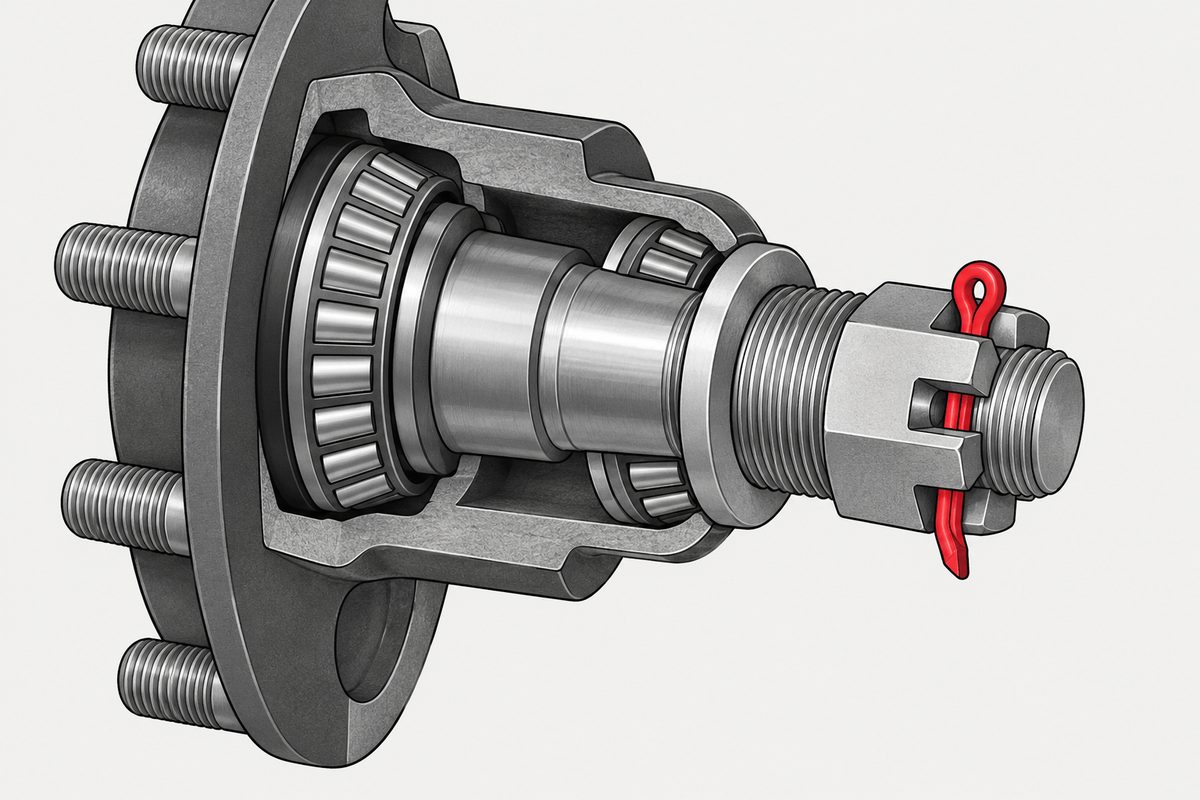
There is no number to tighten to
A castellated nut has slots across its crown and the bolt it goes on has a cross hole. The nut can only be left in a position where one of those slots lines up with that hole. Every other position is unavailable, no matter what the torque wrench says.
So a specification for this joint cannot be a torque value on its own. It has to be a value and a rule for what to do when the hole is not there. Advance to the next alignment, or back off to it. Those are different instructions and they give different preloads, and the difference is not a detail.
The thread shows both rules in use. The best-voted answer was procedural and had no torque in it at all: turn the drum, tighten until it just starts to drag, back the nut off slightly until the drum runs free, pin it. The next answer took the opposite starting point, saying the poster had been lucky to find the hole free at finger tight because that is the ideal place to pin it, and that you should only go further back when the hole is not there.
Both are right for that joint, and neither transfers. A tapered roller bearing is set by end play, so the nut is not there to preload anything and backing off is safe. A joint that has to stay clamped is the opposite case, and backing off to find a hole spends preload that the design was counting on. What the torque was supposed to buy in the first place is torque and clamp force.
The pin is named after the hole, not after itself
ISO 1234 covers split pins, and a footnote to its dimension table says something most people have never noticed: nominal size is the diameter of the split pin hole. The pin itself is smaller, and the table says by how much.
| Nominal size (the hole) | Pin diameter, max |
|---|---|
| 1,6 | 1,4 mm |
| 2 | 1,8 mm |
| 2,5 | 2,3 mm |
| 3,2 | 2,9 mm |
The same footnote recommends the hole itself at H13 below nominal size 1,2 and H14 above it, which is loose by any standard. Put those together and the picture is unambiguous: a split pin is a deliberately slack part in a deliberately slack hole.
It is not a shear pin and was never meant to be one. It is a stop that prevents the nut travelling past a position. A pin that is meant to carry load sits in a reamed hole with an interference or a close fit and has a published shear rating, which is only one of these two pins has a rated shear load.
The ductility requirement is one bend
ISO 1234's requirements table has a ductility row, and it is worth quoting because the number in it is easy to miss. Each leg of the split pin shall be capable of withstanding being bent back upon itself once, with no visible indication of fracture at the point of bend.
Once. That is the whole verified life of the bend. Straightening a pin to remove it and bending it again is a second cycle at the same place in a part whose material was only ever qualified for one, and nothing in the standard covers what is left. The same question asked about the fastener rather than the pin is can you reuse a screw.
The workmanship row is unusually specific for the same reason. Pins shall be free of burrs, the eye shall be as circular as possible, and the cross-section of the two straight legs together shall be circular. All of that is about a part that has to go through a loose hole and then be bent, in that order, without cracking.
One duty the standard names, and tells you to upsize for
Standards rarely name an application. ISO 1234 names two. A second footnote to the dimension table says that for railway applications, and for cases where split pins in clevis pins are subjected to alternating transverse forces, it is recommended to use the next larger split pin size than the one the table gives.
Read that as an admission about the default. The table's normal selection assumes the pin is a stop that does not get worked. Reverse the direction of load on it often enough and the standard would rather you had more material, which is the closest thing in the document to acknowledging that a split pin can be fatigued.
Why our own table left this out
We rank locking measures by which failure they address, in why screws loosen, and until now that table had no row for positive locking at all. Prevailing torque, thread locker, wedge-lock washers, split washers and re-torquing were there. The cotter pin was not.
The reason it is awkward to rank is that it belongs in a category of its own. Positive locking does not resist rotation, it forbids it beyond a discrete step, so against the first failure mode it is absolute in a way friction never is. Against the second, the slow loss of clamp force to embedding and relaxation, it does nothing at all, and it adds a second problem the others do not have: the preload you finish with is whichever one the hole allowed, not the one you chose. The row has been added.
That is also why the anecdote in the thread about a race welding itself to a spindle is not an argument against pinning. It is an argument about the nut position that got pinned. What actually happens to a nut that will not rotate but still loses load is they glued the nut and it still came loose.
What to settle before the drawing goes out
- Give a torque and a direction. Not a value alone. Say whether to advance or back off to the next alignment, and say which quantity the joint is actually setting: clamp force, or end play.
- Specify the hole, because the pin is named after it. ISO 1234 nominal size is the hole diameter, at H13 or H14, and the pin will be smaller.
- Say new pin on every assembly. The ductility requirement is one bend, so reuse is outside what was verified.
- Check for alternating transverse load. The standard names that case and railway service, and tells you to go one size larger.
- Ask whether the joint should be this sensitive. The second-best answer in that thread made the point without naming it: if the difference between two adjacent pin positions matters to you, the problem is upstream of the pin.
The hole in the bolt has a standard of its own, and it gives the diameter and a minimum end distance but not the position, which it says must be calculated for each application.
This is not one of the six steps. It shows up across them, or after assembly. Where the decisions that lead here were made is in specifying a screw, which sets out the order and why doing it out of order is rework.
Common questions
What torque do I use on a castellated nut?
The question has no answer on its own, because the nut can only be left where a slot lines up with the cross hole in the bolt. A usable specification is a torque plus an instruction for what to do when the hole is not there, either advance to the next alignment or back off to it. Which of those is correct depends on what the joint is setting. A tapered roller bearing is being given end play, so backing off is safe; a joint that has to stay clamped loses preload every time you back off to find a hole.
Is the size of a split pin the diameter of the pin?
No. A footnote to the dimension table in ISO 1234 states that nominal size is the diameter of the split pin hole. The pin is smaller: a nominal 3,2 pin has a maximum diameter of 2,9 mm, a nominal 2 is 1,8 mm. The same footnote recommends the hole at H13 below nominal 1,2 and H14 above. So both the pin and its hole are loose on purpose.
Can a split pin carry shear load?
It is not designed to. It is undersize in its own hole and the recommended hole tolerance is H13 or H14, so it cannot act as a close-fitting shear pin, and ISO 1234 publishes no shear rating for it. Its job is to stop the nut travelling past a position. A pin intended to carry load sits in a reamed hole and its standard gives a shear figure, which is a different part and a different document.
Can I reuse a split pin?
The standard verified one bend. The ductility requirement in ISO 1234 is that each leg withstands being bent back upon itself once, with no visible fracture at the bend. Straightening the pin and bending it again is a second cycle at the same place, and nothing in the standard says what the material has left after it. Use a new one.
Why is a cotter pin missing from most lists of locking methods?
Because it does not fit the usual axis those lists are built on, which is how well a measure resists rotation. Positive locking does not resist rotation, it forbids it beyond a discrete step, so it is absolute against loosening by rotation and useless against the other failure, the slow loss of clamp force to embedding and relaxation. It also carries a consequence the friction-based devices do not: the preload you end up with is whichever one the hole allowed, rather than the one you set.
References
- ISO 1234:1997 — split pins; Table 1 dimensions with the footnote defining nominal size as the hole diameter and the footnote on railway and alternating transverse load, Table 3 material, ductility, surface finish and workmanship
- ISO 7035 — hexagon slotted castle nuts, the ISO equivalent of DIN 935 (cited without a link: we could not verify its catalogue number)
- ISO 4042 — electroplated coatings, referenced by ISO 1234 for coated pins
- ISO 3269 — fasteners, acceptance inspection, the acceptance route ISO 1234 points at
ISO 1234:1997 was read from the publicly available preview, which for a document of that length carries the dimension table, both of its footnotes and the requirements table in full; every figure quoted here comes from those pages. The castellated nut standards were confirmed at catalogue level only. We could not verify the number of slots on a castellated nut from a standard, so no slot count and no angular step appears anywhere on this page, only the fact that the positions are discrete. DIN 935 dimension tables carry a column naming the matching split pin, which is a catalogue-level observation rather than a clause we read. The advance-or-back-off rules are vehicle and equipment service practice; the fastener standards do not contain them, and both directions are genuinely in use because they belong to joints that are setting different quantities. Nothing here is a judgement about the trailer in the source thread, whose bearing specification we do not have. The ISO 7035, ISO 4042 and ISO 3269 catalogue numbers were not cross-checked against a second source.
Enquiries
If a castellated nut and split pin are on the enquiry, send the cross hole size and tolerance along with the thread. The pin is specified by the hole rather than by itself, and the hole is the part of the drawing that decides whether the pin ever fits.
Request a quotation
Tell us the part and the quantity. We will come back on feasibility, lead time and price.
Or email us directly sales@tigerfasteners.com